06 — Conditional
by D.M. BarachA common critique of a fully planned economy is its hubris. We build our harmonious structures over the ruined foundations of the past, believing our new logic has erased the old. But the physical history, the forgotten infrastructure, the abandoned means of production and logistics, the lived in places—those always remain. We must remember that these spaces are not just historical artefacts, but ungoverned territories. And in any ungoverned territory, the brutal, inefficient, and primal economies of raw survival are not truly gone. They are merely dormant.
—Naomi Feld, The Economic Renewal Fallacy: A Theory of Replacement
The smell seeped into Ari’s consciousness first—a damp, earthy mix of cold stone, the sour bite of mildew, and something he couldn’t quite identify, either old straw or unwashed bodies. The throbbing in his jaw, where the fist had connected, followed hard upon it. He opened his eyes. What he saw belonged in a medieval Imager simulation, not CGS managed London.
Rough-hewn, moss-covered stone formed the walls, slick and cold to the touch. A rusty grille of thick iron bars served as the door. A single, flickering torch set in a wall sconce—a ridiculously inefficient light source—cast long shadows that flickered like video artefacts. They obscured more than they revealed, smoke adding a greasy, acrid layer of interference to the air.
He lay on a thin mat of straw, its dry stalks prickling his skin through his damp clothes. He sat up, his internal gyroscope struggling to calibrate. Through the bars sat a guard, a hulking figure in a leather jerkin on a wooden stool, looking like an NPC awaiting a trigger event.
“Exit Imager.” Nothing happened.
“Oi,“ Ari croaked. “Where the bloody hell am I?“
“Timmy,“ the guard said. “Your topsider is awake.“
A moment later, the zip-cuffed man saturated the available space before giving a curt, almost imperceptible nod to the guard. With a loud, grating screech of metal on metal like microphone feedback, the guard unlocked the cell door.
Timmy entered, grabbed Ari by the arm with the strength of a hydraulic grapple, hauled him to his feet, and marched him out of the room. Ari stumbled, trying to keep up on the uneven stone floor.
“Honestly!” Ari said. “Where are we going?“
Timmy didn’t answer. He led Ari through a series of narrow, stone-walled tunnels. The air grew colder. Timmy moved with silent economy, scanning the intersecting passages with the air of someone who expected trouble.
They passed a heavy, wooden door with a barred window. Ari flinched at the scene within, an infirmary where the pandemic was clearly present. Several people lay on simple cots, their bodies shaking, their skin slick with sweat. A woman’s muffled sob drifted out, followed by the low, pained murmur of a name. Ari recoiled. For a fraction of a second Timmy looked down at him, the iron grip on his arm softened before it clamped down again, hard and unyielding.
“Look here,” Ari said, swallowing sour bile that had risen in his throat. “I’d like to at least know where I’m going. Is that too much to ask?“
Timmy stopped so abruptly, Ari’s momentum spun him around to face him. For the first time, the torchlight revealed his eyes properly. They weren’t cruel, just utterly uninterested, like a firewall filtering a benign packet. The silencing look communicated more effectively than any words could.
“By the way,“ Ari added, unable to help himself, “did I mention I love your cologne? Is that Eau de Cro‑Magnon or Essence of Abduction?“
Timmy’s jaw worked once, a grinding of molars audible in the quiet tunnel, before he turned and resumed walking.
A large, ornate metal door barred their path, completely out of place in the rough-hewn tunnel. Timmy threw it open, and the world changed.
They walked into a vast, luxurious hall so unexpected his mind stuttered over it. High arches of restored Victorian brickwork stretched overhead, illuminated by the warm glow of hanging globe lights. Recessed into the main walls, gable-style archways lined with cream and maroon tiling housed plush, velvet sofas, the fabric worn smooth where people actually sat. High on the far wall, a preserved enamelled sign—a red circle bisected by a blue bar bearing the words BAKER STREET in white—marked the place like a sigil of the old world.
A mosaic of mismatched polished marble cooled the floor, and the air engulfed him with a wall of warmth—beeswax, roasting coffee, and the dust of old paper. In a place of honour near the centre of the room, a gleaming white Mono ambulance rested dormant. Ferns erupted from its shell, their roots mapping a chaotic green circuitry across the white polymer.
These people had chosen which pieces of the old world to preserve and which parts of the new one to exploit. The lamps drew electricity, the fireplace burned wood. They used technology, but seemed to reject the technocratic pursuit of optimised perfection. The hall itself existed as a sanctuary for reclamation, each object within defying tenet four. Replacement Ensures Reliability. Repair Creates Instability.
People filled the room, lounging on the furniture, reading physical books, their pages rustling with dry friction. A woman in a silk kimono chatted with a man in torn, flared jeans. A group of pre-teens played at a green velvet card table. Among them, a boy with curious eyes studied the other players with more intensity than his own hand.
Unlike the meticulously consistent historical Imager simulations he favoured, this place felt disjointed and its inhabitants incongruous. A shiver cycled through Ari’s body like a voltage spike. In his damp CGS issue worksuit, he stood out like an incompatible part.
Timmy’s grip tightened, propelling him forward. They moved toward a heavy oak table where a man in a perfectly tailored morning suit sat smoking a cigar and reading a book. For a brief moment, the man’s gaze drifted towards the teenagers playing cards, the hard lines around his eyes crinkling into a trace of a smile as he looked at the curious boy Ari had noticed, before his attention returned to his book.
“Please,” the man said in a perfectly modulated audio stream. Without looking up, he gestured to the empty chair opposite him. “Sit. Be my guest.“
Ari remained standing. “Your guest? I don’t recall being invited. What I do recall is you lot breaking into my flat and trying to kill me.“
The man finally looked up, placing a thin ribbon to mark his page before closing the book with a soft sigh. “Break into your flat? What are you talking about? You appeared in one of our tunnels, half-drowned. Timmy here saved your life.“
“Appeared?“ The room tilted, the marble floor feeling suddenly spongy under Ari’s boots. “I was chased down those tunnels by men with guns.“
“Yes, well…” he said with a dismissive wave of his cigar. “The point is, the CGS has been increasing its patrols in the upper tunnels. Justice Baron has become… zealous. I cannot allow uninvited guests trailing gunmen down here.”
“Where is here?” Ari asked, sitting down in a chair opposite him. “Who are you?”
“I’m Charles. You’ve met Timmy,” he said, pointing with his cigar. “We are Walkers and this is our home.”
Ari stared at him. Walkers. The vandals of the public feeds.
“So this is how Walkers live.” Ari ran a hand over the velvet upholstery of his chair arm, checking the nap. This was not the desperate society he had imagined.
Charles’s eyes lit with a low-voltage amusement. “We choose to live simply where no one can prevent us from enjoying the real things in life.” He picked up an elegant, silver cigar cutter. He fed the tip of his cigar into the guillotine, the blade slicing through the tobacco with a definitive snip that echoed in the cavernous hall.
“Take this,“ he said, turning the cutter over in his fingers. “It is a tool, but it is also a work of art. It could trim a cigar, or a man’s finger, with equal elegance.“ He smiled, but the warmth didn’t reach his eyes before he continued. “Real wood. Woven fabrics. Books printed on paper. Things with texture, with history.”
“Impressive, I must admit,” Ari said. “Still doesn’t excuse sabotaging the Sup. You’re hacking critical infrastructure for the sake of nostalgia.”
Charles’s smile persisted. “We don’t harm anyone,” he said, “as long as they don’t endanger us. We simply take what we need. A tithe, if you will.”
Ari tapped the table. “You’re a closed network, drawing power and resources from the main grid without contributing anything back. You’re a parasite on the system.”
“And you are a component of that system, designed to produce what you are told and consume what you are given,” Charles shot back. “The contentment of the menagerie, a gilded cage where the door stands wide open, yet no one leaves.” His gaze became more intense. “You topsiders simulate life while your real lives wither away from neglect.”
Charles’s words had reached past the whole topside world and put a finger on him alone.
“And you left the cage. Congratulations. Now you’re just free to starve in the dark,” Ari said.
“We live how we choose. We scavenge, we build, we create. The CGS decided that personal choice was a complication to be eliminated. That’s not living. But I don’t have to explain my philosophy to you. You are a problem I’m done dealing with.”
Charles leaned back in his chair, his elbow on the armrest, the cigar between his fingers. He looked past Ari to Timmy, his expression now cool and pragmatic. He picked up his book and ran a thumb over the gold leaf of the book cover. “Dispose of him.”
Timmy’s huge hand clamped down on Ari’s shoulder.
“Now wait just one minute!” Ari shouted, his voice fragmenting.
Ari struggled against Timmy’s grip, but soon realised he was only embarrassing himself.
“I’m not a threat! I’m here by mistake!”
“Oi, what’s all the noise?”
A small, wiry man wobbled over from a polished bar.
“Stand down, Santo,” Charles said. “This requires a clear head, something you surrendered three glasses ago. Go back to your drink.”
The name pinged a specific directory in Ari’s memory. He looked closer at the drunk man’s face.
“Santo?” Ari lunged against Timmy’s grip, ignoring the pain in his shoulder. “Bloody hell, we were in college together. Don’t you remember me? Ari Feld.”
Santo squinted. “Feld? Only Feld I ever ’eard of is the fucking Founder,” he mumbled, though his eyes stayed on Ari.
“Come on, Santo,” Ari pleaded. “I’m in a right mess here.”
Santo shook his head. “Piss off.”
Ari executed a frantic search query, hunting his mind for a shared memory. It came to him. Julia, laughing, her face bright with an unmoderated energy he’d found both intoxicating and terrifying. He had won her over, not with charm, but with competence she couldn’t resist.
“What about Julia?” Desperation sharpened his tone.
Santo stared, head cocked.
“You must remember Julia!” Now desperate for a way to trigger Santo’s memory, and remembering what Santo was like back then, Ari cupped both his hands in front of his chest in a crude, universal gesture of anatomical significance.
Santo’s eyes widened, a flash of ancient, adolescent outrage cutting through the alcoholic fog. “Julia!” he roared, slamming his pint down on a nearby table. “You bastard, I remember Julia!”
He launched himself at Ari. Against Timmy, Santo weighed nothing. The big man held him back with one arm, shifting his weight with a heavy exhale that made the leather of his jerkin creak.
“Santo, you know this man?” Charles asked, genuinely surprised.
“Yeah, I bloody know him,” Santo spat. “She left me for him.”
“Come on, Santo,” Ari said, a laugh venting like a pressure valve. “You had no chance.”
Santo shook his head and stood down, the drunken lag momentarily gone. “Left me for the sodding Fixit Kid,“ he said, the nickname sounding less like a joke than a score kept open.
Timmy looked from one to the other, scratching the bristly stubble on his chin, the dry rasp loud in the silence. “Who’s the Fixit Kid?”
The nickname closed a circuit. The fear remained as persistent static, but a dormant subroutine of confidence initialised. “That would be me,” he said, clear and steady. “I can fix anything.”
His eyes darted around the room, cataloguing the beautiful antique and utterly non-functional artefacts. The curious boy at the card table stood, his eyes wide with fascination. Charles’s gaze flickered to him for a moment.
“You talk about real things?” Ari said. “Look around. You’re surrounded by useless bricked hardware, things I can fix for you. You want to dispose of me? Fine. But you’re scrapping a functioning asset. One that’s more valuable to you alive than dead.”
Charles studied him for a long moment. He didn’t smile. He simply placed the ribbon bookmark with precise care and closed the volume. He set the book down on the oak table and picked up his cigar. Timmy, catching his boss’s mood, seized Ari’s arm again.
“Your value does not offset your risk,” Charles stated. He lit his cigar and pulled a long drag, staring at Ari all the while. He looked past Ari to Timmy. “Dispose of him.”
The order slammed into Ari. He took a half-step back, his heel catching on the uneven stone. He would have fallen if Timmy hadn’t been holding him.
“Look,” Ari said, his voice tight with anger, “I didn’t ask to come here, and I don’t intend to die here. Come on, Santo, say something, for old times’ sake.”
Santo, who had been watching the exchange, sobered. He looked at Charles, his posture straightening.
“Steady on, Charles. Maybe he and I have knocked heads in the past, but I know him. He’s an old mate… and he can be useful.”
Charles tapped the back of his cigar on the book cover.
“Here,” Santo continued. “We’re bleeding resources, boss, why bin a master technician? Seems a bloody waste when half our kit is on the blink.”
Charles let the silence accumulate like static. A few hard faces in the crowd remained unconvinced. A large man with a scarred cheek muttered something to his companion, his hand resting on the hilt of a knife at his belt. Charles silenced them with a glance, and the muttering stopped.
Charles studied Ari, the lethal pressure in the room holding steady. Then, he picked up his book, the threat evaporating as quickly as it had arrived. “A functioning asset,“ he mused, accepting the logic. “Very well. You may stay. But understand this—my hospitality ends the moment your utility does.“ He nodded to Timmy. “Find him a room and some clean clothes.”
As Timmy led him away, Santo intercepted Ari’s arm. “Fixit Kid, eh?“ he said, a thin smile touching his lips. “Been a bloody long time.“
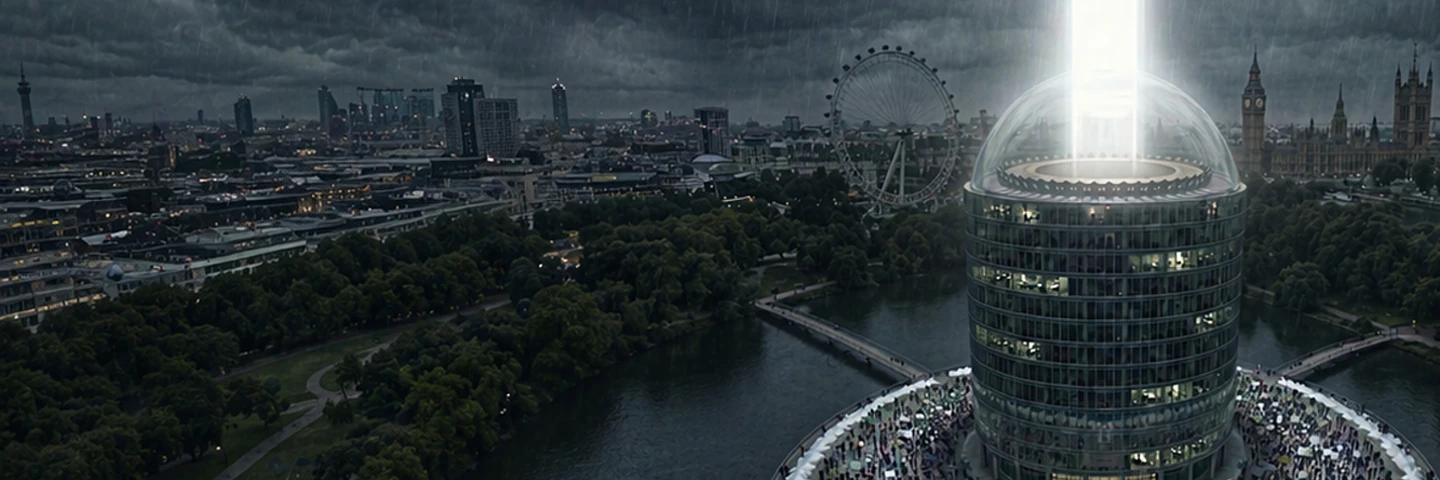
A simple warrant request, filed electronically, should have been approved within the hour. Instead, Alene had been summoned by Magistrate Radford to the Palace of Westminster for a face-to-face meeting. Walking its sepulchral corridors was like stepping into a different century. This building had once reverberated with the roar of real debate, the clash of imperfect but passionate ideas, but now it echoed with the hushed voices of schoolchildren on a field trip to learn about an archaic form of economic rule.
Magistrate Radford’s office occupied a cavernous space on the third floor. It was all dark wood panelling and dusty, leather-bound books arranged for display rather than use. On the marble mantelpiece, a gilded clock sat under glass, its brass pendulum still. Radford sat behind a desk large enough to convey status and stacked with enough paperwork to demonstrate his self-importance. His jowls hung in damp folds above a collar gone shiny with wear. He looked like the kind of official who better-tailored men kept around to absorb contempt on their behalf.
He did not stand when Alene entered. He scratched neat, precise notes with a ludicrously archaic fountain pen and continued to do so for a full minute, leaving her standing in the centre of the room. Finally, he screwed the cap on his pen and looked up, his eyes small and assessing.
“Yes?” he asked, his voice a dry rustle of old paper. “Can I help you?”
Alene’s jaw tightened, a micro-spasm of muscle she suppressed instantly. “Case file 9112-Delta,” she said, her voice clipped and professional. “You summoned me regarding my warrant request.”
“Ah, yes. DCI Ardone.” Radford tapped a few keys on his terminal, affecting a theatrical search. “Here it is. Feld, the CGS technician.”
Radford leaned back, the old leather of his chair groaning in protest. He steepled his fingers, but his eyes drifted to a speck of dust on his blotter, flicking it away with a fingernail rather than meeting her gaze.
“A rogue actor within the CGS structure, yes?” he said.
“That is the current classification,” Alene said.
His gaze drifted over her, a slow, dismissive appraisal. “This is a complex security situation with potentially high-profile political ramifications. It requires a delicate touch, not just a simple case of… reclassification.”
The word hung in the air, precise as a dart. He thought it a weakness. She had spent too long and endured too much to make sure it was not. Her expression hardened into the flat, reflective glare of a riot visor.
“You’re right, Magistrate. I am an expert in reclassification,” she said, her voice quiet, controlled, and sharp as a filed-down coin. “I reclassify whispers as evidence, anomalies as patterns, and bureaucratic inertia as criminal complicity. Now, about the warrant for Ari Feld.”
Colour rose in Radford’s jowls. His eyes flicked to the door ajar to his right.
“Given the sensitivities here, I’m not convinced there is sufficient evidence to justify a residential search at this time. We can’t tip him off. The request is denied.” Radford pitched the refusal for the listener in the next room.
He picked up his pen, a clear dismissal. But Alene didn’t move. Her hand slipped into her pocket, her thumb tracing two familiar shapes. The cool, solid metal of her whistle, and the raised, silvery line of an old scar on her knuckle. A recidivist instinct to solve problems with fists resurfaced, one she had learned to suppress a long time ago.
“That refusal is unacceptable, Magistrate,” she said with an authority that made Radford look up, startled.
“This isn’t a simple request,” she continued, stepping closer to the desk and raising her voice. “This case has the personal attention of Councillor Herbert, who reported the subject missing herself. Are you suggesting I inform the Councillor that your office is obstructing a critical investigation into the disappearance of her own foster son?”
A flicker of panic crossed Radford’s face. He opened his mouth to respond, but a new scent cut through the musty air first—rich and complex, the aroma of peat, oak, and privilege. Then a voice, as smooth and resonant as the cognac swirling in its bearer’s snifter, joined in.
“Is there a problem here, Magistrate?”
Justice William Baron stood in the doorway of an adjoining office, dressed in an immaculate, dark grey suit. He was the man from the news feeds, but in person, his charisma flowed like molten iron.
“Justice Baron,” Radford stammered, scrambling to his feet. “No, not at all. The DCI and I were just concluding our discussion.”
“It sounded rather more heated than a discussion,” Baron said, stepping into the room.
He crossed to Radford’s desk with fluid grace and perched on the edge, setting his snifter down with a soft clink. A dusty portrait of a scowling Oliver Cromwell loomed on the wall behind him. Alene noted the irony. A historical figure who wielded power with passionate force, now the backdrop for a man who exuded power through a paternal smile. From his waistcoat pocket, he produced an intricate pocket watch. The metallic clicks as he wound it sounded alien in the CGS world of sealed interfaces and silent transport. He consulted it, snapped it shut, and turned his warm smile on Alene.
“You mentioned Councillor Herbert’s name with some… emphasis.”
The hand that held the pocket watch tightened as he said Francis Herbert’s name. He is seeking to turn a procedural refusal into a political opportunity, she thought.
“Let’s not stand in the way of good police work, shall we, Radford? The DCI is showing commendable initiative.”
He picked up Radford’s stylus, his eyes meeting Alene’s. “DCI Ardone, isn’t it? A missing CGS technician, a concerned Councillor… Cui bono? as the old Romans would say. Who benefits? A question usually ignored by those content with an official narrative.”
“Precisely, Justice,” Radford chimed in, overly eager. “A classical approach is always best for these complex matters.”
“Quite,” Baron said without looking at him, a simple word that erased Radford from the conversation.
Baron keyed the authorisation into the desk terminal and signed it, his movements fluid and decisive. A soft chime confirmed the warrant’s approval. He did not place the stylus back on the desk, but held it out for Radford to take from him. The Magistrate accepted it with the deferential caution of a subordinate.
“There you are, DCI Ardone,” Baron said, his smile never wavering. “And if you encounter any further… institutional friction, my office is always open to you. A direct line.” He pulled out his comm unit and held it close to hers. A blue pulse confirmed the transfer of his secure key. “I can ensure the proper channels are cleared.”
“Thank you, Justice,” she replied, her own smile polite but edged with steel. “It’s reassuring to know that the official channels have such dedicated oversight.”
Their eyes held for a beat too long. Beneath the courtesy she caught the shape of the game he was playing, one with roots in these very halls. Older than policy and messier than procedure, built out of personality, leverage, and inheritance. Baron wore the robes of a Justice to disguise the gauntlet of a falconer. His offer of a direct line was not a lifeline, but a tether to bind her to his fist.
She gave a single, professional nod and walked out. She had what she came for, but she left with the encounter still lodged behind her sternum.
Once alone in the vaulted corridor, Alene stopped and leaned against the cold stone wall, the silence of the museum pressing in on her. She let out a breath and recalibrated herself for the investigation.