Background, Insider Stories, & The Writing Process — essays by D.M. Barach
I sent the first three chapters out on a Thursday in April. A few hundred people I knew got a personal email from me, people who would open it because they recognised my name in the subject line. Whether they’d read it I had no way to know. What I’m actually waiting for, though, are the moments when strangers arrive at the site with no introduction, find the first chapters, and decide whether to continue.
That version of success I couldn’t arrange. The personal email was outreach, which is another way of saying I was calling in a small amount of goodwill I had already accumulated. Visits from strangers need to be earned in other ways.
One way is to let a publisher with sufficient standing decide whether the work deserves to be introduced to readers. The credential function of that process is genuine—a stranger doesn’t need to evaluate an unknown novelist from scratch if a professional reader, in good faith, has already decided the work meets a bar.
I’ve written about the practical arguments for not waiting on it. Publishing moves slowly. The industry’s current relationship with AI-assisted work creates a complication I wasn’t willing to manage. And the commercial logic of acquisitions doesn’t map well onto a literary novel that requires careful and engaged reading. Those arguments are real. But the one I keep returning to isn’t practical at all. It’s that I wanted the stranger’s verdict more than I wanted the institution’s.
When I decided to adapt Utopia, the screenplay I had written in 1996, into a novel, I expected the challenges to be structural—updating the story for the intervening decades, expanding the world, converting a screenplay into prose. I didn’t expect to discover how much the form itself would change what the story was able to be.
Utopia had qualities worth keeping. It moved. It had a plot that understood its own direction, scenes that drove themselves forward, a governing system at its centre that carried real thematic substance. It lacked the interiority that prose affords, especially in situations where actions and thoughts are contradictory.
In 2000, I finished an MA in fiction writing at Johns Hopkins University and did the next most logical thing. I built a software company.
The internet was new and exciting at that time, and I had a problem at my nonprofit marketing job that I knew the internet could solve. How do you connect people who care about the same causes and help them act together at scale? An online marketing for nonprofits pioneer named Mark Rovner served on a committee at my nonprofit’s national organisation and he invited me to present my ideas for solving this problem. The result was that I designed an online community platform called FedWeb that is still in use today by hundreds of Jewish Federations across North America.
While I was looking for an agency to build FedWeb, I met Laura Kittleman and Tom Yeatts who had already built out some very effective advocacy and community organising software through their company VirtualSprockets. They asked me to join them. I said yes. They taught me what it meant to be an entrepreneur and I was hooked.
In the summer of 2025, I was advising founders at a business accelerator in Vancouver on how to incorporate AI into their companies and products. I had thoughts about workflow and the categories of use that were likely to produce real returns versus the ones that were mostly theatre. What I did not have was a personal use case. I had founded and sold three technology for philanthropy companies before the AI era. I had used plenty of tools. But AI, for me, had remained something I recommended to others, but not yet folded into anything substantial of my own. I needed my own hands-on experience with AI to credibly advise founders through my consulting practice.
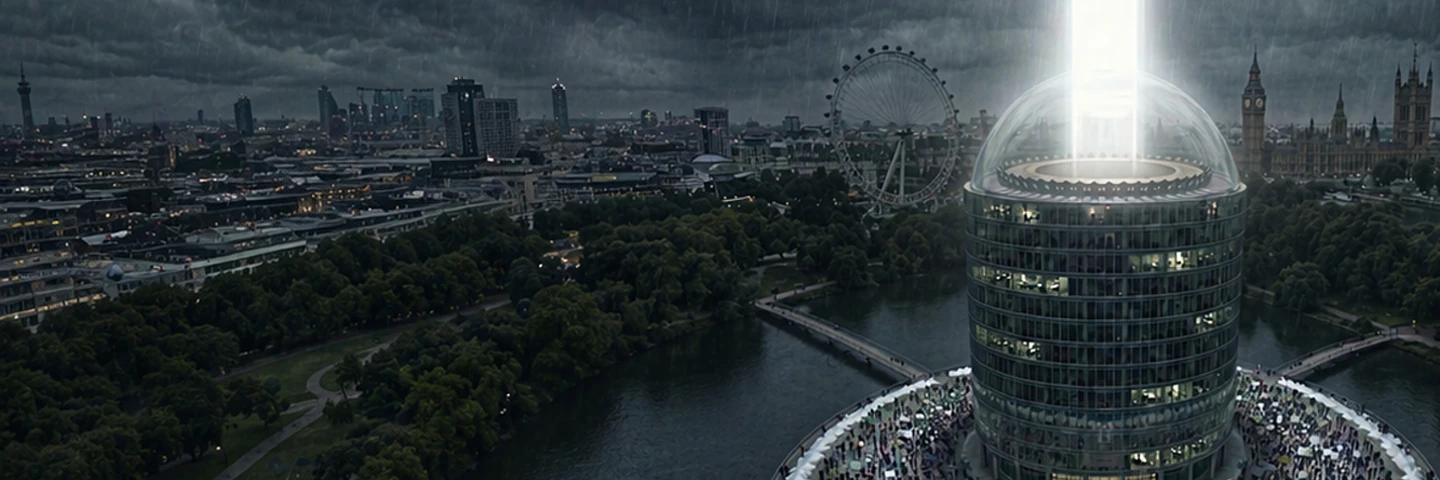
The experiment itself was not ambitious in the beginning. The original version of A Frictionless State was a screenplay I’d written at Tel Aviv University in 1996. I thought it would be interesting to ask an AI to convert it from screenplay format into prose fiction. I wanted to learn from the process. I really didn’t expect much from the output. Expectations met. It was my creation, but it had been put through a meat grinder.
There is a kind of reader who reads fiction not to have their existing judgments confirmed but to test them. Someone willing to stay inside moral complexity long enough to understand it, rather than resolving it quickly into a verdict. If you’ve read N.K. Jemisin’s The Fifth Season and felt unsettled for days, or read Frank Herbert’s Dune as a study in how power rolls and shifts, or read Octavia Butler’s Kindred and found it harder to be comfortable afterward—you’re probably the kind of reader I wrote this for. That’s not exclusion. It’s calibration.
A Frictionless State is a literary speculative novel, a genre that may not have its own section in your local bookstore, but names something genuine — fiction that uses an invented world to put pressure on questions the real one hasn’t resolved. That distance from real institutions and history lets readers examine what they actually think without the defensive shorthand that comes with familiarity. This novel explores what it means to do the most beneficial thing when beneficial and right are not the same.
I’d been having so much fun and frustration writing A Frictionless State, including many nights when I couldn’t stop writing in my head when I should have been sleeping. There was just one problem. I am an unknown novelist asking strangers to trust me with their time. How I addressed that challenge shaped everything about how I decided to publish.
The traditional approach is: find a literary agent, submit to publishers, wait for an institution with the right credentials to decide whether the work deserves to reach readers and on what terms. For the right book, at the right moment, that process makes sense. It wasn’t the right process for this one.
Part of the reason was practical. Traditional publishing moves slowly. I was ready to put this novel into the world now, not in two or three years. But practical reasons alone don’t fully explain a decision that shapes the entire relationship between a writer and their readers. The more interesting explanation starts a few years earlier.