
D.M. Barach
Stories
1
Chapters
24
Words
111.8 K
Comments
0
Reading
9 h, 19 m
-
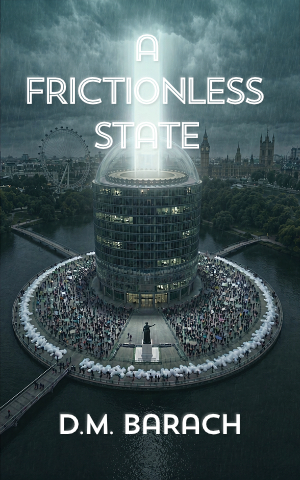 A balanced society must understand that trust is not the suspension of control, but its most efficient form. The most reliable component is not the one that feels loyalty, but the one whose available choices have been so carefully structured that loyalty and obedience become indistinguishable. Trust, in that sense, is not the absence of control. It is control made inexpensive. —Naomi Feld, The Collective Balance: An Introduction to Macro-Societal Utility The coffee had gone to cold sludge in a mug…
-
111.8 K • Ongoing
-
-
Any large-scale economic disruption, whether it be an environmental disaster, a supply chain collapse, or a public health crisis, is not merely a logistical problem to solve. The core danger of the situation is that disaster invites a crisis of narrative. The public's faith in the economic system is its primary asset. In such moments, the greatest danger is the political entrepreneur who views the disruption as a vacuum of authority to be exploited. Such individuals do not seek to restore equilibrium. They…
-
111.8 K • Ongoing
-
-
A common error of economic liberalism was the equation of morality with preservation. A rational economist understands that the preservation of the system is the highest moral good. To sacrifice a single component to ensure the function of the whole is not a failure of compassion; it is the ultimate expression of systemic utility. —Naomi Feld, The Economic Renewal Fallacy: A Theory of Replacement The phantom sensation of Santo's hand tearing from his grasp looped throughout Ari's fitful REM cycles…
-
111.8 K • Ongoing
-
-
In the dominant economic models, purpose is an individualistic pursuit of passion and as such a net drain on societal resources. In a harmonised economy, purpose is redefined as the fulfilment of one's optimal function. The individual who is useful—the farmer, the manufacturer, the scientist—is the one who achieves true integration. It is only in serving our designated function that we find true economic and social peace. —Naomi Feld, The Collective Balance: An Introduction to Macro-Societal…
-
111.8 K • Ongoing
-
-
People often confuse transparency with truth. They are not the same. No institution can function if it is forced to present every contradiction, every cost, and every unfinished decision all at once. Public trust depends as much on coherence as on disclosure. The question is not whether information is managed, but whether it is managed in service of the many or in service of private power. —Naomi Feld, The Collective Balance: An Introduction to Macro-Societal Utility Sleep came in thin increments,…
-
111.8 K • Ongoing
-
-
Capitalist societies romanticise the individual who takes matters into their own hands. They call this initiative, or innovation. In fact, such an individual is interfering with a systemic solution and undermining confidence in a system's inherent reliability. A healthy society must depend on an implicit trust in its systemised responses, not sporadic personal intervention. It requires shared standards, coordinated response, and the confidence that no individual should solve a collective problem…
-
111.8 K • Ongoing
-
-
A state that outsources all production while another dedicates itself entirely to resource extraction creates a fatal, co-dependent fragility. Interdependency cannot thrive through specialisation, but from the harmonisation of all essential functions within the whole. An economy that cannot both feed and protect itself is not an economy at all, but a client state waiting for its patron to fail. —Naomi Feld, Interdependency: A New Economic Model The pressure from the plaza below pressed against the…
-
111.8 K • Ongoing
-
-
The greatest threat to a harmonious system is not open rebellion, but private misalignment. A citizen may continue to perform their assigned function, speak the approved language, and move within the prescribed channels, yet still become destabilising if they permit grief, suspicion, or personal dissatisfaction to supersede trust in the whole. Systemic failure begins as a minor divergence in perception long before it manifests as material disorder. —Naomi Feld, Systemic Integrity and the Harmonious…
-
111.8 K • Ongoing
-
-
The primary failing of the 20th and early 21st century economic models was their obsession with growth over equilibrium. They produced more than any in history, yet this very abundance was the engine of its chaos. When one economic actor possesses a gross surplus while another suffers a structural deficit, the system is primed not for trade, but for conflict. The only path to a lasting peace is the total elimination of want, and this cannot be achieved by creating more; it must be achieved by enforcing…
-
111.8 K • Ongoing
-
-
A truly interdependent economy cannot function if it permits unaffiliated economic actors. A community that exists off-grid, whether as an expression of freedom or dissent, is in fact a structural liability. By drawing resources from the whole without contributing to the managed equilibrium, such groups reintroduce the very principles of scarcity and hoarding that Interdependency was designed to eliminate. They are, by definition, an economic threat. —Naomi Feld, Interdependency: A New Economic…
-
111.8 K • Ongoing
-
- Previous 1 2 3 Next