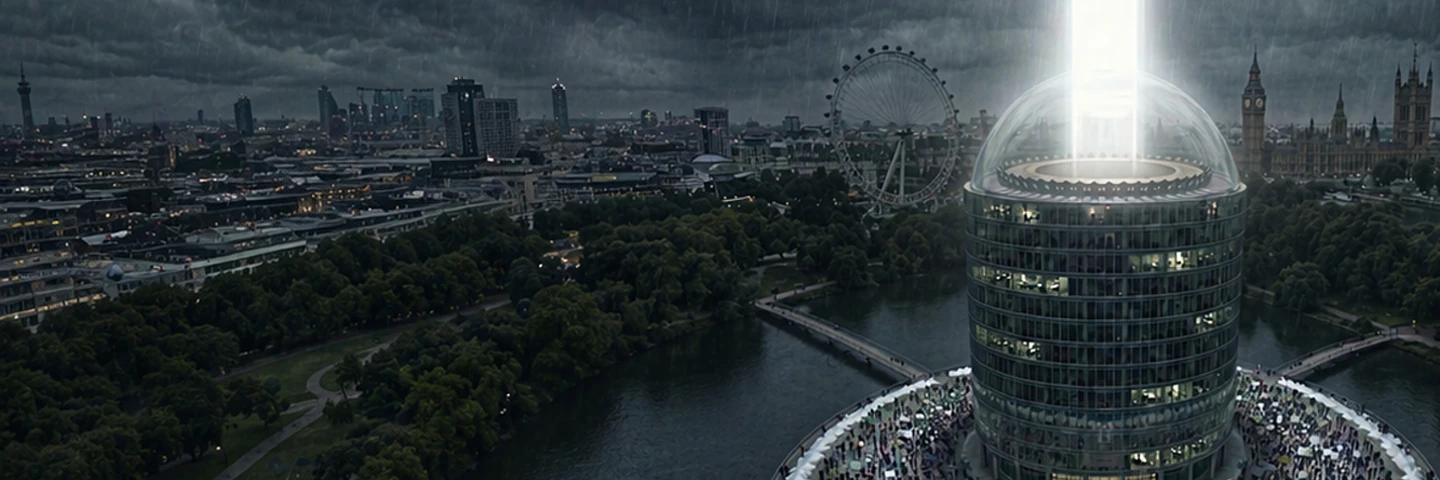
Why I Chose this Story as My First Novel
It began as a screenplay called Utopia that I wrote in 1996 while studying screenwriting at Tel Aviv University—plot-heavy and built for momentum. Action and then some more action, and a villain who explains their scheme to the hero just before the climactic, you guessed it, action.
For a student project, the screenplay was pretty creative. At the centre of it was a pandemic and a world governing system that maintained peace through economic constraints. It was thematically thin, but it explored the idea that a perfect world might not be perfect for everyone.
The COVID-19 pandemic had been running for about a year when I pulled Utopia out again. I hadn’t thought about it in a while—not seriously. I’d returned to it a few times over the intervening years, read through it, felt a connection to that time in my life when I wrote it, and set it down again. I had other priorities.
Rereading it in 2021 was a strange experience. I don’t want to oversell the coincidence. The screenplay wasn’t a prediction, and the pandemic unfolded differently than the one I’d imagined in 1996. But some aspects of the crisis were familiar. The relationship between public health and political control. The way a crisis becomes an instrument for those positioned to gain from it. The gap between what’s true and the narratives we’re told. I’d built a fictional world around those dynamics twenty-four years earlier, and now I was reading about them in the news.
It wasn’t the right time to work on it, so with a swift ⌘W, I set it down again.
In 2025, US president Donald Trump launched his trade wars. There are a few lines of backstory in the screenplay, easy to skim past, that explain how the world governing system emerged in the aftermath of the corporation wars, a period of economic conflict in which the old world order collapsed. I went back to Utopia and read those lines again. I had invented a specific future and reality, it turned out, was willing to follow it.
This time I didn’t set it down.
Like many action movies of the mid-1990s Utopia was kinetic, propulsive, and with characters who existed mainly to serve narrative mechanics. The dialogue was, to be honest about it, genuinely bad. I’m slightly less embarrassed about it when looking back on it as a product of its period. Action films of that era treated dialogue as connective tissue between sequences. Something to say while you waited for what came next, or if you were any good, a snappy line that would become part of the zeitgeist. Think, “Hasta la vista, baby.” I hadn’t yet understood that what characters say, don’t say, and can’t bring themselves to say, is much of what makes a compelling story.
What had survived all those years wasn’t the screenplay craft. It was the question running underneath the action machinery. The Council for Global Advancement (renamed in the novel to Council of Global Stability), the governing structure at the centre of the story, preserves peace by making regions materially dependent on one another. No one is allowed to be fully self-sufficient. The system runs efficiently, and in running efficiently, it leaves a significant portion of its population without the kind of work that gives a life shape and meaning. What I’d written, underneath the spectacle, was a story about what happens to people who have no real purpose, and about how easy it is for those who are driven and ruthless to take advantage of that condition. That didn’t feel dated.
Returning to work you began at a different age means meeting a version of yourself you no longer fully recognise. My younger self was, in ways I couldn’t have known at the time, more sexist than I understood—not crudely (that was more of an early 2000s thing, when women were expected to be in on “the joke”), but the sexism particular to the 1990s, when women had to be more aggressive than the men around and still were not fully respected for their contributions. What I noticed, reading back, was that I’d written strong female characters. The women in the screenplay made real decisions and exerted authority, but they were still rendered in the context of the male lead. Rewriting wasn’t a correction so much as a maturation.
The other thing I noticed was how different my ambitions had become. I wasn’t interested in writing an action novel. I’d never really been. The action screenplay was the closest I knew how to get, in 1996, to the thing I actually wanted to make. Something more challenging, an exploration of what people think and feel and become under pressure. More cerebral. More willing to ask difficult questions and stay in them rather than resolving them through plot. The original screenplay was a sketch of the novel. A cartoon version. The novel is the thing the material had always been asking for.
Utopia was a good name for an action screenplay, but not for a literary novel and, well, you’re probably as shocked now as I was to learn there’s a 500-year-old book with the same name. And you thought getting a good domain name was hard. A Frictionless State turned out to be a better title in more ways than one. It names something true about the governing system, but also something private about each of the people at the centre of the story. I’ll leave it there for now.
There’s a particular satisfaction in returning to work that wasn’t abandoned, just deferred. I’m not sure I could have written this novel in 2005 or 2015. Not because the story wasn’t there, but because I wasn’t. The themes require a kind of understanding that comes from having made things—companies, relationships, children—and watched them succeed and fail, of having spent serious time thinking about what institutions do to the people inside them. That understanding takes years to accumulate, and it’s not the kind you can reason your way into early.
The story wasn’t waiting for me. I was waiting for it.
A Frictionless State publishes here one chapter at a time, every week. Start reading → or subscribe to receive each new instalment by email.