01 — Disconnected
by D.M. BarachThe primary failing of the 20th and early 21st century economic models was their obsession with growth over equilibrium. They produced more than any in history, yet this very abundance was the engine of its chaos. When one economic actor possesses a gross surplus while another suffers a structural deficit, the system is primed not for trade, but for conflict. The only path to a lasting peace is the total elimination of want, and this cannot be achieved by creating more; it must be achieved by enforcing equilibrium.
—Naomi Feld, The Tyranny of Want: Causal Factors in Modern Conflict
Vargas wiped a film of sweat from his brow. The air was so saturated it felt like breathing through a wet woollen blanket, each breath tasting of stagnant prayer. Rust pitted his gorget. The corrosive rot ate at iron, while insects ate at his men’s flesh.
Vegetation pressed against his pauldrons. Vines snagged his greaves with the drag of drowning men. Ferns lashed his face, whipping his eyes. There was no sky or earth, only a green tunnel packed with wet leaves and the sucking squelch of his men’s boots trudging through muck.
“Capitán,” José wheezed.
The navigator crowded him, stumbling into his back. He smelled of sour fear and drenched wool. He clutched his vellum map case as if it might still contain the truth, knuckles white, eyes magnified and frantic behind grime-smeared spectacles.
“We are lost,” José whispered. “This is not God’s domain, Capitán. The jungle watches.”
“Hold,” Vargas hissed. He gripped the old man’s shoulder. The sodden velvet of José’s doublet slick under his gauntlet.
A pressure-drop clamped the jungle. The insect chittering ceased. The dripping stopped.
A wet thwack. Heat sprayed the back of Vargas’s neck.
He spun. A black-fletched arrow buried to the feathers pierced the throat of an arquebusier behind José. The young man gasped once before folding into the undergrowth.
The green burst into motion.
Shadows slid free of the trees. No barked orders or war cries. The attackers moved through foliage with a fluidity steel-clad men could never match, obsidian-tipped spears arcing out of the leaves with pitiless accuracy.
“Form up!” Vargas roared.
Futile. The column shattered. Men screamed as ferns dragged them bodily into the green, armour clattering like spilled coin.
Vargas seized José by the collar and hauled him sideways. They crashed through creepers and tumbled down a fern covered embankment into a hollow knotted beneath a massive tree.
Tangled and heaving, the space a coffin of mud and roots. José’s heart hammered against Vargas’s breastplate. Above them, boots stamped and bodies fell until screams cut off—short, wet, final.
“Madre de Dios,” José whimpered. “The shadows… they have claws.”
Vargas clamped a gauntleted hand over the old man’s mouth. “One breath,” he murmured, close to his ear, “and I end you myself.”
They lay still. Sweat dripped into his eyes beneath his high-crested morion, the rim limiting what he could see. The smell of rot pressed in. A heavy body moved through the branches above them, too fluid for a man or a crouching animal.
It slithered and uncoiled. A boa, thick as a mainmast, poured down to fill the hollow. It hung inches from Vargas’s face, tongue tasting the air.
Survive.
Vargas twisted and drove his shoulder into the mud to find leverage. He hauled José by the breastplate and thrust him forward.
The strike was a blur. Muscle and scales slamming into flesh.
The coils wrapped José in an instant, a living noose cinching tight. His mouth opened, soundless. The breastplate shrieked as rivets popped, one after another, like gunshots. Ribs cracked with sickening reports like a sail spar snapping in a gale. Through fogged spectacles, José’s eyes locked on Vargas, flaring wide before going horribly still.
Vargas scrambled back, boots skidding. He drew his dagger and lunged, stabbing blindly into scale and muscle, hacking until the coils loosened and the creature collapsed, twitching, beside the navigator’s remains.
Vargas retched, sucking air that tasted of blood and mud.
Move.
He clawed his way out of the hollow and ran. Armour snagged on vines, yanked him back. He didn’t look for a path. He crashed through vegetation, the silence pursuing him.
The ground vanished beneath his feet.
He dropped into a pit, breath smashed from his chest. Before he could rise, leaf litter whipped upward. A net cinched around him, coarse ropes biting through gaps in his plate, binding his arms. The world spun as he was hauled into the air, trussed and helpless.
Men flowed out of the foliage like rising black water. Painted faces and chests. One moved closer, lifting a spear tipped with jagged volcanic glass.
The man looked at Vargas the way a butcher looks at a hog before the knife.
The spear shot forward.
The obsidian smashed into his abdominal plate, shattering as it drove through the gap and into his ribs. The impact, a jagged intrusion without heat—
//HOST TERMINATED. END OF SESSION.
Braced for catastrophic feedback from torn organs, Ari Feld’s brain snapped back into a healthy body instead. The sensation was a vestibular crash, like a gyroscope still spinning inside a skull that had stopped. A gap where continuity should have been.
The pain redacted, wiped before a scream could leave his throat.
The jungle canopy vanished to reveal the sterile ceiling of his flat. The Imager rig hummed beneath him. Ari lay cradled in the haptic rig of the Imager in the exact position the net had trapped him.
“Retract sensory inputs,” he said.
His voice came out flat, stripped of the Capitán’s authority. Metallic limbs adjusted him upright, clamps disengaging from the ports in his black sensory suit. He stepped off the platform and his knees locked, bracing for sixty pounds of armour that wasn’t there. The haptic rig retracted into the floor.
“Purge atmosphere.”
A soft hiss. Mist thinned and disappeared. The smell of decay aborted. Humidity drained away, replaced by the scrubbed vacuum of a London habitat. The climate-controlled room smelled of nothing, an antiseptic void that dried the sweat on his skin.
Ari peeled off the black sensory suit. It came off with a damp shuck. Like a snake shedding a skin, but the logic inverted—peeling it off only returned him to the suffocating tightness of his own reality.
He looked down at his uninjured torso. Forty-two years of runtime had left the chassis serviceable but worn. He had the broad-shouldered build of a man who used to climb data towers, but the definition was softening, load-bearing muscle going slack from too long without anything to carry. Under the harsh lighting, his brown skin took on the deadened cast of composite rather than flesh.
This El Dorado instance was gone. No save state. Over weeks of sessions, he had learned José’s voice, his habits, only to sacrifice him at the end. A calculated routing decision, and still the bleed remained. He rubbed his eyes and blinked a few times.
The Capitán’s adrenaline still coursed through his veins, an appropriated chemical high that had no outlet in this secure room. Ari held up his hand. The fingers vibrated, a fine buzz in the marrow, like a high-tension wire humming under load. Capitán Vargas had a mission with clear threats and definite responses. Ari Feld had a tremor and no fault in the system to account for it. In a machine, this would have been a calibration error, solved by swapping the servo. In the Imager, it meant the body had registered real stakes.
Ari tossed the damp sensory suit onto the unmade bed, the only disordered spot in his flat. More like a storage unit for a living body than a home. He’d lived there six months, since the split with Sharon, yet the space carried all the appeal and vitality of a room full of disconnected server racks. He walked across the room, his footsteps tapping a hollow thump on the polymer flooring. The room lacked the soft surfaces of a place meant to be inhabited, and the sound came back at him thin and exposed.
He tapped the panel for the Sup. “Protein shake. Option four.”
The shake would be texturally perfect and chemically balanced, and gone from memory by the second swallow.
A countdown bloomed on the Sup door. Twelve minutes, forty-six seconds until arrival. It was always twelve forty-six.
He pulled on a fresh vest. The synthetic fabric crackled with static electricity, then clung to his skin like shrink-wrap. Sweat from his exertion plastered his dark curls to his scalp like crushed wires in an overfull junction box.
Beyond the full-wall window, London at dusk continued operating. Ari pressed his forehead to the cold glass. Below, a Mono car carrying a boy lost in a game accelerated from a port, merging directly ahead of another. An algorithmically designed near miss.
He drifted over to the workbench. Every tool hung within calculated reach, a private syntax of order. Spools, gutted network housings, stripped fibre.
10:06
10:05
10:04
He tapped a finger against the bench in sync with the Sup timer.
His gaze snagged on a small circuit board. An obsolete scope controller, its traces scorched by a surge. It still smelled faintly of ozone and singed dust. His fingers followed the severed copper paths.
Efficiency and the fourth tenet argued for the recycling chute. Replacement Ensures Reliability. Repair Creates Instability.
He flicked it onto the workbench. The board slid across the smooth surface and clicked against the dissolution papers. Two pages printed on glossy thermal stock that refused fingerprints, with no crease from being folded, put away, and taken out again. His marriage reduced to justified sans-serif text awaiting a digital authorisation code.
Ari picked up the circuit board again and turned it once in his fingers. Burned out and useless. He gripped it tight.
A blade of cold air struck Ari as he rounded the corner from Mount Street toward Berkeley Square. The chill stung his ears. Spirals of leaves in brittle yellows and oxidised reds whipped past him, while low-profile maintenance bots skittered along the pavement edge, herding the debris into neat seams. Above the greenway, threaded between the mostly bare branches of London plane trees, Mono cars glided on the narrow maglev track with a near-silent hum.
Ari had woken early to a riot in his gut. It felt as if he were hosting a bacterial horde running an exponential replication loop. He had chosen to walk to the dissolution hearing. There was time. Besides, walking aligned his internal clock to the city’s frequency of guaranteed predictability.
Walking through the city’s order wasn’t helping. He tried tapping a three-four beat against his thigh, a sync-pulse that usually steadied his heart rate. His stomach ignored it. The roiling summoned archived logs instead. The old London of his youth. Heat and waste from combusted hydrocarbons choking the air, sirens and horns and voices all colliding into it. Advertising marring every sellable surface. A city of persistent faults and tolerated failures.
He preferred today’s homogeneity, but the earlier version of London had a rough richness. The yeasty warmth of bakeries and the spiced fat from shawarma stands. Elaborate storefronts stirring unknown wants. Apparel varied widely, except amongst professionals in uniformly tailored suits.
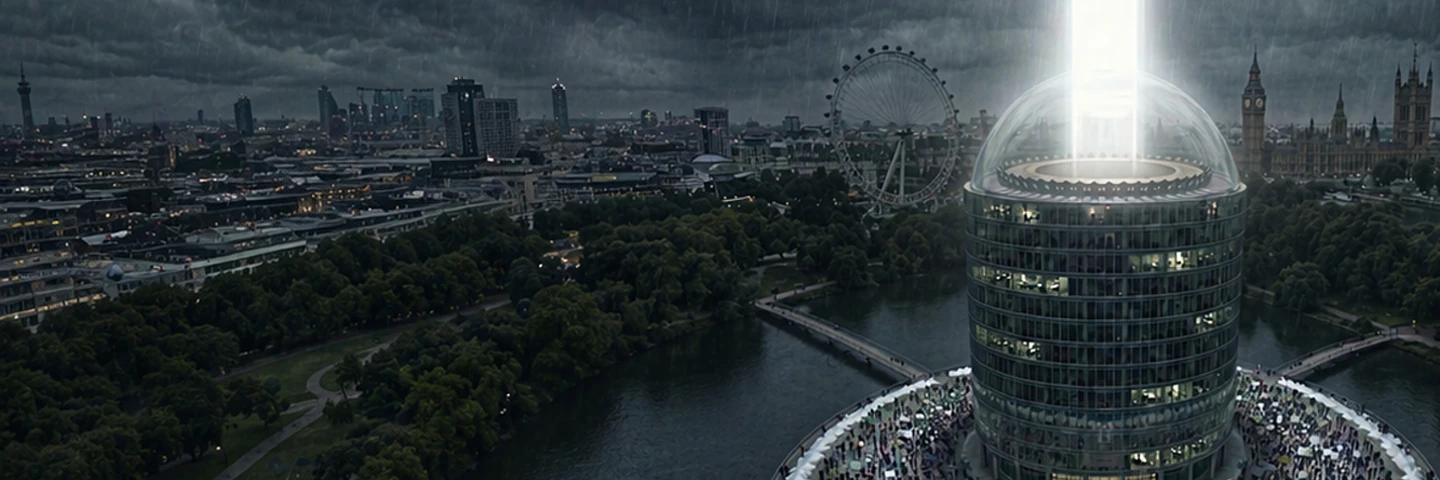
The old contrasting incongruities were gone. Debugged. Couture and clutter levelled through uniform consistency. The Council of Global Stability had recycled the toxic cars and lorries, replacing them with the silent Mono above and the reliable Sup below. Engineers and work crews had razed the old roads, their tarmac scars overwritten with English gardens precise enough to look simulated.
Across the way from Berkeley Square, glass-fronted and slightly out of register with its neighbours, the Artisan Centre glowed warm inside, shelves crowded with glazed clay, embossed leather, and hand-dyed wool. Ari had frequented it before going to uni. A sanctioned exception in an otherwise locked production loop, it was one of the few places that still echoed the old storefronts in their variety. Objects shaped by hands rather than specifications, made for enjoyment, nostalgia, or to occupy idle fingers and minds. Ari let the recollection pass without slowing his pace.
He passed the Guinea on Bruton Place. The pub exhaled centuries-old stale beer into the sterile street. Its dark wood and leaded glass preserved by the CGS for its iconically British cultural representation.
While the CGS had torn down burnt-out buildings, ripped up roads, and bored new tunnels for the Sup, Ari had been a teen burying his own past, orphaned by a crash that had killed both his parents. He had escaped into schematics for the Sup—memorising which Underground tunnels were being repurposed and how new tunnels were drilled to service every building. It made sense to him. Data-networking principles applied to matter. Packages treated like packets. Predictable. A pristine codebase running in parallel with the glitched system of his own life.
As he neared Piccadilly, an irregular motion flickered at the edge of his vision. A few metres ahead, where the pavement forked towards a Mono dock, a woman in a pale-blue worksuit stumbled. She took two more steps, then collapsed onto the grass.
Sick citizens quarantined themselves, like malware. They respected the third tenet, The Well-Being of All Is the Well-Being of One, to prevent cascading errors in the healthy population.
Passing pedestrians looked, some registering a brief diagnostic check, but no stride shortened. The stream of people split and flowed around her like a data stream rerouting around a failing server. It was an exhibit of confidence in the sixth tenet. The System Is Self-Correcting.
Ari, however, halted. An error state had grabbed his attention and his default protocol kicked in.
He crossed the distance and dropped to his knees beside her. The damp turf felt cool through the fabric of his trousers. “You’ve fallen,” he said. “Can I help?”
She didn’t respond. Her skin was clammy despite the autumn chill. A tremor rippled through her limbs. Her pupils were wide and lagging movement. It looked like a short circuit, an internal load overheating from within.
He pulled his comms unit from his pocket. Before he even initiated a connection, a calm synthetic voice spoke. “We pinpointed your location and classified the emergency. Do not engage. A medical unit will arrive in thirty-eight seconds. Thank you for using emergency services.”
He looked back at her. “Help is coming.”
“No.” Her voice rasped, thin and unstable. “My boy. The heat. I have to—” She tried to push herself upright, hands slipping in the grass, movements out of sequence.
Ari placed a hand on her shoulder. “Wait for the medical unit,” he said, keeping his tone level.
“No,” she said again. “He can’t! He’s still—”
Her hand closed around his sleeve, fingers slick and trembling. She was crying without tears.
“I must go.” Her voice rose, cracking. She shoved him with unexpected strength. The force knocked him sideways. He hit the pavement hard, pain spiking in his elbow.
A white ambulance soundlessly peeled away from the Mono stream. It slid into the emergency port with the smooth efficiency of a system daemon isolating a corrupted file. Two paramedics stepped out. Their movements were economical, each action queued and executed without overlap. They caught the woman as she tried to crawl away from them, restraining her without wasted motion. She resisted. One of them pressed a hypo-shot to her neck. Her body went slack.
One paramedic glanced at Ari. “Are you injured?”
“I’m fine.”
“Right.” She gave a curt nod and turned back to her patient.
They loaded the woman into the ambulance. Seconds later, it accelerated and merged up into the flow overhead. From collapse to removal, the incident had taken under three minutes.
Ari lay where he had fallen, rubbing his elbow as if discharging residual static. The woman’s behaviour didn’t parse. Her insistence, the way she’d fought the fix. If her son needed help, the system would provide it to him as well. The paramedics, he understood. They had bypassed comfort and patched the fault.
He stood, brushed grass from his clothes, and headed for the nearest Mono dock. The walk wasn’t helping anyway, and he didn’t want to be late.
He joined the queue. The wind gusted again. A chill creeped down his neck to his spine. His pulse continued to race with the horde in his gut. When finally he reached the front, two cars arrived. He stepped towards the first, then stopped as it diverted into a service port. He pulled back and bumped into the person behind him.
“Sorry.” Ari turned and looked down, busying himself with straightening his tunic to avoid the man’s gaze. The man wore an identical grey worksuit, the shared uniform of functional anonymity.
“Please advance the queue,” the man said, gesturing to the second car.
“I need a moment. You go,” Ari replied.
“I insist,” the man said, executing the ingrained social script.
Ari gave a short nod and stepped into the boxy black car.
A subtle lift vibrated through the floor plates as the magnetic suspension engaged, the car weightless and in perfect alignment.
The crash had killed his parents on Mono Launch Day. After the CGS identified the failure, mechanics replaced the actuators with reinforced assemblies while programmers pushed a patch to the control logic. He trusted the Mono. It had failed once, and the system had corrected itself.
He keyed in his destination. After a calculated delay, the car accelerated and slotted into the stream.
He travelled east, skirting Piccadilly Circus and down Haymarket—the Council of Global Stability Building in the distance to the right. The Mono continued to Trafalgar Square and Charing Cross, and along Strand past InterD Arena. Legacy hardware blended with the new. Two millennia of sprawl now operating logically, historic errors compiled out.
As the Mono carried him towards his dissolution hearing, the city’s steady pulse thrummed through the floor-plates, leaving his heart to find its own rhythm.
Ari checked the chrono on the wall again. 0922. If they finished inside eight minutes, he could still make it to work by 1000.
“Am I keeping you from a repair, Ari?” Sharon said.
He blinked and refocused. Sharon was watching him now, dark hair pulled back, jaw tight. He looked from her to the two solicitors.
“No, I’m verifying the timeline against the agenda,” Ari said. His voice remained even.
The room, devoid of judicial theatre, was charged with static electricity from dry air and white moulded plastic furniture. Acoustic foam lined the circular chamber, swallowing sound and muffling voices.
“You just want to be done with this,” she said. “You’re optimising for an exit, not a resolution.”
Heat flushed his face. The earlier digestive turmoil was still pressing up into his throat.
“I’m complying with what you requested,” he said, adjusting his posture to correct a fault that wasn’t there.
“We appear to be at the final item,” Sharon’s solicitor cut in. “The disposition of the custom-built cellular imaging scope.”
Ari’s thumb worried the fractured pathways of the broken circuit board in his pocket. He didn’t remember picking it up from the workbench when he dressed that morning.
His solicitor cleared her throat. “The components were allocated to my client. Construction was his labour. Ownership is unambiguous.”
“However, it was built specifically for my client,” Sharon’s solicitor said. “As a gift. Its function is bespoke to her research. It has no utility elsewhere.”
Her solicitor’s argument was sound. Ari leaned forward. “That’s correct,” he said, ignoring his own solicitor’s warning glance. “The optical sensors are calibrated to Sharon’s retinal focal length. Recalibrating for another user would require a hardware rebuild. Separating the user from the tool would be inefficient. Logically, it should be hers.”
Ari looked to Sharon, expecting assent. Her eyes, the colour of dark chocolate, were fixed on the table as if reading an invisible brief. She lowered her shoulders a fraction and pressed her fingertips to her eyelids for a long second.
She placed both palms flat on the table. Leaning forward, she locked her eyes on him. “Is that what it is to you? User specs? Hardware efficiency?”
“I’m agreeing with you,” Ari said. “Why—”
“It isn’t about the optics,” she said. “It’s about the focus. You built it. You stayed engaged with me to make it. It’s the only proof I have that you were ever fully present. That’s why.”
Weeks at his workbench. The smell of flux. Fine solder bridges laid by hand. He had finished it for their third anniversary. Her hands had moved over the housing as she marvelled at its design, quick and certain, and for those hours he had kept pace with her. Looking at her now, the memory thinned, sharpening into components and sequence.
He turned from Sharon to his solicitor. “She keeps it.”
Sharon let out a short breath, a contra-laugh. She shook her head once and drew her hands back from the table as if the surface burned hot.
He put his hand back in his pocket and found the small circuit board.
“Anything else?” his solicitor asked. Her stylus tapped the table, a precise click-click that cut the quiet.
Sharon’s solicitor scanned her tablet, then shook her head. “No. The asset division is agreed. Separation protocols are standard.”
“Well then,” Ari’s solicitor concluded, “with that resolved, the dissolution will be in effect as of tomorrow.”
Tomorrow arrived as a boundary condition. He tried to map it as a clean transition, a system cutover scheduled and approved. Nine years of marriage resolved like a support ticket. An error isolated and removed.
“Authorisation codes?” Sharon’s solicitor said.
They input their authorisation codes into the tablets.
“Thank you. I’ll register the dissolution with the court and you’ll get official copies through the Sup later today.”
The four of them stood and shook hands across the white surface. Sharon gathered her tablet, her eyes fixed on the dark screen. As Ari pushed his chair under the table, Sharon stepped towards him.
“We could get dinner,” she said. “Just us. No lawyers. A proper goodbye.” Her voice was light, but it struck him like ungrounded current.
“What’s the point?” he said, sharper than he meant. “The dissolution is done. Dinner isn’t going to fix anything.”
She held his gaze for a beat longer than necessary. Her mouth opened, then snapped into a thin line. She looked away and nodded once.
“Right,” she said, “nothing to fix.” She slid the tablet under her arm, hesitated, then turned away. The door sealed behind her with an airtight click.
Alone in the sound-dampened room, the quiet closed in. The horde in his gut did not disperse. Pressure gathered in his sternum, phantom voltage in a severed cable.
His thumb pressed on the broken circuit board in his pocket. The severed connections pricked at his skin.
Ari checked the wall chrono. 0931. System cutover timestamped. Previous protocols deactivated.