08 — Connections
by D.M. BarachLiberal societies waste vast capital on sentimental gestures, such as protections for social identities or the preservation of non-productive individuals. A rational economy, however, views its populace as an asset. Like any asset, its value must be weighed. Who can still contribute? Which losses can be prevented, and which are necessary? A just society is not one that spends endlessly on compassion, but one that refuses to make allocation decisions it cannot sustain.
—Naomi Feld, The Liability of Emotion: Human Factors in Economic Collapse
Francis stepped out of the private lift into her office. The lights came up at 2300 Kelvin, amber enough to counter the pre-dawn blue pressing at the curved glass. She had the lights calibrated years ago for mornings that began too early, like this one.
The lift sealed behind her with a soft hydraulic breath. Privacy Confirmed appeared above the desk in muted amber. She shook off her jacket and hung it on the back of the chair.
Four days remained until the Walker Affairs oversight resolution vote. If it failed, the system retained its current restraints. If it passed, the sunset amendment Chairman Khosravi had introduced as her proxy would do the work of constitutional hygiene after the fact—restoring oversight before emergency era habits could harden into doctrine.
She would have preferred to put her influence behind ensuring the resolution failed, but the deal with Baron was done. This was manageable.
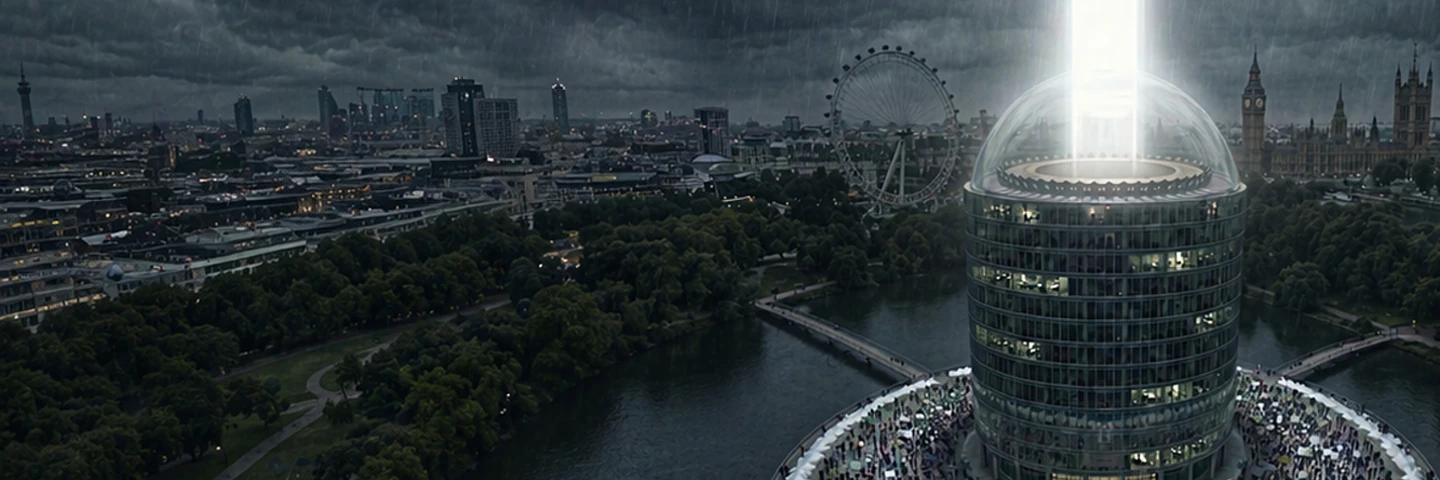
She paced over to the curved glass wall. Down in the plaza surrounded by protestors, Naomi stood on her plinth, her back to Francis. Gazes synchronised, Francis and her mentor’s effigy looked west beyond Saint James’s Park as greenway-lights flickered out across London under a receding purple sky.
Baron’s proxy would argue the state of emergency required Walker Affairs to have discretionary enforcement. Compelling under the circumstances, but an old script.
During the global consolidation debates, Baron had proposed to unify CGS public safety and judiciary authority. He had framed it as a way to eliminate delay, reduce handoffs, and increase decisiveness. Temporary scaffolding, he had argued, until the system matured.
She had vocally dismissed the idea as naive—an underestimation of the long-term dangers inherent in temporary centralised power. Scaffolds became walls the moment they took weight. She had won decisively. The proposal had been shelved.
Afterwards Baron had crossed the chamber floor, extended his hand, and congratulated her with a smile that did not reach his eyes. His grip had been cool and dry, the courtesy exact enough to feel notarised. She had understood later that public humiliation did not remove a rival—it taught them patience.
She stepped past the crescent desk and turned a flat palm through the wake-field above its rim, wrist steady until the sensors caught. Amber points struck first along the desk edge. Violet filaments climbed after them, knitting themselves into a room-spanning holo of Council member telemetry.
Rhys’s new report cross-referenced vote indicators with the level of pandemic impacts in each councillors’ region. The higher the region scored across outbreak volatility, weaker local enforcement capacity, and deeper protest indices, the higher the PI number.
The report showed that vote pressure was building in favour of reduced oversight on Walker Affairs where she expected—PI-3 through PI-5 sectors. Opposition clustered along the usual vectors of regional pride, ideological adherence, and in PI-1 regions that were experiencing fewer pandemic related consequences. Nothing yet suggested Resolution 422 was guaranteed to pass.
The outer office doors opened with a hiss. Corridor air entered carrying bergamot, sandalwood, and coffee.
“Thank you, Rhys,” she said, still studying the data.
He crossed the threshold and approached her with a slate under one arm. In each hand, grappled from above by their lids, he held two cups. He passed one to her, then settled his own between both hands, thumbs braced under the rim. His tie hung a fraction off-centre, which on Rhys meant he had chosen speed over correctness. No doubt one of the staff at Number 10, beholden to him for some favour, had alerted him that she was on her way in.
Rhys edged back to the outer ring of the projection. “Khosravi is fraying,” he said. “The Maghreb-Sahara bloc rejected the latest sunset language. They’re calling the hard date a paternalistic restraint.”
Francis took a measured sip. The coffee was exactly right.
“That’s because it is,” she said, “or did they forget that Walker Affairs is a subordinate agency to the Council they sit on?”
“Chairman Khosravi wants room to negotiate. He’d like to propose a staggered review at ninety days, framed as responsiveness to the Maghreb-Sahara bloc’s concerns rather than a retreat.”
Amber nodes hovered over the Maghreb-Sahara overlay. “They’re testing the surface tension. If Khosravi yields on the date, he signals that the 422-A structure is malleable.”
Rhys angled himself to the outer ring of the projection, careful not to let the brighter sectors make direct contact with his eyes.
“He’s worried that if he’s too rigid, we won’t reach the margin of support target.”
She set the cup down on the white marble of her desk. “Tell him to frame the hard date as adherence to Tenet Eight. It will make the rejection sound procedural rather than principled.”
Rhys tapped his slate. “Take a look at my updated vote projections.”
Francis turned from the projection and went around her desk to sit at her terminal. The holo could tell her where votes stood, not where commitment had softened. She touched the lower left corner of the dark glass, entered a private code sequence, and called up the unofficial whip ledger Rhys maintained for her.
The screen resolved into councillor names, regional identifiers, status flags, confidence weights. It showed who was firm, conditional, transactional, silent, or would only give verbal commitment.
She read.
Then she read it again.
The alignments in the holo and the private commitments in the ledger did not match.
Support that should already have hardened remained unrecorded. A councillor from Abyssinia she would have placed in the firm column now sat under conditional with a seventy-two confidence weight. Two councillors in the PI-1 sectors had been reclassified as transactional overnight.
“Why is Chrétien still verbal only?” she asked.
Rhys came closer, though not close enough to crowd the screen. “He wants the amendment to pass, but without the trace of having stood behind it if the centre moves the other way.”
Francis touched the entry for Chrétien and dragged up his history of prior votes and committee behaviour. He had never required public insulation before.
“And Cruz?”
“The same instinct. Less elegantly expressed.”
Rhys’s face remained impassive. This was as close as he got to levity.
Francis opened a second history, then a third. The same hesitation appeared among people who did not usually need political cover. She widened the display and drew a set of exposure variables down the side of the screen.
Francis looked up. Rhys was watching the ledger rather than her.
“What?”
“This is more than usual hedging,” he said.
“This is an unusual time.” She widened the display and drew a set of fatality rates down the side of the screen.
He shook his head once. “Outside of those waiting to be reassured, some councillors who have shifted category are also shifting language.”
That stopped her hand. She left it resting against the edge of the desk. The ledger glowed in narrow columns beneath her fingertips.
Rhys stepped back from the terminal. “They are not asking whether emergency authority is warranted. They’re asking whether visible limits on enhanced security measures are responsible.”
Francis drew the PI-1 sectors forward in the holo with a cut of her fingers. Violet lines brightened, then thinned. “Crisis produces mimicry. Once one group takes a stand, the others can borrow the posture whilst not sharing the conviction.”
“Yes,” Rhys said, “and posture often lags belief, but that’s not what we’re seeing in numbers.”
She isolated three councillors and ran their private notes side by side. One had moved from firm to conditional. One from conditional to transactional. One remained technically supportive but refused to place a trace on terminal. Beside two of the entries, brief notation tags had been added under Rhys’s handle.
Concern about Walker-led rebellion.
Concern that CGS tenets aren’t suited for a time of crisis.
Francis’s hand stopped on the glass.
“Whose language is that?” she asked.
Rhys woke the slate with his thumb and scrolled. “No single source.”
He hesitated, then looked up.
“There is something else.”
Francis’s attention returned to him in full.
“A second amendment moved through public safety on an emergency track while we were focused on 422-A.”
He extended the slate. She took it without looking away from his face.
“The Andean-Amazonian Collective?” she said after the briefest glance.
Rhys nodded. “Sup logistics emergency override for Walker Affairs.”
Francis set his slate beside the terminal and flicked the file into the main workplane. The display collapsed inward, then reassembled around the amendment in a dark pane of legal text.
Control of transport hubs, emergency resource reallocation authority, routing vetoes during periods of unmanaged civil unrest—all written in very broad language.
“Who sponsored the emergency track?”
“Condori from Antisuyu and the Pantanal Councillor. Co-sponsored and fast-routed under continuity grounds.”
Those two were from PI-1 regions. They could afford patience.
“The sponsors are wrong for the measure,” she said.
“True.”
She dragged the support overlay across this new 422-B amendment and a small cluster brightened in other PI-1 sectors with no immediate concerns.
“Baron must have some leverage over Pantanal and Antisuyu,” Francis said, “but more concerning are the PI-1 alignments. Find their motives, Rhys.”
“I’ll start with Condori. I know him from Cambridge,” Rhys said.
“If Baron gets a logistics veto, the Council becomes a simulation of authority.”
“I won’t let that happen, Councillor.”
She pushed back from the desk and walked to the curved glass, telemetry light sliding off her tunic as she left the holo behind. Below, the lake moved with shallow wakes, flowing without collision or dominance.
She had built the CGS on the assumption that no single body should carry physical force sufficient to silence the others. Economic ties counterbalanced power. Power redistributed itself. When fear displaced trust in that correction, people reached for any available mechanism of control.
Either way, Baron would control too much force through the worst of the pandemic. If the amendment passed without an overwhelming majority, he would argue at the end of the term that relinquishing it would be irresponsible. He would be wrong in ways that took longer to measure and were harder to reverse. The question was how many councillors saw that.
Behind her, Rhys set his cup down with a small ceramic click. “We can separate fear votes from ideological shift votes.”
Francis turned.
He had not moved from the desk, but something in his posture had changed—less deference and more necessity.
“Quietly,” he said. “I can cluster the motives off-ledger. Track where firm became transactional, where support remains verbal only, and where the imported language is appearing. If this is organised, the count matters less than the permission structure driving it.”
Francis considered him for one measured beat. “Do it.”
Rhys gave one short nod and reached for the slate.
“And Rhys.”
He stopped.
“Do not let them see us looking.”
“I never do, Councillor.”
He transferred the revised parameters to the slate and turned toward the door. The outer seal released ahead of him with a hiss that pulled a thread of cooler air into the room. Then he was gone.
She crossed to the bookcase near the white plinth by the door. The geometric sculpture there caught the room’s amber light in hard planes and returned none of its warmth. Her hand found the spine of Naomi Feld’s The Liability of Emotion: Human Factors in Economic Collapse. She did not pull it out.
Naomi would have called the bargain with Baron sentiment dressed as calculation.
She let go of the book.
Francis returned to the desk. The holo still held the public count. The terminal still held the private ledger. She looked from one to the other.
Four days remained, and not enough support committed to the amendment.
Sharon leaned against the Victorian brickwork wall of her office and rubbed her eyes. The wall belonged to the exterior of the Hodgkin Building, but served as an interior wall to the modern polycarbonate and steel annex that contained her lab at King’s College London Guy’s Campus. She was tired. Except for a few hours of fitful, nightmare-laced sleep on both nights since meeting Ari at the Elephant and Castle Saloon, she had been hunting the pathogen.
Ari’s encounter had reoriented her entire approach. Along with other CGS scientists around the world, he had been searching for an evolved pathogen, but now Sharon sought a design. Her years of research into the flawed folding of the Tau protein had taught her that nature’s most elegant systems could contain their own self-destruct codes. If this pandemic was manufactured, it would bypass the lumbering evolution of a known pathogen, manifesting instead as a subtle perversion of biology itself, a fatal misfold hidden where no one else would think to look.
An unopened meal sat sweating on a clean-room tray, forgotten.
Multiple holo data streams hovered in the air, overlapping schematics of viral proteins and mortality statistics casting a blue light on the pristine lab benches outside her office. At the nucleus of the tangle, a shimmering molecular model of a protein rotated on her main display, a piece of lethal art.
She stared at her comms unit, running her thumb over the rough, etched ridges of the silence switch until the skin grew raw. She’d tried his flat, his personal comms, even his workbench terminal at the CGS. Every call dissolved into the digital void.
Where are you, Ari?
For the past hour she debated making a call she knew she shouldn’t, a personal plea to Francis Herbert, the woman who had been her de facto mother-in-law. Ari wouldn’t have wanted her to ring, but Francis deserved to know her foster son might be in trouble. And if he was, she certainly had the means to help.
Through the glass wall, she saw one of her colleagues talking to two police officers. Her colleague turned and pointed towards her office. The police officers started walking towards her. Her pulse soared, a sudden spike in hydraulic pressure. Her thoughts replicated like a viral culture. They found out about the hack. Did Ari mention my name? Are they here for me?
Two officers stood on the threshold. Sharon’s attention immediately went to the female officer who wore her fiery red hair pulled back severely, accentuating piercing green eyes and a face more handsome than pretty. Even in a standard-issue police coat, she possessed intense poise and radiated a focused energy. A constable hovered a step behind her, his gaze sweeping the lab with a rehearsed professionalism that couldn’t quite mask his curiosity.
“Ms Feld?” Her voice was calm, professional.
“Dr Feld,” Sharon said.
“Of course, Dr Feld. I’m Detective Chief Inspector Alene Ardone. This is DC Leo Hatch. We’d like to speak with you about Ari Feld. We have you as his next of kin.”
“I’m his ex-wife,” Sharon corrected, the words precise and cold. “The divorce was finalised weeks ago.”
“My apologies,” Alene said, her expression unreadable. “Even so, you’re the closest we have. May we come in?”
Sharon hesitated, then gave a curt nod, stepping back from the door. Her office was small and had no guest chairs. She could have taken them to the small conference area with its comfortable chairs, but she wanted them there, in private. Let them stand, she thought. Let them feel like intruders.
As they entered, the DCI’s gaze drifted to the holo display.
“What is that?” she asked, her curiosity seeming genuine.
“It’s a misfolded protein,” Sharon said, surprised by the question. “It contains a single error that causes a cascading failure in an entire organism.”
“I see,” Alene said. She straightened her coat, the stiff fabric rustling with a disciplined snap. “When was the last time you saw or spoke to Mr Feld?”
“The day before yesterday, in the evening, at the Elephant and Castle Saloon.”
“Interesting choice,” Alene noted. “What was the nature of your discussion?”
“Private,” Sharon countered, her tone sharp. She didn’t like this woman’s quiet confidence, the way her eyes seemed to catalogue everything.
“Alright then, what was his state of mind? Was he agitated?” Alene asked.
“Ari’s state of mind is always complex,” Sharon said. “He’s a brilliant systems analyst. He sees the world as processes. For example, what you might consider agitation, he would call processing an unexpected variable.”
Alene raised her hand to stroke her chin, her eyes narrowed. Sharon knew that look too well, the DCI employed the same dispassionate, analytical process she herself used to dissect a problem, and she disliked feeling it trained on her.
“Would you characterise him as obsessive, Ma’am?” Leo interjected, his tone a little too eager, trying to mirror the DCI’s cadence. “Prone to tunnel vision when he finds a… what did you call it? A variable?”
The question hit a nerve, triggering a painful and bruised part of her marriage. From the corner of her eye, the DCI shot the constable a brief, silencing glance.
“His focus wasn’t the problem, Constable,” Sharon said. “If you are asking if he was irresponsible, the answer is no. Our marriage didn’t fail due to recklessness. It failed because he treats human emotion like interference in a signal.”
“Could an unexpected variable, drive him to be reckless?” Alene asked. “For example, breaching a top-secret CGS medical database? Would that be typical behaviour?”
So it is my fault. He did what I asked and that’s why they are here.
Sharon turned back to face Alene slowly, forcing a neutral expression. “No, but if Ari believed something was broken, he would do what was necessary to fix it. That’s what he does.”
“Even outside his area of responsibility? The System Is Self-Correcting,” Hatch quoted. “Unusual, wouldn’t you say?”
Sharon chastised herself for making such a careless blunder related to a prime tenet in front of the police. She said nothing.
Hatch continued. “Was he involved with any subversive groups? The Walkers, perhaps? Did he ever express any anti-CGS sentiment?”
“Ari? He loves the system. I’m sure you know his family history.”
The questions kept coming, chipping away at her composure. Each one implied Ari was a criminal, a traitor, a loose wire that needed to be snipped. And with every defensive answer, her guilt grew. This was her fault. She had pointed him at the database. She had injected the catalyst.
“What’s this all about, then?” she demanded, her splayed fingers pressing the edge of the lab bench, the tips white. “Are you building a case against him? Have you arrested him? Is that it? Just tell me what’s happened to him!”
The DCI held her gaze for a long, unblinking moment. Her expression offered nothing, deepening Sharon’s dread that she was responsible for what happened to Ari. Then, Alene turned to her subordinate. “Constable, wait outside.”
The young man nodded immediately. The door clicked shut behind him, leaving the two women alone. The rhythmic thrum-hiss of the sequencer in the lab seemed to grow louder, filling the sudden void in conversation.
“Are we building rapport now that he’s gone?” Sharon said. “A bit transparent.”
“Perhaps,” Alene admitted, crossing her arms. “But I honestly do think this will be easier for both of us without him. He’s bright, but young. You understand.” She took a step closer. “Dr Feld… may I call you Sharon?”
Sharon didn’t react.
Alene continued, “Your ex-husband’s actions are perplexing. He lives like a monk and fights like a warlord in those sims of his. A man who builds a door just so he can enjoy the challenge of picking the lock. He doesn’t think like other people. Your answers have confirmed that. I’m not here because I think he’s a subversive. I’m here because I think he found an unexpected variable that drove his actions, and it’s put him in danger.”
This DCI already understood Ari. She was here to validate her diagnosis, and she too thought Ari was in danger.
“I haven’t been able to contact him,” Sharon said, her voice barely a whisper.
“Mr Feld is missing,” Alene said. “We have reason to believe he was abducted from his flat last night.”
Sharon’s knees unlocked, forcing her to grab the desk for support. The antiseptic smell of the lab suddenly turned cloying, suffocating her. Ari was right. He was right and they’d taken him because of what he knew.
“Then it’s true,” she whispered, more to herself than to Alene. “It must be because of the transmission.”
Alene’s focus sharpened, precise as a scalpel incision. “The transmission? Are you referring to the pathogen’s vector? Did he identify how it’s spreading?”
“No,” Sharon said, shaking her head. “Not that kind of transmission.”
Trusting this DCI was an insane gamble. What if the police aren’t here to solve a crime, but to contain a leak? And Ari—and now me—we are the leak.
Alene leaned forward again. Her intensity had changed to resemble the hard pull of a mind trying to lock onto the truth. Sharon related to the professional curiosity as something she could trust.
Sharon took a deep breath, the sterile air of the lab thin and inadequate. “Ari was in the network tunnels, fixing a fault in a data conduit. There was a power surge, and he said a holo-conversation just… bled out of the junction box. It was fragmented, corrupted.”
“What did he see?”
“Two figures. One was an Asian man. The other was disjointed, an arm and a shoulder. Their voices were distorted, mostly noise.”
“Did he recognise either of them?”
“No,” Sharon admitted. “He said the pitch was too unstable to recognise a voice. But for a moment, the distortion cleared. He heard a sentence, in English.” She paused, and the memory of Ari’s frantic voice on the holo when he had rung her sent a fresh chill through her. “The English speaker said, The pathogen is effective well beyond the expectations of the developers.”
Alene stood motionless, her eyes fixed on Sharon’s. “Did he get a recording? Any logs of this bleed?”
Sharon shook her head. Her throat tightened around the answer. “No. There’s no evidence.”
“So he came to you for the proof,” Alene stated. It wasn’t a question. “He asked you to check if the pathogen was manufactured.”
“Yes.”
“And is it?”
“I don’t know yet,” Sharon admitted. “But it’s not a virus and it’s not bacteria. Scientists would have otherwise identified it by now. I think the pathogen manifests as a folded protein.”
With a few gestures, Sharon manipulated the holo Alene asked about earlier, spinning the shimmering protein and zooming in with surgical precision on a single, tight coil. “This is the most likely candidate. See this hyperphosphorylation? It shouldn’t exist.”
Alene stared at the model, not looking at the protein model so much as through it. “It’s plausible,” Alene said, a spark of excitement in her eyes. “Ari’s hack was a crime, but he’s a witness first. I can see how it fits his profile.”
The detective’s excitement stung like a betrayal. “You’re dissecting him like he’s already a cadaver. He’s not,” Sharon insisted, her voice collapsing. “But if you don’t find him, he very well could be one soon.”
“You’re right, I’m sorry.” Alene’s eyes refocused and returned to look directly into Sharon’s. “My constable, the one I sent outside? He buried his nephew last week. The boy was twelve.” Her words were quiet, but they bore deeply into Sharon’s chest.
Without any procedural edge Alene said, “I’ll find Ari, but my investigation is now about more than just him. I’m chasing the pathogen now, same as Ari was. Same as you are. Can I count on your cooperation?”
The panic remained, a constriction in her throat, but she forced a deep breath. She smoothed the front of her lab coat, the rough friction of the starched fabric sounding abrasive. “Can I count on yours?” Sharon asked.
A beat of silence passed between them. Their eyes locked over the rotating protein and the fact of Ari’s absence.
Sharon turned back to her terminal, wiping the scattered holo displays away with a swipe of her hand, her focus narrowing. “I can’t help you find Ari, but if you can get me raw patient data, mortality statistics, geographical clusters, genetic markers, everything the CGS is holding close, I will discover the pathogen.”
Alene didn’t hesitate. She pulled out her own comms unit, her movements quick and decisive. “I can generate an anonymous access key to the primary medical archives. No logs, no trace back to you. You’ll only have one shot to download everything you can before the system purges the key.”
The key appeared on Sharon’s terminal, ready to be activated.
She looked from her terminal to the lethal protein model still rotating in the air. “The protein… it’s a biological execution command. Finding Ari won’t stop the code from running.”
Alene followed her gaze. She exhaled slowly through her nose, a controlled sound like a pressure valve releasing. Her posture shifted, the fabric of her coat straining across her chest as she squared her shoulders. “Yes, the hunt is for these developers,” she said. “But Ari’s my best lead.” She reached out and placed a hand on Sharon’s arm, a simple gesture of solidarity sealing the promise.
Sharon flinched, the sudden warmth of Alene’s dry palm rasping against the cool skin of her forearm making her entire body go rigid. It had been so long since she’d felt an unsolicited, gentle touch that wasn’t procedural or accidental. The contact breached her containment. Her breath hitched. She didn’t pull away, but stood frozen for a long second. She looked down at the DCI’s hand on her arm, then back up to meet her eyes, and gave a single, firm nod.
The earthy scents of charred parsnips, caramelised onions, and baked bread supplanted the damp chill of the tunnels, tantalising Ari even before he arrived at the Walkers’ dining hall. Near the entrance, an old man sat under a bare bulb, meticulously sharpening a set of kitchen knives on a whetstone. Beside him on the wall, a climbing vine in a salvaged pot had withered, its brown leaves a testament to the struggles of living underground.
As he opened the door, the hall exhaled, warm and humid, the air thick with the smell of heated bodies and vegetable stew. Above, exposed conduit pipes snaked across the high, stone ceiling, with suspended caged bulbs casting yellow light that pooled on the patrons below.
Ari joined the queue for the evening meal—the process a textbook example of structural inefficiency. Topside, he would have ordered from the Sup, and a nutritionally optimised, temperature-controlled meal would have arrived silently at his flat at a precisely calculated time. The Walkers shuffled in a queue, Ari with them, holding a heavy and chipped ceramic plate. A large, cheerful woman with steam-reddened cheeks stood behind a long, metal counter, wielding a ladle like a manual lever. She slopped a heap of roasted vegetables and a thick slice of meat pudding onto his plate, the gravy spilling over the side.
“Eat up, topsider. Get some meat on you.”
Her directness struck him like a system error, yet, as he took the plate, the unregulated heat bleeding through the ceramic was comforting against his skin.
He’d spent his second day in the workshop, his hands rediscovering their old rhythm, his mind finding a quiet harbour in the solvable logic of broken machines. Benjamin had joined him again for a little while and they had worked together comfortably. Now, sitting at a long, scarred wooden table, listening to the clatter of mismatched cutlery on wooden plates, the scrape of repaired chairs on the concrete floor, and the murmur of dozens of conversations in a half-dozen languages, muscles used for something other than an Imager simulation throbbed with an almost forgotten ache.
He raised a forkful of roasted vegetables, but stopped when the hall’s main door swung open, admitting a woman caked in grime, her forearm bleeding. She carried a heavy canvas sack that she dropped with a thud onto an empty bench, then limped out without a word, turning towards the infirmary.
Santo stood near him with a plate of food watching the woman leave, his eyes tracking the droplets of blood on the flagstones. He gripped his pewter mug so hard his knuckles were white. He turned and looked down at Ari.
“Mind if I join you, Fixit Kid?”
Santo didn’t wait for an answer. He slid into the chair beside Ari, his face clean-shaven and his eyes clear. He looked younger than he had in the main hall the day before, more like the boy Ari had known, albeit with a harder, more cynical edge. He rubbed a hand over his face, the sound of dry skin on stubble rasping, and when he dropped his hand, the drunken slackness was gone. His simple work tunic had a security patch on the shoulder.
“You know, you could have helped me out a little more,” Ari grumbled, rubbing his shoulder where Timmy’s grip had left a mark.
“Nah, mate, I was drunk,” Santo said with remorse. “Just come off a double. Never drink on the job. Still, you could have reminded me who you are in some other way. We did do other things at school besides fight over Julia.”
Santo grinned and Ari remembered that look. “The best I could come up with under the circumstances,” Ari said.
“Remember rigging the Tannoy to play that ridiculous synth-pop track during assembly? I thought old Headmaster Rowan was going to have a coronary.” Santo clapped Ari on the back, easy as if the years between had only been a long lunch break. “So, whatever happened with you? Last I heard, you were getting married to some scary-clever science girl.”
The memory of the Tannoy prank loaded unbidden, bright with the cheap thrill of getting away with it. But the sharper memory was Sharon, listening to the story years later with that patient look he had never known how to read. “It’s a silly way to hack a Tannoy, Ari,” she’d said, “but the story it tells about your friendship is more important.” He hadn’t understood her then. He had seen the mechanism and missed the people inside it.
“Sharon,” Ari said, the name feeling heavy on his tongue. “We, uh… we had a dissolution. It was finalised a few weeks ago.”
Santo paused, a piece of roasted potato halfway to his mouth. “Dissolution? Bollocks. That’s for machines, mate. People don’t get dissolutioned. They break up. Get divorced.”
“The connection degraded,” Ari said, picking at his food. “It was the logical thing to do.”
“Logical,” Santo repeated, shaking his head. “That’s topside bollocks right there. Always tossing a good mess in the rubbish. Replacement Ensures Reliability and all that shite. Sometimes the mess is the whole point.” He took a large bite of meat pudding.
Ari’s fingers twitched, instinctively reaching out to align his mismatched cutlery into a parallel grid.
“So what happened to you, Santo? Last I saw, you were a junior network tech at a Sup hub.”
“Yeah, well.” Santo’s smile faded. “I was good at the job. Too good. They promoted me to routing logistics. I spent twelve hours a day staring at data streams, optimising routes, shaving off milliseconds.” He let out a humourless laugh. “I was spinning my wheels in neutral, Ari. Engine running, gears stripped. Felt like a spare part in a machine that didn’t even know I was there. Topside? It’s all just inputs and outputs, innit? No wonder half the city is brain-dead on Imagers. Better to be a fake hero than a real nobody, right?”
“That’s not all it is,” Ari didn’t want to admit that he knew that feeling intimately. “It’s efficient. Things turn up on time and nothing backs up. It works and it’s stable.”
“Stable? It’s a bloody padded cell,” Santo shot back. “People swapped their souls for cushy pads and nutrient paste. They’ve pacified the whole world and called it peace. We ain’t meant to be that… clean.”
“So you came down here,” Ari said, gesturing to the hall. “To live off the grid. Sabotaging the Sup, taking resources from regular people. Same as the old Capos.”
Santo slammed his cup down. “Don’t you ever say that. The Capos hoarded. They were greedy, isolationist bastards who’d let the world burn to protect their own pile. We never take more than we need, just like everyone topside. We share, we build, and we fix things.”
Santo leaned in. “You know that prime tenet? Replacement Ensures Reliability. Repair Creates Instability. That’s the biggest lie the CGS ever sold. It’s how they teach people to stop seeing loss as loss. To throw out a person, a place, a whole way of living, and call it maintenance. We don’t live like that down here. You don’t replace people, Ari. You don’t replace a home. You fix what’s broken and carry what you can. That’s what we do. We’re the pit crew, mate, not the bloody wrecking ball.”
A few other Walkers at the table nodded in agreement. A young man with cybernetic tracings on his temple spoke up. Ari remembered someone in the workshop calling him Dax.
“You heard the news feed? CGS’s blaming the Walkers for the Sup failures in Islington, but it wasn’t us. Maybe we should have done, but we didn’t. They’re deflecting. Trying to blame an external enemy so people don’t see their own system failing them.”
On the table beside Dax, a battered microwave chassis jury-rigged with a car battery and a tangle of salvaged comms parts sparked intermittently.
“It’s Justice Baron,” said a woman sitting next to Dax. She had a pragmatic face. “His lot are getting twitchy. Looking for a reason to kick the door in.”
“Good,” Dax said with a smirk. “Let ’em. Maybe it’ll finally light a fire under Charles’s arse. This no more than a tithe limit of his is too soft, Elara.” He pointed a knife at the woman. “I don’t want to burn it all down. I just want them to feel the consequences of messing with us. A smashed Sup maglev track is a message. It’s the only language the topside understands.”
“Breaking things gets people killed, Dax,” Elara cut in, her voice sharp with painful memory. “We lost Anya last time you and your friends got ambitious near the Shadwell Sup line. See those two kids eating at the far table?” she flicked her fork. “Notice who isn’t sitting with ‘em? We’re not doing that again.” She tapped Dax’s device. “That scrubber of yours keeps us hidden on mission. Charles’s caution is why you even have the parts to build it.”
Santo stared hard at Dax. “I’ve walked that path, lad. It ends with getting flushed with the sewage. Charles keeps us breathing.”
Dax ground his teeth, then broke eye contact with Santo.
The Walkers were not one thing, but a mesh of grudges, debts, skills, and shared need held together without the CGS’s rigid architecture. Looking at them, Ari could see the heresy in it, a society built on repair instead of replacement, but it was alive. Maybe Santo was right. Maybe without greed and isolationism, the Capos could have made their inter-compatible system work. In comparison, the CGS was a crystalline lattice, perfect and rigid, but brittle.
Elara turned her assessing gaze on Ari. “So, you’re the Fixit Kid Santo’s been telling stories about.”
“Yeah, I… uh… restore functionality,” Ari said.
“Good,” she said, finishing her meal. “We’ve got a lot of broken shite down here. Welcome to the workshop, topsider.”
Later, the main hall pulsed with life. A crackling gramophone playing a jaunty, brass-heavy tune. The sound was warm, punctuated by the gentle hiss and pop of the needle on vinyl. Laughter and arguments clashed over the slap of playing cards. On the far wall, a vast mural painted directly onto the stone depicted the Walkers’ history—stylised figures emerging from a sterile, geometric cityscape above, descending into the organic twist of the tunnels below. Ari and Santo found a small, quiet table near the bar. Santo nursed a beer, his shift long over.
“So,” Santo said, “you fixed Charles’s music player. That was clever. Timmy was ready to snap you in half.”
“He’s a cheerful bloke,” Ari muttered, taking a sip of the smoky spirit Santo had pressed on him.
“He’s loyal. He does the job. Don’t mean he enjoys it.”
The bulbs flickered. Once. Twice. Dead. The gramophone groaned to a halt. Blackness swallowed the cavernous space, severed by a collective intake of breath. Conversation died. For a few long seconds, the only sound was a child’s whimper from a far corner.
A scrape of a match, and a tiny flame bloomed in the darkness, held aloft by an old woman. It cast long, dancing shadows that turned familiar faces into strangers’ masks.
The lights buzzed back to life, flooding the hall in their harsh, steady glare. The gramophone needle scratched into its groove, and the music resumed its jolly as if nothing had happened. A nervous laugh rippled through the room, and the conversations slowly restarted, a little quieter than before.
Santo took a long drink of his beer. “Grid wobble,” he said. “Happens. Keeps you on your toes, dunnit? Reminds you the dark is always waiting.” He leaned back, his expression serious now. “So, you never really told me. How’s it a shiny component like you end up in the sump, running from the heavies?”
The music and smoke formed a Faraday cage blocking the CGS’s frequency in his mind. Santo sat across from him without the managed caution of topside, just waiting. For the first time since meeting Sharon, Ari found himself wanting to drop his firewalls.
“It’s the pandemic,” Ari said, his voice barely a whisper. He told him everything. The impossible signal bleed in the tunnel. The developers. The abduction attempt. The raw, visceral terror of being hunted in the tunnels. Timmy’s fist.
“I play those Imager trips, you talked about,” Ari confessed, staring into his drink. “Conquistadors, soldiers, all the violence you could want. It’s a rush. But this… having an actual gun on me, knowing Charles could just kill me where I stood?” He shook his head. A tired smile touching his lips. “It’s mad. A few weeks ago I was stuck in network maintenance and dissolution papers, bored out of my gourd. Now the whole system’s crashing, people are shooting at me, and I’ve never felt more alive.”
Santo put a hand on his shoulder and squeezed. “I’m happy you’re alive too, mate.”
Ari fought the urge to squirm out from under Santo’s attention.
“Bloody hell, it was a logic error!” Ari exclaimed, a jagged, barking sound tearing from his throat that barely sounded like a laugh. “Remember how I trapped myself with that bloody fire door? I’ve been trying to parse it. The manual override for the floodgate protocol was on the wrong side of the bulkhead. A catastrophic design flaw. A first-year engineering student would be failed for that.”
Santo chuckled. “That’d be one of ours, probably. We’re good, not perfect. We use those flushes to move heavy scrap.”
“Right. Well, it nearly moved me, or rather, removed me.” Ari’s brief humour faded as the trajectory that flushed him to the Walkers replayed in his mind, reminding him of what he needed to do.
He leaned in. “Santo, this is serious. I can’t be here. I need an uplink. Sharon—my ex—she’s running a diagnostic on the pathogen. She thinks she can patch it, but she can’t compile a solution without the source code. I need the patient data. The raw files.”
Santo set the mug down. The slosh of liquid settled quickly. The drunken schoolmate overlay dissolved into the hardened, low-poly reality of Walkers security. “So, the Fixit Kid has a new project,” he said, a knowing smile spreading across his face. “That’s a bit bigger than a music player, mate. You’re trying to patch the whole bloody world.”
A racking cough echoed from a corridor, momentarily silencing the nearest tables. The clatter stopped dead. For a second, the only sound was the low, nervous buzz of the hanging globe lights and the ragged breathing from the hall, before the low hum of talk started up again, quieter this time.
“I’ll be honest, Ari, the pandemic’s hitting us hard,” he continued quietly, nodding toward the passage that led to the infirmary. “We’re losing people. Good people. Charles, he’s been investigating, too. He’s not just a scavenger, mate. He’s tapped into lines the CGS forgot they laid. Dark fibre. Deep stuff. He’s been trying to find the pathogen’s source.”
“You think he’d help me?” Ari asked. “He was ready to dispose of me.”
“That was when you were a security threat.” Santo finished his beer. As he stood, a shadow fell over their table. Timmy walked past, silent, his gaze fixed on Ari. The heavy creak of his leather jacket cut through the sudden quiet, and the air shifted, carrying the iron scent of dried blood.
Santo didn’t flinch. He met Timmy’s gaze and gave a slight, almost imperceptible nod before turning back to Ari. “Now? You’re a live wire. Who knows, maybe you’re a bloody jackpot.”
“No, I’m the bloke who keeps things running,” Ari said. “I don’t build exploits. I’m not made for this.”
“Yeah, well, you’d better learn.” Santo looked at Ari, the old, familiar glint of mischief back in his eyes. “You know, I’ve been running from that perfected, polished world for five years. But you—you were born for it. Factory standard, mate. A perfect little cog. And yet, here you are in league with the Walkers.”
“I didn’t choose any of this,” Ari said. “I got flushed into it.”
“Yeah, at first.” Santo’s gaze was sharp. “But you ain’t running now, are you? You’re plugged in. Suits you.”
“So, what now?”
Santo’s grin widened, but his eyes were serious. “Now, we go talk to the boss. But be ready, Ari. Charles runs a tight ledger. You’re either an asset to be leveraged or a debt to be reconciled. There’s no middle ground. If he chooses the latter, my neck is on the line right next to yours for vouching for you.”
He clapped a hand on Ari’s shoulder. “Come on, Fixit Kid. Let’s go roll the dice.”