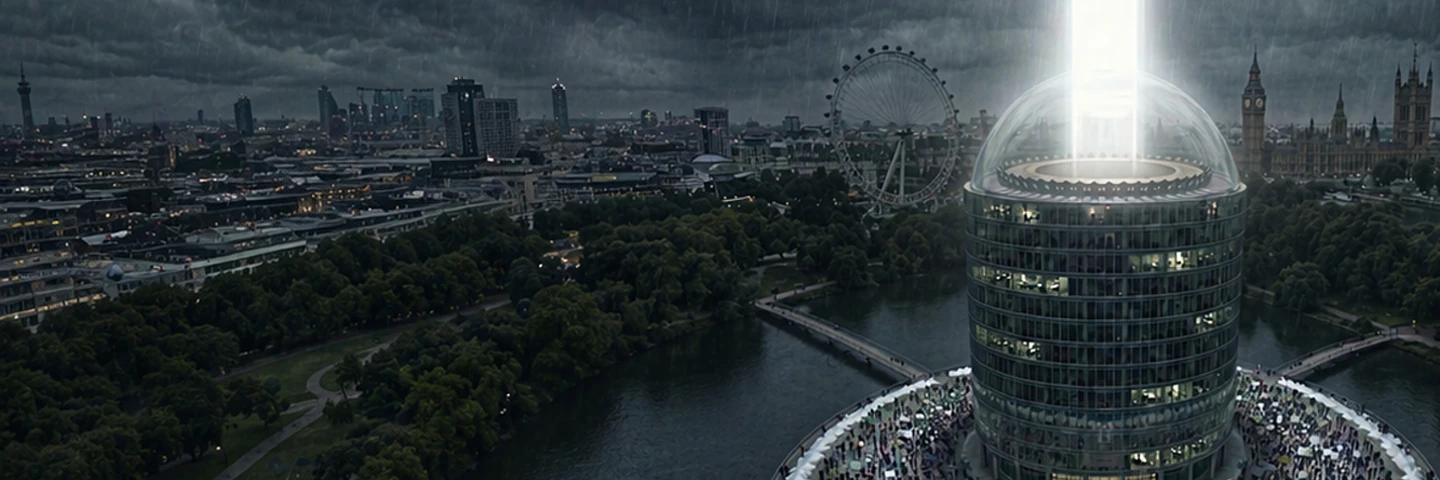
02 — Isolated
by D.M. BarachThe greatest threat to a harmonious system is not open rebellion, but private misalignment. A citizen may continue to perform their assigned function, speak the approved language, and move within the prescribed channels, yet still become destabilising if they permit grief, suspicion, or personal dissatisfaction to supersede trust in the whole. Systemic failure begins as a minor divergence in perception long before it manifests as material disorder.
—Naomi Feld, Systemic Integrity and the Harmonious States
Just past Admiralty Arch, Ari’s Mono branched out of the flow and descended into a port at the northeastern edge of St. James’s Park. 0953. Plenty of time to walk the rest. The empty car at the front of the queue disengaged, vacating the port for the next arrival. It slid up the slip into the main flow, reassigned by the Mono to a less congested node.
The System is Self-Correcting.
Ari crossed St. James’s Park Lake on the north footbridge, the soles of his shoes padding silently on the polished white stone. Two other bridges connected to Duck Island, one pointing southeast to Buckingham Palace, the other southwest to the Palace of Westminster. Each housed museums of failed economic systems, one feudal order, the other capitalism. He wondered, not for the first time, whether the former rulers of those palaces had ever stood on this ground and imagined a world that did not centre around them.
Glare from the Council of Global Stability Building flared in his vision. Ari didn’t slow. The glass façade of the massive cylinder and its position at the centre of Duck Island were mapped in his head. He knew this place as intimately as he knew its data network topography.
He skirted the perimeter of the plaza toward the southern staff entrance. Mallard ducks waddled across the paving stones as if they still owned the island. Near the western edge he paused, standing in the long shadow cast by The Founder.
Naomi Feld rose ten metres above the stone, bronze arm extended, her back to the CGS Building. Drones had polished her that morning, the bronze stripped of tarnish and residue. The white marble plinth glowing from direct and reflected sunlight. The Founder’s gaze cut across the tree line of St. James’s Park towards the Victoria Memorial outside Buckingham Palace. The originator of Economic Interdependency eternally staring down the matriarch of Empire.
Ari didn’t remember her. He had been four years old when Naomi was shot. What he knew of his nan came in fragments. Family photographs of a frail figure, a pale old woman with silver hair. Anecdotes from his mum about a stern professor and from his dad about an even stricter mother. His foster mother mimicking Naomi’s rants about self-defeating Capo trade policies, or about artificial cognition stripping the middle classes for parts before the CGS ended that branch of development.
Somewhere between the LSE lecture theatre and the marble plinth, his grandmother had been requisitioned, reassigned, and returned to him as an emblem. He tried to link the statue back to the woman who might have held him, or spoken his name without an audience, but the connection wouldn’t resolve.
Ari turned away and continued toward the CGS Building. He shot a quick glance up toward the structure’s massive glass dome. Transparency and constraint.
On approach to the staff entrance, a soft chime greeted him, followed by a pleasant neutral voice.
Visual identification Ari Feld, Communications Technician for the Council of Global Stability. Permission to enter CGS Building, granted.
The glass door parted. A scan swept him head to toe. He felt a static prickle across his skin, like circulation returning to a numb limb.
Security scan complete.
The inner door unlocked. Beyond it, the empty antechamber terminated at a single lift set into the far wall.
The lift ran on a two-minute cycle. Always had. Ari watched the counter tick down. At the usual shift changes, staff choked the antechamber, waiting for the lift to take them down. Inefficient. An escalator would have handled throughput better, much like old roundabouts were more effective than four-way stops. Continuous flow meant fewer queues.
“You really don’t know why it’s a lift?” Gus had said once, over lunch. “You?”
“Why, you?” Ari had looked up from his tray. “How would I know?”
“I’ve never met a system that you couldn’t reverse engineer. Truly, I’m shocked. It’s so simple.” Gus’s face contorted with mock horror.
“Then tell me, genius.”
“Escalators are open pipes. Lifts? Lifts are valves.” Gus had grinned, delighted. “I can shut a valve.”
Security logic. Different toolsets. Ari had shrugged.
“My foster mum used to say if all you have is a hammer, everything looks like a nail,” Ari had said. “She called it Maslow’s Hammer.”
“You wound me.” Gus had laughed putting the back of his hand to his forehead. “Besides, it’s called a Birmingham screwdriver.” He had mimed hammering a nail into the table with the side of his fist.
The lift chimed and carried Ari down to the operational level. He turned left into the communications wing and followed the corridor to his workshop.
The familiar smells arrived first. Flux and heated copper. Stale coffee. The room was small and overfull. Spools of fibre optic cable nested in a corner. Boxes of networking kit stacked on wire shelves. Ari dropped into his chair, sweeping polyethylene scraps of wire insulation under his workbench with his foot. Without looking back, he reached past pliers, crimpers, and probes to pluck a spudger from the pegboard.
Circuit boards lay in various states of disassembly across the bench. Generally, failed components were replaced before anyone noticed. Here, they were opened and made to work again.
The air filtration unit hummed a flat, unmodulated note. Instead of flattening the chatter of relays and the whisper of cooling fans, it only sharpened the ringing in his ears. He rolled the spudger across his knuckles and let it fall onto the bench. It clattered once and came to rest among the circuit boards.
Ari folded forward, elbows on knees, head in his hands. His pulse thudded against his palms. The ringing did not settle. Lower, the turbulence in his gut kept turning.
Sharon’s back, the door closing behind her, replayed behind his eyes. Marriage had been a bounded system, a set of known tolerances. With constraints gone and every possible direction now available, he was left with no direction at all. The code was still running, but there was no longer a target state to optimise against.
He stared, unfocused, out his simulated window at the CGS plaza. After a moment, he pulled himself back and turned to his desk, bringing his terminal out of sleep. A ticket stack filled his display, a queue with no terminal condition.
A shadow interrupted the light across his desk.
“You’re late.”
He looked up.
Adebayo stood in the doorway, one hand resting flat against the frame. His suit was cut sharply—dark charcoal, no visible wear, lapels precise. The knot of his tie precisely calibrated.
They were still new to each other. Three months, perhaps. Long enough for expectations to form, but too little for either of them to know where the other would bend.
“It was a personal matter,” Ari replied. “I logged it last week.”
“You mentioned it.” Adebayo crossed his arms over his chest. “That is not the same as planning for it.”
Ari kept his hands still on the desk. “It won’t impact productivity.”
“That remains to be seen.” Adebayo stepped into the office. He did not sit. “Commitment is not only measured by output. Presence is noticed, and it reflects on the department.”
Ari saw the reflection of his ticket queue in Adebayo’s thin rectangular glasses. “Understood.”
Adebayo adjusted a cuff. “Most people wouldn’t last on your metrics. You’re lucky you are… insulated.”
Ari’s nostrils flared. His jaw clenched. He said nothing.
“The Councillor was looking for you. She’d like to see you. Now.” Adebayo’s eyes tightened. “And while you may be insulated, I’m not. Do not give her cause to look closely at this department.”
Ari stood. “I won’t.”
Adebayo stepped back into the doorway. Ari came around his desk. After a moment, Adebayo shifted. Ari squeezed past him.
The lift carried Ari up through the building’s spine. The numbers climbed in a clean sequence. No stops. Anyone travelling to the second-to-top floor got a priority override. The ascent was smooth, only a low vibration threaded through the soles of his boots. It faded when the lift slowed.
The doors parted.
The air on this level felt stripped. The resin and dust smell that clung to the operations floor was gone. Here, the ventilation operated in near silence, the atmosphere scrubbed to an expensive neutral.
Councillor Herbert’s outer office was quiet. The carpet was pale and thick. His boots sank a fraction deeper than expected. The sensation made him aware of their weight.
Rhys stood from behind a low white console as Ari entered.
He was only a few years older than Ari, though he bore the difference as if it were deliberate. His suit immaculate. Hair trimmed close at the greying sides, longer on top, held in place without shine. His expression was neutral, but not empty. Composed and watching as always.
They knew each other, but not well.
“Ari,” Rhys said, voice measured. “She’ll see you now.”
Ari’s gaze flicked once to the sealed door behind Rhys, then back. He had always wondered how Rhys had lasted this long as her aide-de-camp. The Councillor’s orbit was not forgiving.
“Thanks,” Ari said.
Rhys inclined his head and touched the panel. The wooden double doors swung inward without a sound.
Councillor Francis Herbert looked up as Ari entered.
The room was bright with few right angles. A wall of windows to his right bent around the private lift behind her desk. Even the ceiling line flowed into the interior walls in a continuous sweep.
Ari looked over at The Councillor’s built-in shelving. He’d been in this office a few times over the years to service the private RAID array secreted behind the panelling.
He was used to this office when it was empty. It was different when she was in it—smaller.
“Ari,” Francis said. “Come in. Sit.”
He lowered himself into a curved back velour armchair in front of her crescent shaped desk—white marble and open like a table with waterfall side panels. Currently bare of any papers or holo projections, only a single silver photo frame adorned the desk angled precisely toward her chair.
Up close, the lines in her face were more pronounced than they appeared on broadcast. The expression she wore was one he had known long before he had understood what Francis Herbert was to everyone else. She had taken him in when he was a pre-teen and had fostered him after the Mono crash had killed his parents.
She was now Britannia’s Councillor to the Council of Global Stability. Taking the job there almost a decade ago had meant answering to her again.
“You didn’t respond to my messages. I wanted to see how you are,” she said.
He fixed his gaze a fraction to the side of her shoulder, on the thin distortion where the window’s curve bent the light.
“Systems nominal,” he said, the words tasting like plastic. “Operating within parameters.”
Her mouth curved down slightly. “Don’t reduce yourself to a status report.”
He recalibrated. “I’m… I’m fine.”
“Did everything go well at the final hearing?”
“Yes.” He paused. “Tomorrow I’m a free man.” He aimed for a light, ironic tone, but it fell flat. A ping with no return.
She regarded him for a moment that lasted too long to be accidental.
“Anjali used to bury herself in schematics when things got… complicated,” Francis said. “You have her focus. Be careful not to linger there too long.”
The mention of his mother arced like a high-voltage jump. His fingers twitched against his thigh. Francis was the only person still alive who had an uncompressed memory of who his mother truly was.
“If she managed,” he said. “So will I.”
“That is not quite what I meant.”
He kept his gaze on the bend in the glass. “I’m fine. Really.”
She inclined her head but did not withdraw her attention. “If you need anything, tell me.”
“Yes, Madam Councillor.”
A flicker crossed her expression, then was gone. He knew what that meant. She hated it when he deployed formality as a firewall with her.
He leaned forward. “If there’s anything in your queue, I’ve got bandwidth.”
She did not look away. For a moment, neither of them moved.
“Very well, Ari.”
She turned to the embedded console in the marble. Councillor mode engaged without visible effort.
“There appears to be an issue with the CGS tour programme,” she said. “The Imager file. Corruption in one of the public-facing sequences.”
His shoulders eased a millimetre. A corrupted file, bounded and solvable.
“I’ll take care of it,” he said. “And… thank you.”
He stood.
“Ari.”
He paused.
“Distraction is not healing,” she said.
He nodded once and turned.
Francis’s office door sealed behind him with a soft pressure shift. Rhys’s attention focused on his console.
Ari retraced his steps back to his office without looking up at anyone.
The terminal was how he had left it, queue unopened. An alert in the corner of the display pulsed once, then again.
He dismissed it.
Ari pulled the CGS tour programme into a sandboxed environment. The sum-check was wrong. Sections of the code were distorted. He began to trace it. The Imager files unfolded across his screen, public-facing sequence nodes branching by type.
“Load CGS Tour main module,” Ari said. “Run Imager.”
Structured code filled the terminal. Above it, the holo rendered Earth from orbit, a saturated blue sphere suspended in black. The holo’s starkness contrasted with the exposed wiring and open panels on his bench. Its glow washed his face, cool and even, turning his skin pale.
The file was unstable. Voxels flickered at the edges of the image. The music stuttered, swelling and breaking in uneven bursts. Ari leaned forward, fingers moving, tracing the fault as packets dropped and rerouted.
Welcome to the Council of Global Stability.
The narrator’s voice boomed, bass-heavy, engineered to bypass analysis and trigger awe. The view plunged toward the planet. Continents rolled beneath the camera. Capitals resolved one by one. Washington. Mexico City. Tokyo. Beijing. Moscow. Berlin. Clean lines threaded with green Mono corridors. At the heart of each city, the same circular plaza. The same glass dome, a floodlight inside it punching into the sky.
The view arrived in Paris. The CGS Building glowed in the centre of the Champ de Mars, the Eiffel Tower rising behind it. Ari watched command lines scroll while the narration continued. His fingers kept time with the staccato rhythm of the patch, ignoring the holo’s orchestral swell.
Our Founders forged the CGS in 2046 with a singular purpose—to secure a new world order of enduring peace, equitable prosperity, and good government.
The image stabilised, sweeping across the English Channel before plunging into the glass dome of the London CGS Building as if through liquid. Inside the dome, two hundred and eighty-four councillors stood in formation, faces solemn, identical in their composure.
In the twenty-eight years since its founding, the Council has achieved what was once thought impossible. It has extinguished the fires of war, banished the spectre of hunger, and created a framework to ensure humanity never again falls into darkness.
A montage followed. Rainforests, dense and uninterrupted. Oceans clear to impossible depths. The Sup waste lift rising skyward like a carbon-fibre spine.
The Earth has been returned to balance. Clean, renewable energy flows abundantly. Any waste that cannot be recycled is transported beyond the atmosphere and disposed of safely in the sun.
The image shifted. Cities from before. Skies choked with smoke. Crowds pressed into queues. Factories radiating heat. A world Ari knew mostly through archives and carefully curated footage.
In the time before, hundreds of millions died unnecessarily from hunger and disease. Trade wars fuelled by the divisive dogma of Capitalist Populism and Commercial Communism fractured our world—a ruinous era of greed and inequality.
Smiling old politicians. G7 and Sino-pact summits. Shaking hands. Dealing.
One by one, Capo and Coco governments fell to the will of the people, to those who voted for a better world—for this world—governed by your Council for Global Stability. The one envisioned by the Founder of Economic Interdependency, Naomi Feld.
Ari didn’t need to look at the stream to know which photo of his grandmother filled the projection. Feld_Naomi_Beatific_v4. A gentle smile added in post.
He applied a filter to stabilise the audio. The programme’s metadata tagged the next sequence. Davos, 2037 — The Single Bullet Revolution. He didn’t need the file to tell him how his grandmother died. The tour unfolded a tidy narrative, compressed and optimised for public consumption. Naomi’s assassination recast as the catalyst for an orderly transfer of power. New governments united into one Council to complete The Founder’s vision.
Effective packaging. One bullet. One martyr. Clean handoff. But growing up with Francis had given him access to history’s source code. The tour skipped the displacement, violence, and starvation that had scaffolded the transition.
The Council for Global Stability oversees and limits production in every region of the globe ensuring that no nation is capable of economic independence thereby fulfilling our first tenet—Interdependency Is Stability.
Looking at the contented faces in the b-roll, he had to admit the global operating system was stable. Peace and prosperity successfully achieved through the sacrifices of millions and his grandmother’s graven image.
Another patch. The image distortion fell away.
The CGS also ensures the fair distribution of all the world’s resources. No group of people ever has more than any other. Equitable access is guaranteed, as declared in the second tenet—Scarcity Is Eliminated Through Constraint.
He breathed clean air. His needs were met. The CGS delivered.
Economic Interdependency promises this—a world where the system renders aggression impossible. A world where accumulation has no benefit and no person will ever again go without their needs being met. This is how we achieve our third tenet—The Well-Being of All Is the Well-Being of One.
A steady drip-feed of uniformly manufactured satisfaction. No one could have anything he couldn’t have. Nothing to covet—unless your desire was someone else’s lover. After all, beneath the uniform worksuits and contented smiles, biological hardware remained primitive.
He executed the final patch and watched the Earth resolve into flawless clarity.
The CGS brought about the new world order. War has ceased, suffering has vanished. Thanks to the vision of The Founder, the world has never been better.
Ari terminated the program. The blue sphere vanished. His crowded workshop and the churning in his gut remained.
He stood and crossed to the simulated window. Outside, on Horse Guards Road, people glided past on the Mono, faces relaxed, trajectories buffered from friction.
“Never been better,” he said.
His breath fogged the glass. The smear lingered for a second, then dissipated, leaving the view untouched.
Ice-choked water flowed around his boots. Salmon leapt past his knees, struggling against the current. He crouched in Bonanza Creek with the other men, frozen into the same stubborn posture. Hands raw from panning, fingers numb, joints stiff, he moved with the rasp of dry actuators. This time he was a prospector named Silas, his world reduced to the punishing repetition of gravel and current, waiting for a flicker of yellow metal that might justify the pain.
At 2342, Ari stretched and logged the session. The other prospectors had packed up and left for Dawson hours ago. A persistent spasm seized his lower back. He opened the Sup door, disguised by the Imager as a small crate, and pulled out the jerky and beans it had been keeping warm. He ate, barely tasting the food, while staring into a simulated campfire. It was past midnight, the Yukon sun finally below the horizon. He settled into his thin bedroll. Frigid air burned his lungs. Birch smoke stung his eyes. He lay there, listening.
Ari woke shivering.
“Exit Klondike Gold Rush.”
He squinted against the sub-arctic simulated sun until it retreated, replaced with the dim light of a rainy October dawn diffused through the frosted window of his flat. The Imager’s fans ventilated the frigid air. Then the quiet pressed in, the air tight and unmoving.
Ari blew into his cupped hands, ordered breakfast from the Sup, and put the kettle on. He grabbed his coffee mug from the rack and set it on the worktop. Then he reached for the second one. His fingers closed on nothing. The motion completed itself anyway. A routine that had run daily for nine years, now fully obsolete, resisted deletion.
These past six months had been like an overplayed Imager simulation—predictable, with familiar parameters and known constraints. With Sharon there had been another variable to consider. Now there was only his own routine.
A hot shower and a fresh worksuit stripped away the haptic residue of the Yukon. Breakfast arrived as expected with the Sup’s usual precision. He sat at his terminal and tore open the pouch. He squeezed the oat-based nutrient into his mouth while scrolling his public feed. The grey paste smeared across his tongue like expiring thermal compound, faintly chemical, faintly warm. Social updates slid past until a headline snagged him.
CGS Reports on Systemic Health Metrics.
Health items usually resolved into background noise. Sharon’s terrain. Unruly biology. Too many variables. But systemic snagged him. Health was an interconnected network. He paused.
The report was procedural. Global aggregates smoothed into compliance. His eyes moved without intention until a value near the bottom registered as wrong. A slight uptick in emergency medical dispatches. Statistically negligible, no more than a rounding error.
An alert surfaced a moment later.
Elevated incidence of hyperthermia and cardiac distress in Southwark.
The two data points aligned. Nothing definitive, but enough to notice. His fingers twitched, ready to search deeper. Sharon lived in Southwark.
He stopped himself and terminated the query.
He packed his kit and left for work.
A week later, Ari sat opposite his work friend Gus in a booth at the Comet Diner, an Americana-themed eatery near the CGS building. The staff twirled around, poodle skirts, high-waisted pleated trousers, trays balanced with rehearsed ease. A high-fidelity reconstruction of a happy place, yet less real than an Imager equivalent.
It worked for Gus. Even his CGS security uniform slotted neatly into the scene, another costume in a carefully curated archive. Ari bit into a burger and watched the Mono slide past the window.
“So Leo says, ‘ya know mum, synth-duck isn’t even an approved tier-1 nutrient for my age bracket’,” Gus said, laughing. He dragged a chip through a pool of ketchup. “He’s six! Where does he even learn a phrase like approved tier-1 nutrient?”
“Kids,” Ari said. “They’re just biological processors. Input, output, and a lot of system maintenance.”
A neon-lined jukebox shell pumped out relentlessly cheerful century-old Rock and Roll. They had to speak loudly to hear each other over guitar-heavy anthems that an algorithm kept a few decibels above the chatter.
“That they are.” Gus smiled. “You should get back out there. Find a nice girl, have a few nippers. Sorts you right out. Keeps you grounded.”
Ari took a bite of his burger to keep his mouth occupied. Gus might reduce Sharon to a swappable component. Ari would not.
The mirror-polished chrome trim and the wet shine of the cherry-red vinyl booths scraped at Ari’s eyes. He wanted back to the dim, neutral hush of his office.
A flash of white cut through his visual periphery. An ambulance, its gleaming white shell a high-priority data packet slicing through the monotonous flow of black Mono cars. Another followed close behind.
“Another one,” Ari said.
Gus turned. “Another what?”
“Ambulance. Third in five minutes.”
Gus barely looked. He methodically coated another chip. “Seasonal thing. CGS put a bulletin out.” He cleared his throat and straightened. “All public health metrics remain within acceptable parameters.” He leaned back, wiping a speck of sauce from his lip. “Self-correcting, isn’t it? Always sorts itself out. We’re safe as houses, mate.”
“They’re calling them atypical seasonal afflictions,” Ari said. “And it’s not local. Berlin. Beijing. Pretoria.”
“Pretoria. Ah, well now it’s serious!” Gus laughed. “Come on, you see patterns in everything. People get sick, and they make other people sick. Trust the health system. You know they’ll manage it.”
Ari put down his burger and looked out the window.
“Oy, I know what’ll cheer you up.” Gus waved at a server who glided over on roller skates. “Mr. Feld here, would like a strawberry shake to go.”
The waitress skidded to a halt, her painted eyebrows shooting up beneath her fringe. “Feld? Like The Founder? Get outta town!”
Ari compressed himself into the booth, wishing he could simply toggle his visibility to off.
The waitress leaned in and peered closely at his brown skin and dark hair. She straightened and laughed, loud and performative. “Whoopsy, false alarm! One look at you and I see you’re no kin of hers. Wrong paint job entirely!”
His jaw set, the muscles in his neck tightening as if a firewall had snapped into place. Despite the surname, his mother’s Indian genetics usually afforded him anonymity.
“Yes, well.” Ari glared at Gus. “And no, I don’t want a strawberry shake.”
“C’mon, no shake?” Gus said. “Right, well, your loss. I’ll have it in his stead, love. Can’t let it go to waste now, can I?” Gus grinned at the waitress.
“Coming right up!” she winked and rolled away.
“Every week the same routine,” Ari said. “If you want a strawberry shake, Gus, just order it for yourself.”
Gus shrugged and took another bite of his burger.
Waiting beside the Sup pass-through, the waitress popped a bubble of pink gum with a wet crack. She bounced on her toe-stops with the overclocked jitters of a system running too hot. A pointless human interface to the Sup for the sake of ambiance.
Half of his burger remained, grease congealing, the smell turning thick in his throat. He pushed his plate away.
Another ambulance slid past the window, an irregular repeating packet in the city’s otherwise perfect data stream.
A few days later, walking home, it happened again. The man ahead of him slowed, then faltered. Nothing dramatic. His legs appeared to have stopped receiving instruction. He tipped sideways, shoulder dragging down the pristine glass with a fibrous squeal before he collapsed. He hit the pavement with a meat-and-bone thud. Sweat glazed his skin, his worksuit wet around the collar.
The crowd scattered like iron filings repelled by a magnet reversing polarity. Sharp intakes of breath. Soles squealed and fabrics rustled. A woman pulled her child close and hustled away.
From a localised public address system, a calm, synthesised voice cut through the noise. The medical unit would arrive in sixty-two seconds.
Not thirty-eight. Twenty-four seconds off baseline.
The system did not lag. Unless overloaded.