03 — Transmission
by D.M. BarachA state that outsources all production while another dedicates itself entirely to resource extraction creates a fatal, co-dependent fragility. Interdependency cannot thrive through specialisation, but from the harmonisation of all essential functions within the whole. An economy that cannot both feed and protect itself is not an economy at all, but a client state waiting for its patron to fail.
—Naomi Feld, Interdependency: A New Economic Model
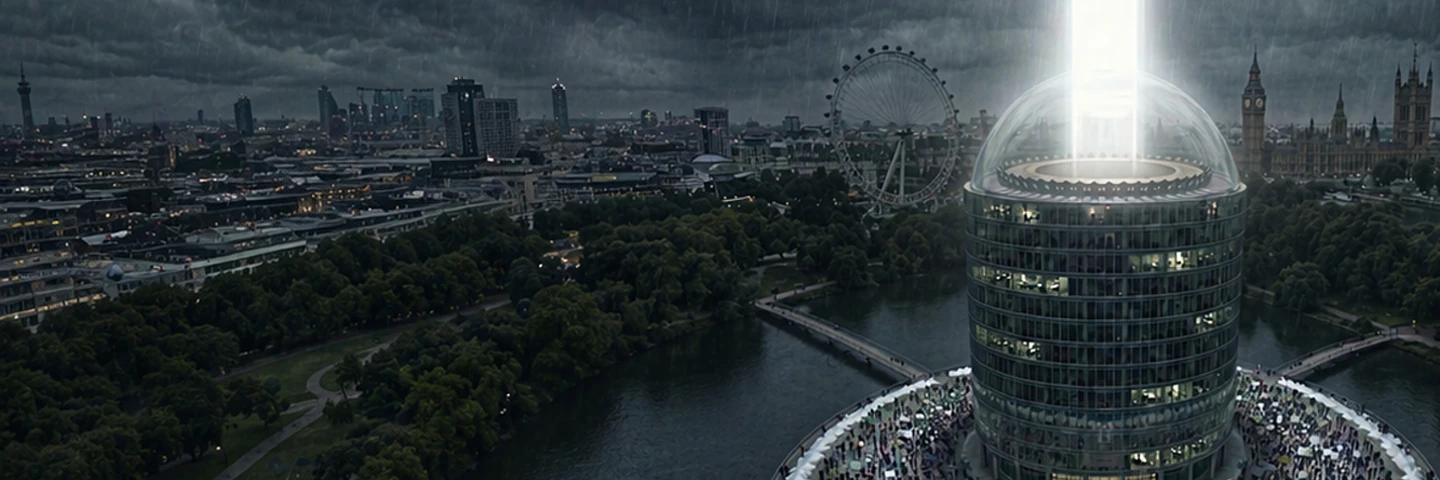
The pressure from the plaza below pressed against the reinforced glass, a low-frequency thrum that settled into the hollow of Francis Herbert’s chest and refused to move. What had been a handful of concerned citizens outside the CGS Building a week earlier had compounded into a dense, vocal mass of fear and anger. The polite shell of her frictionless society had started to crack.
They held cardboard signs, many cut with uneven edges, the ink bleeding into jagged pleas.
MY SON IS GONE. WHO IS NEXT?
CGS, YOU TOLD US WE WERE SAFE!
YOU PROMISED A CURE. WHERE IS IT?
The Communications subcommittee had failed predictably in their attempt to rebrand the sickness as an atypical affliction, a sterile, manageable phrase meant to hold panic in check. The language had already been revised twice, softened and reissued, each iteration buying less time than the last. The word they had tried to excise from public consciousness was now scrawled across a hundred signs beneath her window, the letters thick and uneven.
PANDEMIC.
Earlier that morning, failures had cascaded down her terminal in a now familiar sequence, each one a fresh fracture. Mumbai’s textile sector flashed red, production stalled at forty percent. A logistics chart for the Rhine Valley showed Sup delivery times drifting from minutes into hours. Security dispatches from every major city scrolled past in a relentless column of location tags and incident codes, the alerts blurring together, like the voices rising from the plaza below.
Naomi Feld theorised that an economic system could overcome human weakness if people accepted interdependency. Francis believed in her theories, then built the political framework to enforce them globally. Now the system she had spent half her life arguing into existence was stuttering on her screens.
The recycled air in her office tasted stale, filtered once too often. She rolled her shoulders inside the tailored cut of her tunic, feeling the knot at the base of her neck. The fabric was a deep slate, chosen to project authority without ornament. A uniform meant to disappear, to allow the office, the building, and the system to speak instead.
Her aide-de-camp, Rhys, stood a few paces behind her desk. Late forties, immaculate suit, expression carefully neutral. Only after he cleared his throat a second time did she turn from the window.
“Is it time?”
“Yes, Ma’am. The emergency session is opening shortly. You’re needed in the Council Chamber.”
Emergency sessions were not convened lightly. This one came only after provisional measures, advisory briefs, and silent reallocations had failed to arrest the system drift.
She smoothed the front of her tunic, a gesture of readiness more than vanity, and stepped past him into the private elevator. The polished steel reflected an older woman than the public image allowed, silver threaded through her dark hair, lines earned rather than concealed. She met her own gaze, straightened her shoulders, and released the tension in her jaw. The private fatigue receded. The Councillor remained. She kept her eyes on her own reflection as the doors closed. Panic was a contagion, and she would not be patient zero.
The lift opened onto the Council Chamber, an immense circular hall capped with a hydrophobic glass dome one hundred metres across, forged as a single pane. The cost to produce one was astronomical, let alone for each Council Chamber in the world. She remembered arguing for it line by line, justifying permanence as policy. A system that meant to endure had to look inevitable.
The dome felt thinner today.
The chamber smelled of expensive wool and sour, nervous sweat, a transmitted human reek that resisted even the aggressive hum of the air scrubbers. Two hundred and fifty councillors had already fractured into tense constellations around the massive round table, their overlapping voices forming a discordant undercurrent.
Francis moved through it without haste, reading the room as she always did. The crisis no longer startled some. For them, it had settled into routine, into briefing packs and standing agendas, which frightened her more than the early confusion had. The Brazilian councillor’s stylus rattled against the mahogany in a frantic rhythm. The Nigerian representative sat rigid, jaw braced as if for impact.
As she took her seat, backs straightened around the table. Conversations truncated. The Chairman straightened without looking at her.
Beyond the glass, the crowd’s shouts pressed faintly against the dome, reduced to a distant, insistent beat.
Behzad Khosravi, the Kurdish Chairman, ran a finger around his collar, the fabric darkened with sweat where it clung to his neck. He was a good man and an adept politician, but his strength lay in the delicate pruning of egos, a skill utterly useless against a magma flow. He caught her eye. She gave a single, almost imperceptible nod. He stood immediately and tapped the terminal embedded in the table. A sonorous chime rolled through the chamber, severing the murmurs. The councillors took their seats.
“Councillors, this emergency session is now open,” he said, his voice taut. “We will begin with a report from our esteemed colleague from Quebec, chairman of the Subcommittee for Health. Councillor Chrétien, you have the floor.”
A large, white-haired man rose, shoulders squared, chin thrust forward. He slapped a stack of papers onto the table. Francis smoothed a nonexistent crease at her sleeve. True certainty was rare in a crisis. His felt rehearsed.
“The source of the affliction remains unknown,” Chrétien began, his Québécois-accented voice thick, scraping like dry parchment. “Our global research teams have confirmed only one thing. It is not airborne. Transmission does not occur through proximity to the afflicted.”
“So you’re saying it’s not contagious?” the councillor from Texico cut in.
Cruz, Francis noted, her gaze sliding to the woman’s rigid posture. Reduction was her instinct. Minimise the scope of the problem until it could be ignored.
“Order,” Khosravi said. “There will be time for questions. Councillor, proceed.”
“We are operating on the assumption of an alternate, as yet unidentified, transmission vector,” Chrétien continued, “as both respiratory and blood-borne paths have been ruled out.”
“If it’s not airborne, then it’s a containment issue,” Cruz interrupted again, her drawl edged with impatience. “Isolate the clusters and let them burn out. Why are we halting production for a localized biological failure?”
Khosravi’s chime sounded. “One more interruption, Councillor Cruz, and you will be ejected from this Chamber.”
Chrétien’s hands tightened on the table until his knuckles blanched. “I cannot speak for how you treat people in Texico, Councillor, but the Council cannot be seen ignoring a mass-casualty event. To let them burn violates the third tenet. It would be political suicide.”
A ripple of outrage and brittle laughter passed through the chamber.
“The casualty report is grim,” Chrétien continued, his voice forced back into alignment. “Since this affliction began, the global death toll has exceeded eighty million. At the current rate of acceleration, projections exceed three billion dead within thirty days.”
For a long moment, only the muffled cries of the crowd beyond the dome remained. A sharp intake of breath from the Japanese councillor. The clatter of a stylus dropped by the German. Whispered calculations blooming and colliding.
Fifteen percent of the world’s population, dead in thirty days.
The projection was an abstraction, a bureaucrat’s estimate of probable loss, but it wasn’t just a number. Not to her. She had seen the faces of those destroyed by the Capo regimes, remembered the collateral damage of implementing Economic Interdependency. When she closed her eyes, she could still see Ari’s parents on the Mono launch day, their faces bright in the sun before the sickening smell of ozone and burning plastic filled the air. Each digit of the eighty million was a debt she had incurred, a deficit of souls balanced against the ledger of peace.
The chime sounded again. “Councillor,” Khosravi asked, “is there any progress? Anything to report on a solution?”
“Unfortunately not,” Chrétien said in a brittle rasp, the force gone from his voice. “Until we isolate the vector, we are cataloguing casualties, not preventing them.”
Cruz rose. “Councillor, the Subcommittee’s failure to provide a clear critical path is degrading public confidence. We are three days from a cascading supply failure. If quotas are not met, food availability will drop five percent in the Northern Hemisphere. Is your committee prepared to explain that?”
Francis secured her tongue to the roof of her mouth.
Quotas. The word, so sterile and bureaucratic. She talks about quotas while people are dying in the streets. Her jaw locked. They didn’t need posturing. They needed a solution. Cruz was exactly the kind of politician Naomi Feld had always warned her about.
The memory surfaced, sharp and clean as an Imager trip. Naomi’s office, smelling of old paper and bitter tea, Naomi herself a bird-like figure behind a mountain of books.
“Doctrine—Capo, Neoliberal, Commercial Communist—that’s not what drives politicians, Francis,” Naomi had said, her voice thin but cutting as a laser. “It’s a convenient costume. Power is what they want. Power. Getting it, and keeping it.”
Francis had been a doctoral student then, her head full of frameworks Naomi dismissed as foolish, impractical exercises. Yet those critiques had been the crucible that forged her theories. Theories that became publications. Publications that governments adopted as the blueprint for the CGS. Looking at the Councillor from Texico now, Francis knew that on this point at least, Naomi had been right.
Chrétien drew a breath. “Production will continue. As transmission is not person-to-person, quarantines are not necessary. Health is no less of a prime tenet than production. We will act accordingly.”
Cruz’s jaw tightened. She tapped her terminal, her voice cutting back in, “With respect, Councillor, a healthy population is irrelevant if the supply chain collapses.”
“And both are irrelevant if Capo factions establish new strongholds,” the Russian councillor shouted. “The Volgograd Free-Zone is expanding under cover of this emergency.”
Francis gripped the undersides of her armrests, the hard metal biting into her fingertips. The stress fracture that had always worried Naomi. Economic Interdependency was itself interdependent. One factor raised above the rest and the whole structure turned on its own joints. This was why Francis had created the eighth and final tenet.
One System, Indivisible.
Khosravi looked to her. Waiting. Not asking.
She gave a single, sharp nod.
“If there is nothing further to report,” he said, “I suggest we each do what we can to project calm while we solve this. We may still need to consider quarantines or lockdowns in cases of civil unrest. Put public safety forces on high alert and plan for those contingencies. This meeting is adjourned.”
The chime echoed again.
One by one, the councillors’ holos winked out, retreating to identical offices scattered across the globe. The chamber emptied until only the dome remained, vast and hollow. Francis walked to the glass.
From this height, the crowd resolved into a restless swarm, faces turned upward, expecting coherence.
Francis saw the load path beneath it, the way one failure could drag the whole structure after it.
She turned from the window. Humanity needed the system to endure. She would protect the CGS, even if some of the population had to burn to keep it intact.
A complex holo map of London hovered above Ari’s office desk, the blue grid of Sup logistics logs overlaid with a mortality heat-map. Red clusters bloomed and spread through the geometry, bleeding across clean lines as if the system itself were haemorrhaging. The glow of his quarantined private terminal cast hard colours across his face.
The server stack at his back vibrated with a steady, imperfect hum. One fan was slightly off-axis. He logged the frequency drift automatically and, despite the itch to fix it, kept his attention on the holo. On the far wall, a virtual window showed the plaza above—demonstrators packed shoulder to shoulder. He had throttled the audio down to a low, arrhythmic thump that travelled through the wall like distant machinery.
The real noise was inside his head, the death count and the gnawing uncertainty of a threat that was everywhere and nowhere and could take anyone.
He dragged two datasets together and forced a handshake. The layers refused to align. Transport hubs didn’t light up. Population density meant nothing. The red clusters sat where they liked, scattered like corrupted voxels in a broken simulation. No centre. No edge.
Pathogens were biological code. They still needed a vector. He kept looking for a routing protocol, one clean line back to source.
He reran the query with different parameters. Same incoherent result. It resembled a poorly coded Imager where the physics engine had glitched to allow objects to clip through walls.
He leaned closer, forearm braced against the desk. The surface was warm and it smelled of dust baking on hot metal. He adjusted the terminal’s cooling profile without thinking and went back to the map.
Time passed without registering. He traced a thin, implausible link between cardiac arrests in Shoreditch and low-pressure systems rolling in from the Channel. He followed it until it dissolved into nothing. He started again.
A chime pinged his focus. He didn’t hear it.
“Ari?”
The holo over his workbench started to form, scattered into unrendered blocks for a fraction of a second, then resolved into Francis Herbert.
“Councillor.” His elbow jerked. Wire strippers skidded off the desk and clattered on the floor. He swiped the holo map down from his private terminal too fast. The motion left an afterimage. He stepped aside, angling his body so the desk surface fell out of Francis’s view.
“I was just running a background diagnostic,” he said. “Recalibrating the logistics feed.”
“No, you weren’t.” Her voice carried the grinding friction of a worn bearing, stripped of its usual polished fluidity. “You’re fixating on a problem you don’t have clearance or capacity to solve. Stop staring at the fire when you should be securing the line. I need you back on the network.”
She leaned closer to the pickup. The image enlarged. The compression artefacts around her jaw tightened and vanished.
“Adebayo flagged a critical fault,” she said. “A data conduit in the lower tunnels is causing latency with subcommittee feeds. He’s flustered and escalated it. I need this resolved.”
A faulty conduit was binary, either connected or not—clean enough to splice or due for replacement. A broken wire behaved the same way every time.
He looked past her to the blank wall. His map, minimised but not gone, a dead-end process waiting to spin back up. His gaze dropped.
Francis exhaled, rough and unfiltered. For a moment the Councillor slipped, and the woman who had raised him showed through, her skin drawn thin under her eyes, a small, involuntary twitch at her lower lid.
“Ari, look out your window. The city is oscillating,” she said. “Structural integrity is degrading. People are frightened. The Council is holding supply together, but only just. Every part of the CGS needs to function, including you. Your flat may be quiet, but the answer is not to fill it with global noise.”
She was right. His flat was quiet. The map gave him nothing. The conduit would answer.
“I’ll take care of it,” he said. The words came out steady.
“Thank you.” Her tone reset, but the strain remained. “This isn’t the first system failure you and I have survived together. Stay focused.”
The holo cut out with a static pop. The room fell back into its own soundscape—the server stack’s imperfect hum, the distant thump from above. The silence felt queued and buffered, waiting for instruction.
He straightened and flexed his fingers once, twice. The pressure on his lungs equalised enough for a full breath.
He pulled the alert log up on his work terminal. The conduit fault sat there in plain view, timestamped forty minutes earlier. He’d missed it. Stay focused. He closed the log.
His previous supervisor would have contacted him first, yet Adebayo escalated it straight to Francis—a deliberate bypass of standard protocol. He didn’t know Adebayo well, but he was beginning to see a pattern he didn’t like.
And even with the global network buckling around her, Francis had rung him. She could have sent a ping. Instead she had made time to reset him, and all he had given back was professional formality and a missed alert.
Stay Focused.
Ari crossed the room, lifted the heavy tool case from under the bench The handle bit into his palm. He keyed the door and stepped out.
Stepping out of the staff vestibule onto the CGS plaza felt like jacking into a corrupted Imager. Heat and bodies hit him at once, sweat and breath riding a pressure wave of sound from too many throats shouting at different pitches, out of sync.
He hitched the tool case higher and plunged in. The conventions that kept traffic frictionless had collapsed. People bumped shoulders without apology. Elbows nudged ribs. Faces were stripped of their public polish—tight mouths, wet eyes, jaws set. The crush compressed his chest, breath going shallow. The crowd carried a charge, unscripted and live, adrenaline buzzing along his nerves.
A shoulder clipped him, knocking him into an old man who staggered, caught himself, then looked up. Deep lines mapped his face. His eyes were bright.
“Sorry,” Ari said. The automatic pleasantry sounded absurd in the uproar. “Big crowd.”
The man laughed, hoarse but delighted. “Yeah, would you believe it?” He had to shout. “Bloody hell! Been thirty years since I’ve seen raw emotion like this. It’s bloody bedlam. Isn’t it beautiful?”
The words struck Ari with an odd force. Raw emotion. An anachronism from a bygone era, like the combustion engine or paper money. Ari watched the mass surge and recoil, saw fear burn through compliance. The man’s grin carried the startled pride of someone resurfacing an old hidden photograph.
Ari let the human tide carry him toward the south footbridge. Off the plaza, the noise collapsed into a dull hum, as if someone had thrown a blanket over a speaker. He cut through Story’s Gate into the alley behind Old Queen Street, a canyon of old brick and new conduits, the fascia between the city’s gleaming new skin and its old musculature. Twenty paces in, almost swallowed by the shadows, stood a utility booth, its grey composite surface scuffed and stained.
“Open up, you old cow,” he said.
Biometrics had made the juvenile passphrase he set years ago obsolete, but the habit stuck.
A chime.
Visual identification Ari Feld, Communications Technician for the Council of Global Stability. Permission to enter service tunnels, granted.
“Just open up,” he muttered.
The door slid open with a pneumatic hiss, revealing a dark, cramped lift. He stepped inside. The door slid shut, plunging him into near-total darkness save for the soft glow of four red light strips. His ears pressurised as he descended into the city’s root hardware.
The lift stopped with a soft bump, and the doors opened onto a different century. Damp air clung to his skin, thick with the smell of mildew and dust. He could almost taste the coppery grit of decay.
Ari clipped a silver light disc to his shirt. Its focused white beam illuminated pipes and cables crowded along the sweating walls, haphazardly added and rerouted over decades. It was a sprawling labyrinth of sewage, power, data—laid wherever they’d fit, then built over and forgotten. A mess to anyone else, yet intuitive to him, the way a spider distinguishes vibrations from each thread in its web.
He walked a few dozen metres down the tunnel to a junction box bolted to the wall, the only sounds the drip of water and the crunch of grit under his boots. After opening it with a key from his case, he found the expected dense clusters of fibre-optic lines and connector blocks inside, a miniature city of light and data.
Ari traced the pathways looking for the source of the signal degradation, but encountered a sloppy bit of maintenance instead. A frayed connection on a diagnostic sensor’s power line, with a tiny break in the protective sheath. Amateur. Ari made a sharp, clicking sound with his tongue against the back of his teeth. System hygiene was important. He might as well clean it up while he was here.
He reached in with a pair of insulated pliers to unseat the cable.
Blue-white fire tore out of the box.
The surge hit like a fist through his sternum. More voltage than possible. It flung him back. He slammed down hard, breath punched out, muscles locking and jerking as if his body had a faulty instruction set. Ozone flooded his nostrils. The smell of a system burning itself out.
The beam of his light disc cut a sharp circle on the ceiling. Into the darkness in front of him, an impossible feed bled from the open panel.
Light and static leaked from the junction box, figures forming from jittering points. An Asian man fractured and solidified, his upper body emerging at an angle from the cobblestones, the rest trailing into code crawling along the damp wall. Beside him, only an arm and shoulder of a second figure glitched in and out of existence, gestures leaving decaying afterimages.
A bit-crushed haemorrhage of static shredded the silence, shrill enough to make Ari’s teeth ache. Through bursts of electronic shrieks, a disembodied English voice broke through.
“…the plan is procee… well—”
The first figure answered in Mandarin, his image dissolving into a cloud of voxels before snapping back.
“Yes,” the English voice said. For a heartbeat the distortion cleared enough to be understood. Pitch slid too much to make the voice recognizable.
“The pathogen is effective. Well beyond the expectations of the developers. We should begin to—”
Noise surged. The signal collapsed. Light scattered like startled insects and vanished. The tunnel fell back into itself, leaving only the steady beam of Ari’s disc on the stained concrete.
Ari lay there, heart hammering, skin buzzing with residual current. He pushed up, hands shaking, fingers slow to answer him. The words kept scraping through his head. This was a planned rollout not an outbreak, a developed product.
He scrambled to his feet and slammed the junction box shut. The latch cracked loud in the stillness. He grabbed the tool case with his numb hands and ran. His legs lagged a fraction behind intent. He clipped a wall, stumbled, caught himself on wet brick. The lift doors opened and he fell inside.
The lift surfaced into a reality stripped of its user-friendly interface. The pandemic recompiled as systematic execution.
He fumbled the light disc back into his pocket and took three steps before the world tilted. He braced a shoulder against brick, dry heaving as the aftershocks of the surge racked his nerves. The ringing in his ears cut through the street’s thrum. He forced himself upright and stumbled back toward the CGS Building.
Evening dragged long shadows, but the crowd hadn’t thinned. If anything, they were denser, more desperate. The air, previously electric with anger, now carried the wet-wool smell of labourers waiting for the shift whistle.
He overrode the shock, letting the technician take over. While the transmission’s payload was astonishing, the delivery mode itself was impossible. Signal bleed from a shielded channel made no sense. Emergency projectors didn’t have the keys. A leak should decay into noise, not resolve into structured data. Somebody had forced a handshake and piped the feed straight into the fault.
Which meant the data conduit had been sabotaged to pull someone down there. No, not someone. Him. He was the only one who fixed CGS faults in the tunnels.
Why?
As he crossed Birdcage Walk, a woman folded. Her body convulsed, limbs jerking. People recoiled, a ring opening around her. Pity flashed, then instinct took over.
The pathogen is effective. The phrase had the bloodless polish of a requisition brief. But this woman wasn’t a statistic. She was dying on the pavement because someone out there was measuring outcomes against projections and considered this success.
He inventoried what he had. No capture, no logs, no witness, only his account. Gus would reject it as corrupted input. Besides, he already thought Ari’s recent behaviour suspect. And Francis… she was the system. Francis would follow protocol. Contain the anomaly. Which meant contain him.
Any clean channel could already be dirty. The entire world seemed to be built on a foundation of lies, and he had just stumbled out of the basement.
He pushed through the crowd to a red public holo-booth. He stepped inside, and the door hissed shut, cocooning him in absolute silence. The opaque glass blocked the sensory overload of the street.
He needed an external processor. Someone who would not dismiss the signal because they distrusted the source. An expert who could analyse the most complex, obtuse systems. Despite everything, there was only one person whose mind he trusted implicitly. He took a deep, shuddering breath.
“Ring Sharon Feld.”
ONE MOMENT PLEASE
The white light of the words on the terminal lit his face, his pupils blown wide. The reflection moulted the detached technician. The new skin carried a man with a mission, a desperate echo of Capitán Vargas.