10 — Gathering
by D.M. BarachA truly interdependent economy cannot function if it permits unaffiliated economic actors. A community that exists off-grid, whether as an expression of freedom or dissent, is in fact a structural liability. By drawing resources from the whole without contributing to the managed equilibrium, such groups reintroduce the very principles of scarcity and hoarding that Interdependency was designed to eliminate. They are, by definition, an economic threat.
—Naomi Feld, Interdependency: A New Economic Model
“Here you go, mate. I forgot to give you one last night.”
Santo handed Ari a hard hat with a miner’s torch fastened to it. Each of the assembled Walkers had one—Charles, Benjamin, Timmy, and Santo, along with Dax and a few other Walkers Ari didn’t recognise—some already donning them. They wore an assortment of practical, hard-wearing clothing and heavy boots.
“Thanks. Anything else you forgot that I might need?” Ari asked.
“I guess we’ll find out the hard way if I did,” Santo said with a smile.
The small group clustered in a cramped staging area. At one end of the muck-scented chamber, a metre-wide pipe opened like a severed data conduit. Ari caught Dax’s eye across the room. The man’s gaze was cold and appraising, making it clear Ari was still an outsider, a topside interloper.
Conversation died down, replaced by the clicks of carabiners clipped onto synth-leather climbing harnesses, the zip of cinching straps as they fastened flattened empty packs, and the snap of tool belts buckled to their waists. They checked their seals with the solemnity of soldiers checking parachutes.
Tools varied wildly—one Walker carried a set of antique rubber-handled screwdrivers, while another beside him had a sleek plasma cutter holstered at her hip. The scavenged gear was mismatched but meticulously maintained, chosen for what it could endure.
Ari moved over to Benjamin, who was struggling with a clasp on his pack. With a simple, practised movement, Ari fixed it.
“Here,” Ari said, pulling two boxy objects from his own pack, their plastic casings scuffed but clean. “A birthday present.”
Benjamin took them, his eyes wide. “What are they?”
“Walkie-talkies. Single-channel voice transmitter. Ancient tech, but it works.”
“You mean… it only transmits voice?” Benjamin asked, turning it over as if looking for the missing holo projector.
“Primitive, isn’t it?” Ari said with a small smile. “I found a pair in the workshop stash. Fixed them up for you.”
“Thanks, Ari,” Benjamin said, turning the device over in his hands. “How does it work?”
Ari took them back and switched both units on. A crackle of static filled the air before settling into a low hiss. He handed one to Benjamin.
“Press this button on the side to talk,” he said. “Ari to Benjamin. You there?”
Benjamin’s voice came back instantly, thin and tinny. “Hello, this is Benjamin.”
Ari chuckled. “You have to let go of the button to hear me.”
“Oh.” The boy’s face flushed. He pressed the button again. “Hello?”
Charles walked over, smiling. It softened the calculating edge Ari had seen in the reservoir chamber. “Gentlemen. We are losing time.” He nodded to Ari, then gestured toward the dark, circular opening of the large pipe. “You’re up first, Mr Feld. Into the breach, as it were. We’ll be right behind you.”
Ari hesitated. He glanced at Santo, who gave him an unreadable shrug. Then he looked at Benjamin, who was watching him, his hands gripping his straps until the tendons stood out like wire, his eyes wide and unblinking. The boy had to go down this pipe eventually. Ari could at least go first.
He pasted a grin on his face, though his mouth felt dry as dust. “Right. Off we go, then.” He swung his legs into the pipe, gave Benjamin a final nod, and pushed off into the darkness.
The slide hurled him into a disorienting plunge through pitch-black curves. Up and down vanished, acceleration taking their place. He tore through the dark, every turn slamming him against metal too fast to think.
His hard hat lamp illuminated the circular shape of a solid steel door. Rivets studded its surface. A wheel handle in the centre loomed larger as he hurtled toward it. It looked ancient. There was no patch for this.
“Shit! Shit! Shit!” he yelled and braced for impact.
A violent CLANG and a hiss of pneumatics. The door sprang sideways into the wall in a blur of motion, gone the instant before he would have become a smear against it. He shot through the opening, his heart hammering.
The relief was short-lived. The pipe ahead terminated at a solid wall. He was still moving too fast. He twisted, turning his shoulder to the wall. He jammed his elbows and feet into the pipe, trying to slow himself. No use. The wall was on him.
Until it wasn’t. He shot past the lip of the pipe into nothing. The tunnel simply ended. Weightlessness punched through him, then gravity seized him by the spine and dropped him into a wide vertical shaft. Nothing to grab. Nothing to brace against.
“Bollocks!” he screamed, the sound thin and distant as he plummeted. Some hardened part of his brain calculated—velocity, distance, force of impact. Enough to tell him what his gut already knew. He would not survive the bottom of this.
Can’t fix the fall. What can I fix? Warn Benjamin.
His hand fumbled for the walkie-talkie clipped to his belt. He mashed the button. “Benjamin! Don’t go in the shaft!” he yelled into the device. The receiver only gave back a static squawk.
His insides floated in a sickening, zero-g suspension. Then, a violent wrench shattered his momentum.
The shaft hooked. A brutal curve seized him and hurled him sideways onto a new trajectory, like a particle being yanked in an accelerator by an immense magnetic force. He was no longer falling. The deceleration crushed him flat, stole the air from his lungs, and pinned him to the shaft while his speed bled off.
He was just catching his breath when another light flashed ahead. A strobing light, broken by the blades of a large, fast-moving fan.
The air grew colder, pulled past him towards the fan in a steady, hungry draught. The roar of the blades rattled his teeth, each rotation a slice that promised to shred him. Cold sweat broke across his back.
“Bloody hell!” he yelled, squeezing his eyes shut and tucking his head, a final, futile gesture. The roar became a deafening, all-consuming shriek. He braced for the chopping, the tear of metal through flesh—
Reality flashed into blinding white static. A brief tingle washed over his skin. He was through. No impact.
The tunnel floor on the other side proved brutally solid. He hit it hard and tumbled, limbs flailing, concrete grinding across his shoulder and hip before he came to rest in a tangled heap. He looked back at the fan, still spinning, and understood that it was a holo, a lie made of light and air.
Pain flared through him. Not the clean haptic buzz of the Imager, but bruised bone and scraped skin. He’d died a hundred times in the Imager, speared, shot, killed by snakes. Each time, the simulation ended with a phantom ache and the comfort of his own flat. Dread vibrated in his gut, a resonant frequency that destabilised his core. //HOST TERMINATED. END OF SESSION. was not an abstraction here.
A few seconds later, Timmy shot from the pipe through the holo fan and landed on his feet with a solid thud. The others followed, Benjamin stumbling but staying upright.
“Ari, are you alright?” he asked, rushing to his side, his face pale in Ari’s torchlight. “Your voice came through! It was… just screaming, but the walker-talker worked!”
Ari looked up from the floor and managed a weak groan. A small, pained smile touched his lips. “Walker-talker. Well played.”
Santo loomed over them, an amused grin spreading across his face. “That’s what we call a proper Walker welcome, mate.” Santo laughed. “Gotta knock the topside out of you somehow.”
Charles helped Ari to his feet, his expression serious. As he did, Ari glanced at the faces of the other Walkers. Timmy was impassive as ever, but a few of the others were watching him differently—not the cold appraisal they’d given him in the staging area. He had survived the test, doing so without complaint. He was still an outsider, but he was an outsider who had bled on their floor.
“Santo’s games have a purpose, Mr Feld,” Charles said. “Topside, the ground doesn’t open up beneath you. The system corrects the error before you fall. Down here? There is no system. There is only gravity and luck. We teach our people, especially our children, to question everything. To not trust the floor beneath their feet or the air in front of their face. You do not assume the floor holds, Mr Feld. You verify it. Every step.”
Ari stood, his hip throbbing.
Charles’s gaze swept over the group, lingering on Benjamin. “From this point on, there are no holos. Every rusted ladder, every crumbling ledge is real. You test every handhold. You watch for the signs. What’s the first rule of the old lines?”
“Red is dead,” a few of the veteran Walkers muttered.
“Explain,” Charles commanded.
Santo spoke up, his tone now serious. “It’s the bleed you look for. When the rust seeps into the concrete? That means the corruption is systemic. The core is gone. You put weight on that, you’re falling. Red is dead.”
Dax scoffed from the back. “Or we drive carbine pitons and bypass the rot entirely. Why trust rust when we have alloy?”
“We don’t always have gear. We rely on our senses first,” Charles said. He turned his head slightly, his gaze falling on Ari for a second before returning to Dax. “Slow is careful. Careful is quiet. And quiet is the only reason we are still here. The old rules kept us alive this long. Ignore them, and you won’t last the hour. Now, let’s move out.”
Charles turned and led the way into a low, narrow passage Ari hadn’t noticed before. The dry air of the chamber gave way to a damp chill that clung to his clothes and carried the foul reek of ancient sewage. The floor became slick with a film of grime. Ahead, a rhythmic drip… drip… drip echoed, too loud in the sudden quiet, each drop worrying at the old concrete.
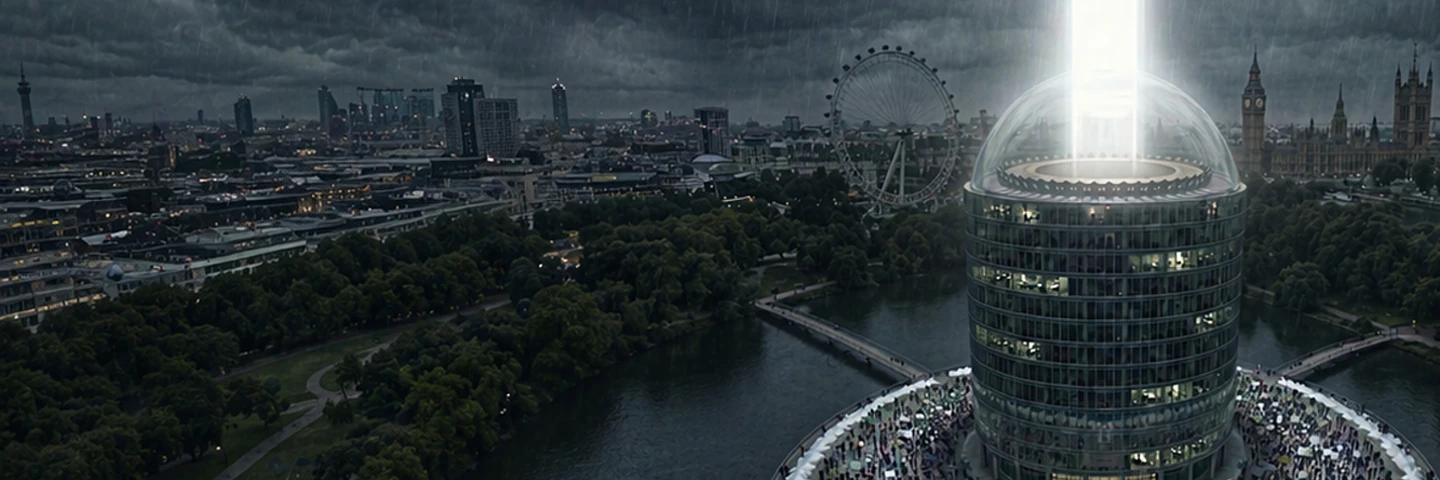
Behind Francis Herbert, the enormous Council table cast long shadows on the Council Chamber floor. Francis stood at the edge of the chamber beside the curved glass wall of the dome and watched her holo in the plaza below lie to the world.
The holo was twenty metres tall, a giant standing in front of the CGS building to address the seething mass of terrified citizens. Her projected face radiated maternal calm. Her amplified voice boomed over their panic in soothing contralto, tuned with just enough precision to steady the crowd.
“I see your fear. I hear your anger. And I share it,” her giant self said as she spoke, the sound coming back to her muffled through the dome.
She held her expression in a calculated state of compassion. “To lose a loved one, to see your neighbour fall, to feel the system you trust begin to tremble… that is a terrifying thing.”
The crowd’s roar subsided slightly, curiosity overriding anger.
“This affliction is an enemy we have never faced. It is silent and it is invisible. It does not follow the known forms of disease. But it is an enemy we will defeat. The full, unified resources of every CGS division are being brought to bear against this single foe. But we cannot do it alone. The greatest strength of our interconnected world has always been you.”
Inside the chamber, the old familiar grinding of compromise was back. Naomi had envisioned a world built on truth. Francis reinforced the structure with engineered non-falsehoods.
“I am not asking you to go home and hide. I am asking you to go home and fight. Monitor your neighbours. Report anomalies through official channels, so your heroic medical teams can respond. Be the system’s sensors. Be the antibodies in the lifeblood of our society.”
“The Founder promised us a world without suffering. Today, we are suffering. But she also gave us the tools to overcome any crisis by working as one. We will not falter. We will not break. We will endure, and we will win. Now, go. Be with your families. Be strong for each other. Go in peace.”
She held her compassionate gaze for a final moment before terminating the broadcast. The crowd began to disperse with a quiet, simmering unease.
Her aide-de-camp, Rhys, waited twenty paces away. “They don’t know where to direct their fear,” he said in his usual measured tone. “Public anxiety is volatile, Councillor. It might be prudent to provide a lightning rod. Shall we use the Walkers?”
Francis met his gaze. “Blaming the Walkers is only a patch. It gives the public a familiar enemy, but it won’t fix the underlying cause. They don’t need a new target. They need results.”
“Of course, Councillor,” Rhys said. “Next. DCI Ardone from New Scotland Yard is here. She insisted on meeting in person.”
Francis considered that. An in-person visit. Sensitive, then. “That will be all, Rhys. Have them send her in.”
He gave a single, deferential nod and moved silently toward her personal elevator.
A few moments later, a door hissed open on the far side of the vast circular chamber. Detective Chief Inspector Ardone emerged, a solitary figure in her dark uniform against the clean white lines of the lift. She began circumnavigating the immense council table. Her footsteps on the polished floor were the only sound in the cavernous space, each pace carrying a squeal of rubber on marble. She walked like a woman who owned every inch of ground she stood on, a deliberate advance into the heart of power.
Neither of them spoke during her long approach, but their eyes were locked. DCI Ardone’s uniform was crisp and immaculate, her fiery hair pulled back with severe precision, her posture erect. She presented herself as a peer arriving for a negotiation, not a subordinate approaching to deliver a briefing.
As the DCI finally came to a stop a few metres from her, Francis spoke, her tone a polite but firm assertion of her authority. “DCI Ardone in the flesh. This must be important to New Scotland Yard.”
Alene met her gaze without flinching. “The fact that you agreed to a face-to-face implies you already know why I wouldn’t trust the secure channels.”
A flicker of genuine respect stirred in Francis. The woman was bright and nonconforming. Useful for exactly that reason. “You’ve bypassed protocol to be here. Don’t waste the opportunity,” Francis said, gesturing to a council chair.
Ardone ignored the chair. She walked past Francis to the edge of the dome, placing herself between the Councillor and the city below.
“When we last spoke,” Alene began with no preamble, “we discussed your communications technician, Ari Feld, and his unauthorised access to the medical database before he vanished. My investigation has produced evidence you need to hear.” She paused, her green eyes firmly focused only on Francis. “Mr Feld uncovered evidence suggesting the pandemic is not a natural mutation. There is a high likelihood the pathogen was manufactured.”
Manufactured.
The word hung in the air—a hairline fracture in a high-pressure conduit. Francis’s hand twitched, an instinct to reach for her terminal, to order a diagnostic, to control a variable. She forced it still, resting it on the cool marble of the council table.
The strategist in her took control. Ari was no longer just a political liability and personal concern. He was a security risk, a loose thread that could be pulled until the entire seam opened.
“Manufactured,” Francis repeated. “DCI Ardone, that’s an extraordinary claim. I was under the impression his interest in the data was a reaction to his personal strains.”
“Personal issues aside, his assertion has been validated,” Alene replied, her eyes narrowing, “by Dr Sharon Feld.”
Sharon. She knew and said nothing. Why?
“Dr Feld,” Francis said, her tone carefully neutral. “What did she discover?”
“Nothing conclusive yet, but she found markers of design in a protein that she thinks could be the pathogen.”
The room contracted around the claim. This information, this single uncontrolled variable, had to be contained.
She pressed her thumb against the edge of the marble table until the nail turned white, grounding herself against the vertigo of the situation. Ardone was an unpredictable risk, but she was also the key. Justice Baron was already using the pandemic to consolidate power. No one could be trusted with this information.
Francis walked to the edge of the dome and looked down at the thinning crowd below. Hospitals were overflowing. Supply chains had fractured. The CGS charter, the years of building a just and transparent system, had been written for peace. The peace was cracking.
It’s the same calculation we’ve always made, Naomi. Necessary compromises to protect the whole. The thought offered no comfort, only the familiar discipline of command.
She turned back to face the Detective Chief Inspector. Her voice, when she spoke, was quiet, stripped of public resonance to reveal the iron beneath.
“DCI Ardone. That information itself is a contagion. Entering it into the record pulls the linchpin from the system.”
Alene met her gaze, unflinching. “My report will be filed on a secure server, Councillor.”
“No,” Francis said, taking a step closer, closing the gulf between them. “There will be no report. No file. The information you possess is now more dangerous than the pathogen itself. If it gets out, public trust goes with it. The Founder’s world will come apart.”
She let the implication settle between them.
“We will have justice, DCI Ardone, but our first priority is containment of the manufactured pathogen hypothesis and the people who know about it. An official investigation generates data—logs, reports, chains of custody. We can’t have that.”
Alene’s jaw tightened. “Are you directing me to operate outside standard procedure, Councillor?”
Francis knew what the addition of her title at the end of that question meant. Ardone knew the implications of ordering this level of secrecy in a transparent society. Francis was at risk of losing her trust.
“I am aware of what I’m asking, Alene.”
Alene stiffened when Francis used her proper name.
She sees what this is. Recruitment, not orders.
“Continue your investigation,” Francis said. “Officially, you remain a DCI in your department, but in this matter the shield of your commission will not cover you. It is a risk I would ask of no one else. I need you as a clandestine extension of my office, working in the gaps between the rules. You’ll need to be more than law enforcement to protect the current order.”
She was giving Alene freedom to act as she saw fit, but with a collar of secrecy on it. It was risky, but she knew Alene wouldn’t be able to resist the lure of this case.
“There is one more variable,” Alene said, her voice cutting through the quiet finality of the offer. “Dr Feld. She knows. What is her status in this… arrangement?”
Francis registered the move instantly. The question drew a boundary line around Sharon. Alene was protecting her. From whom? The woman’s own ex-mother-in-law? A flicker of admiration stirred. She had chosen the right instrument.
“Dr Feld’s expertise is invaluable,” Francis replied, her tone conceding nothing. “She will continue her work, and you will be her sole point of contact. Ensure she has whatever she needs. Her safety, and her discretion, are now your responsibility.”
“Understood,” Alene said.
“Any data you acquire comes directly to me. No logs. No copies… And Alene,” she added, her gaze sharpening, “secure Ari. He is the origin point of this informational contagion. If he broadcasts, the system crashes.”
Francis turned her back on the detective and walked to the central table, placing her hands flat on its cool marble surface, grounding herself in the heart of the system she was trying to protect. In the polished stone her reflection looked like a monument, hard and impassive.
“I want him found.”
The words entered the sterile chamber without plea or maternal warmth—an imperative for a secretive mission.
For two hours, the Gathering party delved deeper into the city’s forgotten substructure, the mineral residue of weeping concrete, sour mildew, and waste making Ari gag on occasion. Charles’s warning about zero-trust in their surroundings had proven itself with several minor mishaps, but no injuries. Fear churned Ari’s gut, steady as a live current, but his pulse had settled into the rhythm of the job. His muscles burned from real effort. Grime packed under his nails. He checked his harness and the buckle clicked home.
They found themselves in a long rectangular room with rows and rows of tall racks secured to the cracked concrete floor. Where the others saw a collapsed trap of scrap, Ari stopped short. It was a pre-Sup data hub, half buried in dust and fallen plaster, the air around it dry with the smell of old insulation and dead circuitry. Hardware from before all computing had been folded into centrally managed infrastructure.
“Careful,” Ari said, dropping to a crouch beside the first rack. “These capacitors can still hold charge.”
Dax shone his torch over his shoulder. “What use to us are all these dead boxes?”
“Not dead boxes.” Ari eased one panel loose and exposed a forest of boards, heat-sinks, and old bus lines furred with dust. “These used to be important resources. Local compute with edge storage. Maybe more than that if we get lucky.”
Benjamin knelt beside him at once. “More than what?”
Ari glanced at the old chassis labels, most of them worn blank. One still carried a faded warning glyph from before CGS standard iconography.
“Before the CGS, some organisations kept their own data processing nearby for logistics or forecasting.” He tapped the side of the cabinet with one knuckle. “Sometimes it was artificial cognition.”
Benjamin frowned. “Artificial cognition?”
“Computers trained to do more than calculate. To infer and judge and even replace the person meant to do the thinking.” Ari worked the latch of a rack free and gave the heavy door to Timmy, who took it without a word. “Capo governments and corporations loved that sort of system. They would call what the artificial cognition did optimisation and pretend nobody was responsible for the consequences.”
Santo wiped dust off a cabinet two racks down. “And the CGS doesn’t?”
“Not like that,” Ari said. “After consolidation they kept some models for things like production balancing, route prediction, even weather forecasting. Mostly, they kept the models that made sure bots can do what they’re told. After the Capo collapse, the other kinds got dismantled, or buried. The CGS decided that thinking had to stay exclusively human.” He looked round at the gutted room. “Which is why this is strange. Most of these places were stripped bare.”
Dax gave a low snort. “So topside smashed the clever machines, then kept the ones that portion your dinners and clean up after you.”
“Pretty much sums it up,” Ari said.
Benjamin touched one of the old boards as if it might answer back. “Did the artificials hurt people?”
“Not physically, but they did cause harm. Mostly lost jobs and psychological damage.” Ari found the capacitor bank and began discharging it with a scavenged resistor and insulated clamp. “But that wasn’t the main problem.”
“What was?” Benjamin asked.
“Powerful people blamed artificial cognition for decisions they wanted anyway. It abstracted cruelty and greed.”
That quieted even Dax. Ari kept working, talking as he moved, directing Benjamin where to grip and when to wait, showing him which copper bundles were still worth taking and which ceramic packages hid rare earths in their cores. Timmy braced a rack while another Walker cut through a corroded mount. Santo handed over a pry bar before Ari asked for it. By the third rack Benjamin was already passing him the next tool before Ari reached for it.
The first real test came later at a collapsed junction, where a tangle of rusted rebar and shattered concrete blocked their path. A section of car park, its supports showing the unmistakable signs of red, sagged precariously overhead, bleeding rust-coloured drops into a puddle below.
“A single plasma charge would clear that in seconds,” Dax grumbled, gesturing with his cutter.
“And bring the rest of the ceiling down on our heads,” Charles countered. “We go around. Slow is careful.”
Their pace quickened, packs heavy with salvage, heads down, eyes fixed on the boot heels in front of them. They navigated a dry sewage tributary, the silence broken only by the crunch of grit and rat bones under their boots. Their torch beams cut white circles through the gloom. Benjamin, his fingers drumming a rhythm on his strap, ranged a few paces ahead of the group, his hard hat light skittering over the filth-encrusted walls. Ari’s walkie-talkie crackled. “Benjamin to Ari,” the boy whispered with mock seriousness. “Passage is clear ahead. No hostiles detected. Over.”
Ari smiled and keyed his own unit. “Signal clear. Maintain interval. Out.” He was clipping the device back to his belt when Benjamin stepped onto what looked like a solid walkway, an old pneumatic access plate with its circular seam hidden under grime.
Seals hissed. Metal shrieked, tearing from the concrete. The plate collapsed. Benjamin cried out, a short yelp of surprise and fear that the darkness choked off. Then, a sickening thump echoed up from the shaft, followed by a silence—absolute as a severed connection.
Closest to the boy, Ari scrambled to the hole first, the smell of rust and disturbed decay punching into him. For a second he could only stare. There was no circuit to trace, no code to debug. It was a problem of flesh and gravity, a system he had no tools to interface with. His hands clung to the opening.
“Benjamin!” he yelled into the darkness.
There was no reply.
Charles lunged for the hole, nearly falling in himself before Timmy grabbed the back of his pack, hauling him back. Charles clawed at the edge of the concrete. “Benjamin!” he roared, a desperate plea. “Answer me!”
Around him, the others had gone still, their torch beams wavering over the hole. Ari couldn’t see Benjamin at the bottom. He must have rolled.
“No sound,” Ari said, peering into the shaft. He tried to climb in, but it was too narrow for his shoulders. “No access. I have a rope.”
“A rope won’t help if he’s not responding,” Santo said, pacing the narrow walkway.
“We’ve got to get him out of there,” Charles said, wiping a hand over his mouth, smearing grit. “Santo, where does this lead?”
Santo was already consulting a schematic on his wrist unit. His face had gone pale, but his fingers moved with quick precision. “Sewage,” he said. “This one has a twenty-eight-minute cycle.”
“What does that mean?” Ari asked, though he already had a sickening feeling he knew the answer.
“Automated purge. The city flushing its grey water. Biologicals. Anything in its path is waste waiting to be cleared.”
“Abort the sequence,” Ari said, sounding shrill. “Where’s the terminal?”
Santo put one hand on Ari’s shoulder and grasped Ari’s cheeks with the other. “Oi. Look at me. We can’t stop it from here. Don’t spiral. Work the problem. Think.”
Ari forced a breath through his nose and swallowed against the bile in his throat. He fixed on the grime-streaked schematic on Santo’s wrist, narrowing the world to the green lines. “Is there another way in to that tunnel?”
“Main pipe,” Timmy rumbled. “Access is lower.”
“How much time do we have left?” Charles asked, his eyes wide.
“We don’t know when the last cycle was for this pipe,” Santo replied.
“Come on,” Timmy said, already moving. “There’s another entrance down here.”
They climbed down a ladder into a much larger tunnel. Ankle-deep slurry sucked at their boots with every step. The stench of waste was overwhelming. They called out to Benjamin, their voices and ragged breaths echoing round the vast circular space while torch beams probed the smaller feeder pipes.
“He’s gotta be in one of these,” Santo said, slamming his hand against the pipe wall.
“We’d better find him soon,” one of the other Walkers said. “We don’t know how much time we have left.”
“He is here,” Charles insisted, spitting the words as if they tasted of bile. “Keep looking!”
Ari, wading fast through the foul water, slipped and threw out a hand to steady himself against the curved wall. The walkie-talkie in his pocket scraped the concrete and spat a burst of static. Under the hiss came a barely perceptible rhythm. Click… click-click….
He pulled the walkie-talkie from his pocket and held it up. “Charles,” he called out, “maybe we can find him with this.”
“Toys,” Timmy grumbled, but a flicker sparked in the big man’s eyes.
Ari pressed the button. “Benjamin, this is Ari. Can you hear me?” He paused, listening to the hiss of static. “Benjamin. Acknowledge… Send a ping. Give me a location.”
“Keep trying,” Santo commanded. “Everyone, spread out.”
“Benjamin, please,” Ari said, “answer me if you can.”
“Signal! Over here!” one of the other Walkers shouted from further down the pipe.
The group rushed over, their splashing footsteps echoing in the tunnel. The Walker was pointing to an iron grill that closed off a smaller pipe leading into the main conduit. Timmy grabbed the bars and tried to rip the grill open with his bare hands, his muscles straining, the veins in his neck bulging. It wouldn’t release.
Dax pulled a compact cutter from his belt and, with a flick of his wrist, a needle of white-hot plasma hissed into life. He started on the rusted hinges, filling the air with scorched metal and ozone.
Metal screeched from somewhere deep within the tunnels, a sound of ancient valves groaning open.
Santo’s head snapped up. “The flush cycle.”
Dax’s cutter slipped, gouging a jagged scar in the metal near the hinge. “See! This is what the old ways get you! A bloody death trap on a timer!”
“Shut up, Dax,” Charles shot back, not taking his eyes off the grill. “Now pull!”
Rats that had been scuttering along the ledges squealed and scurried away in a panicked wave.
“Vibration’s getting stronger,” Timmy said in an urgent growl.
“It’s cresting! Move!” one of the other Walkers shouted.
“You all clear the tunnel,” Charles said, his eyes fixed on the glowing metal of the hinge. “I am not leaving him.”
“I’m staying,” Timmy said.
“So am I,” Santo said, his face grim.
“Me too,” Ari added, without a second’s hesitation.
Santo’s eyes met Ari’s. He gave him a quick nod. “You’re one of us now, mate.”
“Go!” Charles ordered the others and took the plasma cutter from Dax.
The others ran off, their splashing footsteps fading into the distance.
Ari’s vision narrowed to the grill, the hinges, the angle of pull. He set his feet and hauled.
“Stop cutting,” Ari snapped, and the command in his voice surprised him. “Just pull.”
Timmy, Santo, and Ari pulled on the grill. With the high-pitched scream of shearing metal, it snapped free, just as the approaching flood began to shake the concrete beneath their feet.
A large glob of slime fell out of the opening, and Charles shone his light into the dark, narrow shaft. Benjamin was lying against the far wall, his face pale, a dark scrape on his forehead. He was unconscious.
The rumbling grew to a deafening roar, thousands of litres of water moving at high speed, generating pressure they could feel in their chests. Charles reached in and pulled his son out. Timmy threw the boy over his shoulders, and they ran.
They scrambled up an iron ladder that led to a hatch in the ceiling, Timmy with Benjamin first. The roar of the approaching deluge was closer now. As Ari’s hands grabbed the rungs, his hard hat torch beam caught bleeding rust around the bolts. Red is dead. Every rung he climbed was a gamble, the entire structure threatening to shear off the wall and plunge them all into the oncoming flood.
Ari made it through the hatch and turned around to help. Charles was right behind him, and Ari helped pull him through just as the wall of water slammed into the base of the ladder with the force of a hydraulic hammer. Santo was almost at the hatch, but the water surged up, a churning, liquid grip that seized him, trying to pull him back down.
Ari, lying on the floor of the tunnel above, grabbed Santo’s outstretched hand.
“Hold on!” Santo yelled, lips pulled back from his teeth in a rictus of strain. “Pull!”
“I have you!” Ari yelled back, his muscles straining, his fingers locked around Santo’s wrist. The pull wrenched his arm, violently torquing his shoulder socket with dislocating force. Santo felt like an anchor tied to a tidal wave. Their connection held for several heartbeats against the load, shrieking through Ari’s shoulder and hand.
The current snapped the link with the violent finality of a blown fuse. He was gone, ripped away into the roaring dark. But not before their eyes met. The terror on Santo’s face vanished. A hard calculation flickered underneath it, not calm exactly, but a quick read of the moment. Then the water took him and the roar swallowed whatever he tried to say.
Ari lay there with his arm flung out into empty air, staring into the blackness where his friend had been. The roar began to fall away, leaving only the gurgle of receding water like white-noise static from a dead feed.
The shape of Santo’s grip still burned in his hand. His fingers locked round nothing. The firewall he had built around his heart collapsed under a buffer overflow attack. Breath would not come. His chest kept trying to seize shut on him. His stomach lurched. Cold spread from his hands up through his forearms, then broke into a violent shaking he could not stop.
“Santo!” he screamed, the word flaying his throat.
Ari’s cry echoed and died.
He pushed himself upright beside the opening. The world around him came back in pieces. Timmy kneeling beside him, staring into the dark water, a muscle jumping in his jaw. Dax and the other Walkers further back, sobered into silence.
Charles cradled his unconscious son against his chest, tight enough to hurt. The lines around his mouth deepened like stress fractures in over-torqued metal. The damp suit clung to his frame, diminishing him. The leader was gone, leaving only a father who got his boy back and lost a friend in the same motion.
Then Charles straightened and handed Benjamin to Timmy.
“Get him up,” he said, nodding at Ari. “We’re exposed here. We have to move.”