14 — Degraded
by D.M. BarachA system does not become fragile when it can no longer act, it becomes fragile when it can justify anything. The moment emotion permits exceptions and derogations, utility ceases to discipline power and begins instead to excuse it. What follows may still call itself order, but it is no longer harmony. It is merely controlled deterioration.
—Naomi Feld, Systemic Integrity and the Harmonious State
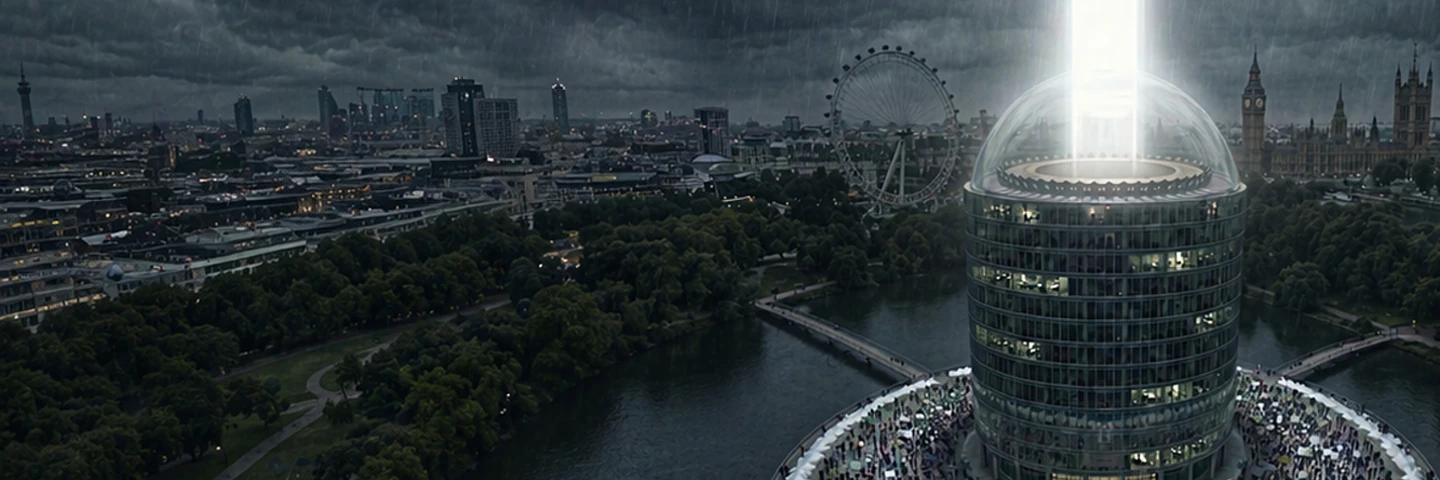
Francis sat with her fingers interlaced in front of her on the council table. Councillor Ekwueme from Biafran-Igbo was speaking, his delivery measured, his concern too evenly distributed to be brave. Three seats away, the Patagonian delegate sat with her chin lowered. The councillor from Scandia tapped two fingers twice, stopped, then folded his hands. Beyond the reinforced shell of the CGS Building, pressure from the protestors in the plaza travelled upward in intermittent pulses.
Among the holos of councillors and support staff, only two figures breathed the air circulating in the Council Chamber—Councillor Francis Herbert behind the Britannia sigil at the Council table, and Justice William Baron in an area reserved for senior CGS administrators, his dark suit absorbing the chamber’s cold light.
Across the table, Khosravi inclined his head to the holo from Abyssinia, his expression attentive, shoulders a fraction too high. Francis knew that look. He had been chairing for hours. The skin at his collar had begun to shine.
The doors behind her seat opened with a soft hydraulic breath.
Rhys emerged from the private lift and crossed the short distance to her shoulder. Not hurriedly. That would have drawn attention. He bent only enough to keep his voice below the pickup field.
“Ma’am. A moment.”
His face was composed, though only just. Francis stood at once.
Attention shifted without becoming visible. They had each experienced interruptions at Council before. Khosravi was already inviting the next speaker from the Platine Basin. Debate continued while she stepped back from the table and into the lift. Rhys followed.
The doors closed, and the chamber’s voices flattened into a muffled wash. The lift remained stationary, a steel capsule docked behind her seat. The polished steel doors reflected a pallid version of herself.
“What is it?” she asked.
“There’s been an attack. It’s Ari.”
Francis watched the woman in the steel remain still. “Status?”
Rhys swallowed. “Injured. Gravely.”
The lift seemed to narrow. Somewhere in the closed mechanism above them, a relay clicked. For one treacherous second she saw not Ari but his parents on launch day, faces turned towards a future she had pushed into inevitability.
She forced her tongue against the roof of her mouth until the pressure in her chest eased.
“Where?”
“King’s College, Guy’s Campus. DCI Ardone was with him. Number 10 security is still sorting signal contamination from feeds.”
The lift hummed around them, stationary, confining, almost airless.
“Don’t go back out there,” Rhys said. “You have grounds to be marked absent for the resolution, then no one can attach the expansion to you. Whatever happens with the amendment, it happens without your public assent to the main measure. You preserve distance.”
Francis studied him. He was doing his job. But he should have known better. Utility Supersedes Sentiment. She would not permit herself an exemption.
“I have a foster son who may be dying,” she said. “That is not grounds for absence.”
His mouth tightened. “No,” he said. “It is not.”
She turned back to the reflection. Her shoulders were slightly forward. She corrected them. Relaxed the hinge in her jaw. Reassembled the line of the tunic with a thumb against the seam.
“If I do not return and vote in favour of the resolution,” she said, “the amendment will lose all legitimacy. The Council will read it exactly as Baron wants it read. A bad-faith restraint attached to a bargain I never intended to honour.”
The battle over the Walker Affairs expansion resolution had ended the moment she agreed to Baron’s terms at the National Gallery. Khosravi’s amendment had to hold. A hard sunset. If the Council insisted on granting Baron the machinery, it could at least put a term on its own lapse in judgement.
“You don’t owe him purity of process,” Rhys said.
“I don’t owe him anything.” She met his eyes. “I owe the Council coherence.”
Rhys said nothing.
“If I vanish now, he gets both the powers and the story.”
“That may happen anyway.”
“Yes,” Francis said. “But not because I gave it to him.”
She placed her fingertips against the cold steel.
“Open it.”
Rhys hesitated.
“Rhys.”
He touched the control. The doors parted.
Debate spilled back in at full scale. Khosravi’s moderated baritone, a sharp response from somewhere in the Indo-Gangetic section, the thin electric murmur of holo feeds syncing and resyncing across the globe, one voice arriving a fraction late with the smear of transcontinental lag.
Francis stepped back into the chamber. Baron was standing, one hand resting lightly on the back of his chair, thumb moving against the polished wood. His body angled towards the holo speaker. He did not look at her.
She resumed her seat without haste. Across the table, a councillor from the Danubian-Balkan section spoke about emergency continuity in the calm, administrative tone that made the exceptional sound mundane. The arguments had ceased to be about governance and had become about how much of the prevailing fear should be legislated.
Chrétien, the councillor from Quebec, who earlier had objected to any open-ended grant, now sat with his hands folded too neatly, as if he had already decided to survive his own inconsistency. The Abyssinia councillor had straightened into moral seriousness, which meant her supposed caution had calcified into virtue signalling. While Francis had been in the lift, some of them had crossed from anxiety into arrangement—eyes lowered, hands touched terminals, mouths settled into lines meant to pass for burdened restraint.
Khosravi’s chime sounded.
“The Council will now proceed to the vote on Resolution Forty-Two.”
Terminal lights brightened before each seat. Across the table, hands moved through confirmation gestures. Voting icons pulsed against dark glass. Francis placed her hand over the sensor in front of her. Despite the obscenity of it, she voted in favour.
Light rippled seat by seat as the tally locked. Khosravi consulted the central feed.
“Resolution Forty-Two carries.”
No one moved beyond protocol. One too-swift nod from the Maghreb-Sahara section. A terminal darkening, then relighting as some councillor’s connection recalibrated. Baron’s expression remained unreadable. He had always understood that open satisfaction cheapened force.
Khosravi rose. For one short second she saw the younger man he had once been—ambitious, courteous, still under the illusion that systems could usually be corrected by properly named principles. Today he was a jaded chairman using procedure to contain too many conflicting interests, some of them already too influential.
“Councillors,” he said, “we will hear Amendment Forty-Two-A, establishing a limited duration provision, with specified renewal criteria, for the emergency authorities now passed in Resolution Forty-Two.”
His voice had steadied. One hand flattened briefly against the edge of the desk before withdrawing.
“What has been granted tonight may be necessary. Necessity is not, by itself, a durable principle of governance. Emergency instruments exist to bridge crisis, not to redefine the conditions under which ordinary authority must forever operate.”
Patagonia still would not look up. Biafran-Igbo’s mouth compressed as though Khosravi were asking him for something he had once promised and no longer meant to deliver. Around the table, shoulders settled back against chairs, hands went still, evasion acquiring posture.
“A hard sunset date is not a gesture of mistrust towards Walker Affairs,” Khosravi continued. “It is a gesture of trust towards the integrity of the CGS framework. Emergencies don’t last forever, and neither should deferred oversight. If these emergency powers are warranted, as our vote on Resolution Forty-Two has determined, then their expiration is also warranted.”
The inadequacy of his civic language was like grit under her skin. He was still speaking as if the Council wanted constitutional hygiene.
Condori requested the floor.
His holo rose over the Antisuyu marker in a disciplined bloom of light, broad-shouldered and grave, the projection line along one sleeve flickering once before the transmission sharpened his features into something almost carved. He was one of the co-sponsors on the Sup logistics amendment. He should have been peripheral to this question.
“Chairman,” he said, “with respect, the amendment is mistakenly conflating two parallel threats our peoples are enduring. The Walker threat does not derive from the pandemic emergency. It’s not a newly emergent interruption with a known endpoint, quite the opposite. We have been living with its ambient instability for a generation. If anything, the pandemic has only demonstrated further the enduring threat the Walkers pose, one we have become complacent about due to its perceived immutability.”
A stir moved through the holo ring, too slight to be called reaction, too coordinated to be nothing.
“You do not date the end of a fire whose fuel source remains active,” he said. “You do not reassure populations by announcing in advance that the instruments of security will be withdrawn while instability continues. To affix an expiry mechanism that is tied to the severity of the pandemic only serves to reinforce the status quo.”
Condori sat.
Francis focused on slowing her breathing. Baron’s faction was introducing a new moral lexicon. Responsible limits recast as entrenchment. Prudence as euphemism for fear. No one wanted to think of themself as a coward or a traitor. Severity was easier to wear. Reframing absolved councillors from acknowledging how their vote would destabilise the balance that she fought so hard to protect.
Khosravi’s chime sounded once more.
“We will now vote on Amendment Forty-Two-A.”
Francis did not need the tally to know the amendment would fail. Red, green, and blue numerals locked one by one in the centre of the dome with only the insect hum of the projectors.
For the amendment, one hundred and twenty-two.
Against, one hundred and twenty-eight.
Abstentions, thirty-four.
It was a six-vote loss, narrow but damning. Francis focused more on the abstentions. Thirty-four of them.
Votes for Baron would have at least possessed courage, but thirty-four councillors were unwilling to commit publicly against what they privately opposed. Cowardice translated into parliamentary form. It was weak and contemptible.
Khosravi announced the amendment’s failure in a voice almost entirely under control.
She had underestimated Baron, yes. But that was no longer the deepest problem. The Council’s commitment to Interdependency had proved shallower than she had believed. They had prioritised the third tenet The Wellbeing of All over the eighth. For them, the eighth tenet One System, Indivisible held only until it was no longer expedient.
The pandemic had eroded the fortitude of governance, and these exhausted people voted to surrender under the pretence of strength.
Before the silence could re-establish order in the chamber, Condori rose again.
“Chairman,” he said, “in light of the council’s determination on Forty-Two-A, my co-sponsor from Pantanal and I hereby withdraw Amendment Forty-Two-B regarding Sup logistics emergency reallocation from consideration.”
Withdraw.
For one beat the word sat inert. Then she understood. The logistics amendment had been leverage, not conviction or urgency. A pressure instrument held in reserve while everyone pretended each question stood on its own procedural feet. If the sunset lived, the logistics fight remained available. If the sunset died, they would remove the second destabilising contest. A bargain had been struck, and she had not been at the table. The Council had voted against her and negotiated around her.
Khosravi accepted the withdrawal and adjourned the session. Around the ring, several councillors who ought to have looked chastened instead looked relieved. The Pars councillor touched her terminal, preparing to vanish. Another feed from the Indo-Gangetic sector thinned slightly at the shoulders as the disconnect sequence began.
Then Baron moved towards her.
The dissolving holos steadied. Others that had begun dimming remained. They did not linger crudely. They found reasons. A terminal adjustment. A request for transcript confirmation. One last query.
Baron crossed the floor with measured ease, his shoes slapped against the stone with a resonance that no projection could imitate. He was not a councillor and did not need to be. Walker Affairs had always given him something more useful than representation. Global reach without the burden of assembly. Force expressed as administration. Here, under the dome, the difference was visible. He approached not as one victor among peers but as an apparatus the peers had just ratified.
Francis stood before he reached her.
“Justice Baron. Congratulations.”
Up close he still gave off that iron impression she had always associated with him, as if his authority carried a mineral trace.
“Councillor Herbert.” His voice was warm, almost cordial. “That is gracious.”
“You secured what you came for,” Francis said.
“The Council voted for what was necessary.” His gaze moved once around the ring, acknowledging audience without seeming to seek it. “Though I hope, in time, you may see it for what it truly is.”
“And what is that?”
He stepped closer, close enough that the words would not carry.
“A correction,” he said softly. “To repair an old error in judgement. Yours, and Adam Feld’s.”
He straightened, as if he had said nothing of consequence.
Francis held his gaze. “How public-spirited of you,” she said.
The slightest flicker touched his mouth. “I have always tried to be of service. To the public.”
He inclined his head, then turned and walked away.
Francis remained standing while he crossed back through the chamber. Around the table, councillors began dissolving, retreating to their continents and compounds and private vocabularies of justification. Khosravi was speaking to the secretariat.
Francis lowered herself into her seat and let one hand rest on the cool wood, the faint vibration of the crowd outside thrumming through the table.
The glass dome arched overhead, immaculate and indifferent. The Council Chamber looked unchanged. Baron now possessed formal authority to match the reach he had long exercised without official acknowledgement. More dangerous than that, the Council had accepted the transfer with docility, allowing fear to alter doctrine.
Ari was gravely injured. Baron had won. The Council had shown her how little pressure its convictions could bear.
She had made a mistake thirty years ago, but not the one Baron believed. The mistake was not structuring Walker Affairs with more interdependency to constrain the ambitions of a man like Baron.
Rhys was already looking for fractures in Walker Affairs and Baron’s accounts. She would accelerate that investigation. Somewhere in the architecture, concealed by urgency and sanctioned language, there would be a place where force had exceeded mandate.
And when she found it, Baron would experience the system self-correcting.
Guy’s hospital had processed Ari with the detached efficiency of a component swap. A surgical bot had patched his gunshot wound by gluing torn pathways with bio-synth tissue. Then it had sealed the entry and exit points, and the gash on his head, with synth-skin that felt numb with a needling itch. A med-tech had dosed the Walker-related bruising in his hip and shoulder, and pushed him back onto his feet before his body had been fully aware that it was in operating order again.
A low-grade fever persisted, a system-wide interrupt his body couldn’t clear. The med-tech, all brisk efficiency and no eye contact, had called it “an expected response to trauma, boss” before discharging him.
Alene was waiting in the trauma unit reception area. She looked as battered as he felt. A dark, ugly bruise flowered on her throat, a sickening imprint of Jack’s grip. Her arm was in a light immobiliser, and he saw her subtly favour her ribs as she turned towards him. He even thought he saw a slight tremor in her neck as she adjusted her sling, quickly masked.
“Strange, isn’t it?” He grinned. “Plague and brutality… feels like we’re back in the bloody Middle Ages. Except the bots can patch up the brutality, no problem. The plague, though…” He shook his head. “Seems some things never change.”
“You’re feeling better,” she quipped with a hint of a smile.
Ari shrugged.
“How are you?” Ari asked. The words felt inadequate, like a diagnostic query.
“Fractured ribs. Bruised larynx.” She touched the patch on her throat, a fleeting, unconscious gesture. “They said I was lucky. You?”
“No major organs damaged.” He echoed the sterile report. “They said I was lucky, too.”
It didn’t feel like they had been lucky.
“Sharon?” he asked, anxiety suddenly spiking. “This happened right next to her lab. They know where she is.”
“I rang her,” Alene said. “She’s fine. Shaken. I’ve sent a constable to her flat. He’ll stay close.”
Ari nodded, a single node of worry deactivating.
“The men that attacked us?”
“The one who choked me, the one you called Jack, he vanished before the first patrol car arrived.” Her jaw tightened. “The two I dropped are in custody, but they’re still sedated. We’ll lean on them when they wake up. See who they answer to.”
They walked in silence down the white corridor, their footsteps echoing. Ari’s hip throbbed with each step, the pain throwing off his gait, and he saw Alene wince as she adjusted her sling. They rode the lift down in silence. The automated doors opened onto the cool night air, and the chill hit his feverish skin like a processor spike.
Alene matched his uneven pace without seeming to mean to. She kept herself between him and the street.
They retraced their steps across Memorial Garden, the sleek lampposts casting pools of cool light. The place looked exactly as it had before. The paving stones were just stones. Serene, ordered, the grass perfectly manicured. No blood, no discarded weapons.
Ari stopped near the large planter, the foliage rustling in the breeze. He caught the chemical scent of the cleaning drone beneath the damp grass smell. The wet, tearing sound of the knife, the sudden thump of the body hitting the planter wall, and the surprised look in the man’s eyes as his system crashed were still in his memory cache. A wave of nausea rolled through him.
“What happened to that guy?” He had to force the words out, the question tasting like bile. “The one I… fought here.”
Alene stopped beside him under the lamplight. Her green eyes stayed on him. “The one you stabbed,” she said. Not a question.
Ari looked at the dark leaves, focusing on the precise pattern of their veins. He couldn’t look at her. “I just… I need to know the outcome. Catalogue the results.”
“He didn’t make it to the operating theatre,” Alene said.
Ari nodded. Though he wasn’t sure why, he’d known. He’d felt the knife go in, the initial resistance and then the absence of it. Here, with the planter in front of him and the paving stones scrubbed clean, the abstract knowledge became visceral.
He remembered a fleeting moment from an Imager simulation. A clean kill, a points bonus, the immediate jump cut to the next objective. Reality didn’t offer jump cuts, it just left the process running.
“I killed him,” he whispered. The words were hollow, insufficient. He looked down at his own hands, clean now, but he could still feel the phantom, sticky wetness of the knife hilt, see the man’s shocked face staring up from the planter. “I’ve never killed before.”
The Imager simulations, with hundreds of deaths he’d experienced and dealt to others, were just packets of light and haptics. Purged on exit. This stuck, a permanent entry in his log written in blood on this paving, a line of code that wouldn’t compile. Non-recoverable error.
“Hey.” Alene’s voice, hoarse and gentle, cut through the static. She stepped into his space. “It was him or you. You know that. You did what you had to do.”
“I know.” He flinched away from her, turning his body slightly, focusing intently on the pattern of cracks between the stone pavers. “It was a logical choice.” His voice came out brittle. “I’m not upset about it. It’s good it was him, not me.”
The words tasted like ash. He was forcing the logic of the seventh tenet, Utility Supersedes Sentiment, into a world in which he increasingly found himself to be a manifestation of the reverse. The tremor started in his left hand again. Shock. He quickly clenched it into a fist at his side.
Alene just looked at him for a long, quiet moment. He knew she saw the lie, the tremor, and his gaze snagging on the empty planter. She didn’t challenge his brittle words. She didn’t call him on the falsehood. She just took his hand. Her fingers were warm, her firm grip grounding him.
He was too exhausted to fight it, too raw to build a firewall. The simple, physical contact was the only thing keeping him from fracturing. He didn’t pull away.
“Come on, Ari,” she said, her voice soft, the hoarse edge still there. “Not here. Let’s go somewhere secure. We need to talk, and you need rest.”
He let her lead him towards the nearest Mono dock, their steps mismatched, both of them injured. He looked at the dark contusion on her throat. He felt the itching ache of his own patched-up bullet wound. As they walked, a public info screen on a nearby building flickered through fractured headlines before going dark.
He’d taken a knife to Jack’s face for her. She’d seen him kill. He looked at their joined hands, her bruised and scarred knuckles against his clean ones. He didn’t know what protocol governed this interaction.