11 — Variables
by D.M. BarachAny large-scale economic disruption, whether it be an environmental disaster, a supply chain collapse, or a public health crisis, is not merely a logistical problem to solve. The core danger of the situation is that disaster invites a crisis of narrative. The public’s faith in the economic system is its primary asset. In such moments, the greatest danger is the political entrepreneur who views the disruption as a vacuum of authority to be exploited. Such individuals do not seek to restore equilibrium. They seek to leverage the disruption for personal gain.
—Naomi Feld, Systemic Integrity and the Harmonious State
Ari trudged on in squelching boots and clothes that clung to his skin like a wet shroud. The tunnels had narrowed to grey concrete and the endless drip of water. Each drop marked another second since Santo’s death. Silence where his voice should have been. Santo’s hand a phantom imprint in his own, the severed connection aching all the way up his shoulder. He marched on like damaged machinery running on reserve, his grief throwing errors he had no protocol to process.
Benjamin kept beside his father with one hand twisted into the back of Charles’s coat. Where his skin showed beneath the grime it was pale and sickly. They went on, a silent procession of survivors through the iron stink of sewage and rot.
They rounded a corner into a larger tunnel and stopped dead as light flooded the space in front of them.
The sudden glare wasn’t from scavenged torches. It came from a dozen identical high lumen disc lamps, bleaching the colour from the tunnel and sharpening every smear of grime. Behind the light stood a line of figures with sidearms braced in two-handed grips. Ari couldn’t see them, but the whiff of gun oil, polymer and laundered synth-wool identified them as London police.
For a long moment, the only sound was foul water dripping to the concrete. Dax moved first, lifting his plasma cutter with a snarl. Timmy’s hand went to his own weapon, but his attention stayed fixed on Charles. The other Walkers followed, metallic clicks echoing through the tunnel as safeties disengaged on both sides.
A woman at the head of the police group, a silhouette with fiery red hair, stepped forward and lowered her gun with a calm, deliberate motion. After a heartbeat of hesitation, Charles gave a curt nod, and Timmy and Dax slowly, reluctantly, did the same.
The woman came forward, her boots grinding over grit. Her gaze skimmed the exhausted, filthy group and fixed on Ari.
“Ari Feld?” she asked.
“Yes, that’s me,” Ari said. “Are you here to rescue me?”
“No,” she said, her voice crisp and professional. “I’m Detective Chief Inspector Ardone. I’m here to arrest you for information violations.”
The name meant nothing to him, but the accusation penetrated through the fog in his brain. Information violations. Up close, she had an intense green-eyed stare and the contained stillness of one who was accustomed to being obeyed.
She twisted his arm behind his back with one efficient movement, the torque driving fresh spikes of agony through his shoulder and bruised hip. He gasped as she snapped the cuffs around his wrists. The polymer-coated metal was perfectly moulded. Its clean clicks, one after another, marked his transition from one captor to another.
He looked from the DCI’s impassive expression to Charles, then to the other Walkers. Dax and Timmy were still rigid with defiance. The rest looked finished already, braced not for a fight but for what had been decided.
“Charles?” he asked. “What the hell is this?”
“This is pragmatism. A reality I have to teach my son,” Charles said. He kept his eyes on the DCI. “You brought their world down here. Baron was getting closer. I made an agreement.”
“Agreement?” Ari said, his voice gone hoarse. He looked at Benjamin, then back at Charles. “I almost died saving your son. This is how you answer that? You turn me in for a deal and call it a lesson in reality?”
Charles flinched. “I’m protecting my people.”
Benjamin, who had been standing behind his father, broke free and ran between them, a trembling shield. “Dad, no. You can’t.” Timmy moved to grab him, but Charles held up a hand and stopped him.
Benjamin looked up at his father. “You said today was when I would learn the realities of life. Santo died for us. Ari saved me. Do we not protect our own? Is that what you wanted me to learn?”
Charles turned to him. He did not raise his voice. He only laid a hand on the nape of his son’s neck, the same gesture he had used in the reservoir chamber, though this time it was command rather than comfort. Benjamin froze, then looked at the ground.
DCI Ardone took Ari’s arm, her grip firm, and began to lead him away. “Let’s go.” She gave him a head-to-toe inspection. “And let’s get you cleaned up. That smell is a health code violation.”
Ari stood down, the fight draining out of him. He took one last look back at the Walkers, at the community he had briefly, foolishly, thought he could belong to. He saw the cold calculation in Charles, the shame buckling Benjamin, and the empty space where Santo should have been.
“Yeah, well,” Ari said, his voice flat and dead, “I smell like the deal they made.”
As she led Ari through the line of police, the walkie-talkie clipped to his belt squelched. Benjamin’s voice came through the static, small and broken. “I’ll never forget you, Fixit Kid. Benjamin out.”
DCI Ardone’s pace faltered for half a beat. Her attention went to the battered little device on his belt, then to Ari. She reached down, unclipped the device and clipped it to her own belt.
The lift’s pneumatics hissed like leaking gas. Alene, cramped in with the other police, kept her face angled away from Ari Feld—an act of self-preservation. The man was a walking biohazard, his stench rolling off him in a layered assault of ancient sewage, coppery rust, and sweat.
The doors of a grey utility booth tucked into a Wapping alley, a forgotten crease in the city’s industrial flank, slid open and she ushered Ari out into the hazy dusk. He flinched and squinted, raising his cuffed hands in front of his head.
Alene took a deep breath, shoulders back, opening her chest. The briny smell of the nearby Thames was a welcome replacement to the mustiness from below. An aggressive honk from a Canada goose reached her from a distance.
DC Leo Hatch and the other four constables flanked them as they stepped onto the cracked pavement. “Ma’am,” Hatch started, “Transport to holding?”
Alene shook her head. “That will be all, Constable. You and the rest of the team are dismissed. File the acquisition report and log the tunnel coordinates. I’ll take it from here.”
Hatch looked from Alene to the cuffed figure of Ari Feld, his expression caught between confusion and obedience. “Ma’am? You’re taking him… personally?”
Hatch was a good constable, all procedure. He saw a prisoner to be processed. He didn’t understand, and she couldn’t tell him, why Feld had become too dangerous to handle in the usual way. Transport to holding meant more logs, processing, and a dozen official eyes on a secret she did not yet understand.
“He’s a high-value asset, Constable. And a high-profile one, as you know well enough. We’ll be proceeding with discretion. Go. And deliver the holo comm exactly as I instructed.”
Hatch stiffened and nodded. “Yes, ma’am.” He and the others merged with the few pedestrians on the street, leaving Alene alone with her prisoner.
The moment the other officers were out of earshot, Ari’s posture changed. “Right,” he snarled, pulling against the cuffs, the polymer biting into his filthy wrists, his hands trembling with more than cold. “I’m done with all this. First hunted, then betrayed, now arrested. Why can’t you just leave me alone?”
Alene did not turn. She began walking towards the nearest Mono dock. “This way,” she said.
“I’m not going anywhere with you,” he shouted. “I’m done playing the part of a compliant asset to stay alive. Done with it.” Ari turned and walked off in the opposite direction, a childish gesture that barely reached defiance.
Alene stopped. The rage was predictable, venting pressure after shock. She called over her shoulder. “Good luck trying to get those cuffs off.”
He froze. His shoulders slumped, the brief fire gone. He turned back. “Right,” he bit out. “Wouldn’t want to break the terms of the agreement, whatever that was.” He limped after her, wincing.
Wapping was where the system’s polish thinned and failed. Green algae clung to the old warehouse brickwork. A skeletal crane pointed crookedly at the grey sky, and an empty ambulance sat stalled in an emergency port with its doors agape.
People gave them a wide berth. Not because of her uniform, but because of Ari. He brought the tunnels up with him, and in the public mind that was too close to a contagion.
They boarded an empty Mono car. The car slid into the stream, its motion smooth in an environment that was visibly fracturing. In the enclosed space, the stench sat with them like a third passenger, so thick she could taste the iron and rot. Her first instinct was to activate the car’s air scrubber. She held back. The stink kept her alert.
Alene sat opposite him, finally able to study him properly. Fresh bruises mapped his face. A gash on his forehead still wept. The damage did not read as a fall or a panicked stumble. The scrape along the jawline and the deep purpling mark high on his left cheekbone told of impact. The Walkers had worked him over.
Nothing about the man opposite her aligned with her previous assessment. His file had led her to expect a guarded technician who retreated into Imager simulations to feel alive, and Sharon’s pained testimony had portrayed him as brilliant and emotionally vacant. The bruised, stinking prisoner in front of her kept refusing both versions. Then there was the boy. That final broken transmission she had overheard, I’ll never forget you, Fixit Kid, had not been addressed to a coward. He had earned that devotion. He had found a way to connect, protect, and matter to someone within an environment entirely hostile to him. To her, a woman who had spent a lifetime reclassifying herself against a world of rigid definitions, his contradictions made him harder to classify and harder to dismiss.
Interesting people were liabilities. They broke protocol, inspired loyalty, and turned clean procedure volatile. It takes one to know one.
“So what happens now?” Ari asked. “You take me to a cell? More questions? Or do you just hand me over to the next bidder?”
“My first priority is to get you to a safe location,” she said, her tone clipped.
He let out a short bitter laugh. “Another safe place. The last one didn’t work out so well.”
He was wallowing. She leaned forward. “Millions of people are dying,” she said, her voice low and intense. “And all you care about is yourself.”
His cuffed hands twitched. “Something I’ve picked up from the people I’ve been with over the past few days.” A weak jab. He looked down.
“Look,” he said after a long moment, “I’m sorry. I know you have a job to do. But so do I.”
“I know you do,” she said. “I’ve spoken to Sharon.”
His head snapped up, his expression narrowing in suspicion. “Why? What does she have to do with any of this?”
“She told me about the transmission,” Alene said, watching him.
“Oh great,” he said under his breath and looked out the window.
“She believed it enough to keep working, and I got her the data she needed,” Alene said.
He turned back to her, nostrils flared. “I’ve been through hell trying to get her that data. You’ve arrested me because of it, and now you’re telling me that you just gave it to her?”
“She’s identified the pathogen as a corrupted protein.”
“A corrupted protein?” he dropped his cuffed hands in his lap. “What does that even mean?”
“It means Sharon thinks it was made,” Alene said.
He stared at her. Understanding followed at once by a more urgent question. “But what good does that do? She can’t—”
“Francis Herbert knows,” Alene cut him off. “She believes Sharon and she’s taking action. Incidentally, they’ve both been worried sick about you.”
Ari looked down at the dull polymer cuffs circling his wrists. “Thanks, Francis, I feel the love,” he said, his voice bitter.
“What do you expect?” Alene said. “You’ve made yourself a liability to her.”
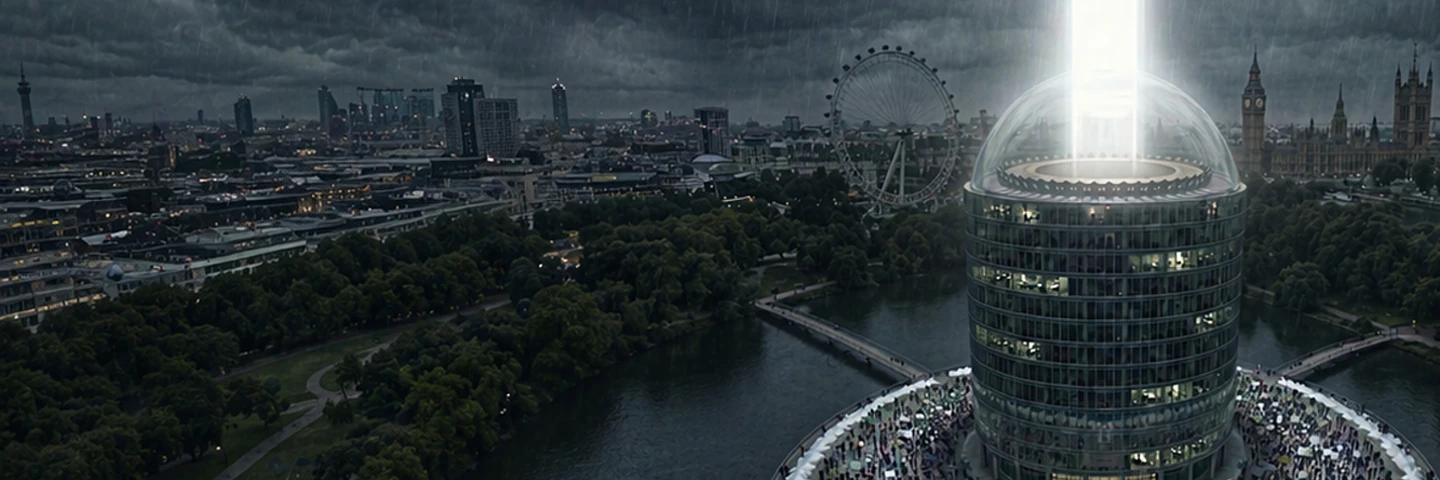
She let the silence stretch, the Mono car’s hum the only sound in the car. They were coming down Whitehall and the CGS Building loomed above them on the right. Its colossal floodlight, set in the dome’s centre, shot a solid, unwavering beam of white light into the early night sky, a beacon of absolute authority.
Ari pressed his forehead against the cool glass, looking down. The plaza wasn’t filled with a rioting mob as he expected. Instead, it was a grid of silent, static horror. Thousands of people lay on the pristine paving stones, arranged in perfect, concentric rings radiating out from the building.
“What are those people doing?” he asked, breath fogging the view.
“Resignation protest,” Alene said, her gaze fixed forward. “They come here when the fever spikes. If the Council won’t save them, they’ve decided the Council will at least have to dispose of them.”
An agile drone scuttled along the outer perimeter of the human rings. It paused over a motionless figure. A nozzle extended, coating the body in rapid-hardening white foam. In seconds, the person was reduced to a sanitary mound.
Farther back, lagging behind the faster drones, a massive yellow Sweeper trundled along the line. It extended a hydraulic arm and scooped the white mounds into its hopper before moving on. Organic Recycling in Progress, read the plaza screens.
The fight had gone out of him, leaving exhaustion.
“Look,” she said, her tone gentler. “I understand you’ve been through a lot, but the stakes don’t get any higher.”
His head drooped. “Nothing I’ve done has made any difference.”
He fancied himself an elite technician, yet he had been beaten by the system he was trying to hack. She’d already given the data to Sharon, and for him that made the whole ordeal look pointless. For a fraction of a second, she felt pity for him. She crushed it. Pity was a distraction.
“The job’s not done yet,” she said. “Sharon is committed to solving this. Are you?”
“Of course I’m committed,” he said, his voice firming. “You’ve seen what I’ve been willing to do. It’s why I’m in these.” He raised his cuffed hands. “But if we’re all on the same team as you say, then take them off.”
Alene’s gaze dropped to the dull polymer circling his wrists, then rose slowly to meet his. “You’re a flight risk, a material witness in a global conspiracy, and you smell like a sewer rat. The cuffs are the least of your problems right now.”
Ari slumped back in his seat, resigned.
Across the Thames, the glass-and-steel of Vauxhall rose to meet them. She had chosen a safe house in the indistinguishable towers for the anonymity they provided.
Feld was dangerous, an information hazard that could destroy the CGS, but he was also a key to her investigation. She was already considering what he might unlock for her.
Francis closed one brief and tapped for the next when a soft chime sounded at the outer door. An aide entered just far enough to break the seal. Cool corridor air entered with her, carrying the scent of coffee.
“Councillor. The steward asked that you return to Number 10 within the hour if you want to review the seating chart before the councillors holo in for the reception. Rhys is already waiting for you there.”
“Attendance?” Francis asked.
“Twenty-seven councillors. Nine deputies. The others have sent their regrets.”
Regrets sent before the vote, to avoid having regret after, she thought.
“Thank you.”
The aide withdrew.
Francis kicked her chair back with her heels and stood. She closed the briefing pane on her terminal and deactivated the pandemic telemetry holo above her desk. Amber and violet voxels folded in on themselves, then vanished into the polished white surface.
Francis took her jacket from the chair back and put it on, pulling her grey hair out of the collar. Beyond the curved glass wall, late afternoon had turned the CGS plaza to beaten bronze.
She stepped into the private lift, the doors closing behind her. As the lift began its descent, her comm chimed. New Scotland Yard. She answered before the second chime.
A young DC’s projection resolved a fraction off centre, one shoulder raised too high as though he had braced himself for the call and forgotten to release it.
“Councillor Herbert,” he said, his voice shaking. “I’m DC Leo Hatch. Apologies for contacting you directly. DCI Ardone instructed me to notify you personally without delay.”
“I’m listening, Detective Constable.”
He swallowed. “We have retrieved Ari Feld.”
“Where is he?”
“Safe, ma’am. He’s with DCI Ardone in secure custody.”
The lift continued downward at the same rate, but the pressure across her ribs loosened enough for one full breath.
“Where was he? What has he said?”
“No details yet, ma’am. DCI Ardone will be debriefing him. He was being detained by the Walkers.” Hatch hesitated. “Justice Baron assisted in securing his return.”
Of course he did.
“Thank you,” Francis said. “Tell DCI Ardone I expect a detailed report when you have something firmer than participating actors and knowledge gaps.”
“Yes, ma’am.” DC Hatch’s face flushed dark and he cast his eyes downward.
He almost ended the call, then stopped himself. “Councillor—if I may—it’s an honour to be of service to you.”
Francis gave him the smallest smile. “Carry on then.”
The projection vanished, but not before she caught the pleased, startled smile he failed to suppress.
The lift doors opened onto the tunnel corridor. The air here belonged fully to neither building. It was cooler than both her office and Number 10, insulated by stone and exposed to the electrical current of the Mono guideway in the floor. Recessed strips of white light ran low along the walls, leaving the ceiling in shadow. She had commissioned the passage years ago and stopped noticing it except as time lapsed between destinations.
She exited the lift, stopping just beyond the threshold to draw one unsteady breath.
Francis approached the Mono dock. The car waited, its black shell absorbing more light than it returned. Its door slid open as she approached. She ducked her head by habit, though the clearance had always been sufficient, and entered. The car accelerated, white bands of tunnel light streaking the glass at measured intervals.
Alive, with Alene, and beyond that almost nothing. Relief loosened one knot and left the rest of her braced. Baron had delivered on his end of the bargain, and late enough that any alteration in hers would now read as politics rather than principle. She would support his motion publicly while limiting it through the amendment she had privately instructed Khosravi to table. Preserve oversight while honouring the debt.
The Mono slowed. The last band of light swept past the window, and the secure dock beneath Number 10 opened around her.
Rhys was already waiting by the lift, slate pinned lightly against his ribs, one foot pointed towards the doors before she fully emerged. His tie was skewed a fraction off centre. On another man it might have suggested carelessness, but on Rhys it meant he had been too rushed to spend time correcting it.
“Councillor,” he said as the Mono door opened.
“The vote?” she asked as she emerged and headed for the lift.
He lengthened his stride half a beat after hers and came level without asking her to slow. “Stable at the centre. Khosravi can still hold Central Asia and most of West Africa, but the Maghreb-Sahara Bloc is pressing him hard on the sunset language. They’re calling the hard date performative mistrust.”
They entered the lift. The doors closed.
“It is mistrust,” Francis said. “There’s nothing performative about it.”
“Yes, well,” Rhys said. “They find that less persuasive than you do.”
The lift began to ascend.
“How much drift?”
“Enough that Baron’s emergency framing is now self-propelling.” Rhys glanced at the slate. “And there continues to be movement in the PI-1 and PI-2 sectors.”
The lift opened onto the private corridor behind the state rooms. The house smelled of beeswax and old wood, with the evening’s preparations beginning to climb through it from above, braised lamb, garlic-roasted potatoes, citrus and rosemary over warm sugar.
Francis left the lift first. “What did you find out about their motives?”
Rhys matched her pace. “Production related language primarily. Limited competition between regions. Differential recovery incentives.”
Francis’s fingers tightened once around the edge of her other sleeve, then released. It wasn’t fear or necessity driving them. Their goal was to weaken the second tenet. Scarcity Is Eliminated Through Constraint.
“So, they want to remove production constraints,” she said.
“They want output incentives.”
“The same destruction, with a slightly more palatable spin.”
The corridor narrowed ahead, their footsteps absorbed by the carpet.
“No one is presenting it as ideology,” he said.
“No,” Francis said. “Because he’s convinced them that it’s arithmetic, but it isn’t. It’s greed. People who are better off than others still always want more. It’s why we built in constraint. Without it, interdependency is weakened.”
Her voice stayed even, but Rhys knew as well as she did that she had a habit of preaching doctrine to hide her stress.
The portraits slid by in dark varnish and gilt, neither of them turning their heads.
“The Andean-Amazonian issue. It’s been handled,” Rhys said.
Francis turned her head slightly. “Handled.”
“You asked me to kill the logistics veto amendment. I did. It’ll be withdrawn.”
“Condori?”
“And one other conversation I’d rather not discuss,” Rhys said.
Francis absorbed that. “Good,” she said.
They entered the private study, lamps glowing against the deepening dusk outside. A fire had been laid but not lit. The desk, Naomi’s old desk from LSE, stood clear except for a carafe of water and two glasses. Francis had claimed it after her assassination and moved it from Naomi’s faculty office to hers, then through ministries and agencies until it came to rest in Number 10.
Rhys placed his slate on the leather inlay but remained standing. Francis went to the window, looked once at the strip of railings and the protesters, then turned back.
“What else.”
“Khosravi thinks we will pass the amendment more easily if we go for a passable majority and stop trying for a decisive victory.”
“That is a narrower objective than the one I gave him,” Francis said.
“It is.”
“And you’re recommending it anyway.”
“Yes.”
“Why?”
“Because some of the people we thought were movable are not. They aren’t being frightened or pressured. They’re convinced,” Rhys said.
“By him?”
“By what he’s providing licence for.”
Francis crossed to the desk and brought up the vote map with a lateral sweep of her hand, a sharper one than the system required. Sectors lit between them, some steady, some flickering at their edges. The PI-1 vote commitments were worse than they ought to have been.
“If we pass the amendment with a narrow margin,” she said, “we will have conceded power.” She tapped her chest with two fingers. “I will have conceded power.”
“We postpone the problem. When the pandemic ends, perspectives will swing back.”
“No.” Her finger hovered over the pulsing sectors. “If Walker Affairs expands under emergency authority without visible, continuous constraint, oversight becomes ceremonial. He won’t need permanence. He will have habit, precedent, frightened councillors telling themselves the arrangement has already proved itself useful.”
Rhys said nothing for a beat. “And if you try to force the Council to limit the authority by a broad majority, you risk alienating enough people that precedent will be the least of our problems. Remember the competition sympathisers.”
She dismissed the projection with a flat-palmed swipe that made the sectors snap inward.
“You think I am asking the vote to carry too much.”
“I think you are trying to win the argument underlying the vote.” His tone remained respectful. “That may not be possible by tomorrow.”
“It has to be.” Francis struck the desk with the flat of her palm, strong enough to joggle the water in the carafe.
Silence settled, familiar but not comfortable. Rhys had been with her long enough to know where she would allow him to push her. She had kept him long enough to know he did it because she required it, not because he enjoyed it.
A knock sounded. Before either of them answered, the door opened.
The steward entered with the silent competence of someone who had spent years moving through power without ever disturbing the illusion that it governed itself. He carried a portable holo.
“Councillor. The seating arrangement.”
“Show me,” Francis said.
He lowered the holo unit to the table, rotated it towards Francis’s line of sight, and activated it. A long dining table rendered in pale light, chairs tagged with names and regional identifiers. Around it hovered notation for menu synchronisation and service timing.
“Everything is coordinated, ma’am,” the steward said. “Each councillor’s steward has the holo details for the physical environment and Sup instructions to reproduce the menu locally. As usual, no haptics.”
“Pantanal is too isolated,” she said. “Move Condori closer to the Cruz.”
The steward made the adjustment.
“Not beside them,” Rhys said. “Opposite. Let him spend the evening looking at the votes he’s helping to dislodge.”
Her eyes went first to the gaps, then to the adjacencies. She considered, then nodded once. “Opposite.”
The projection shifted.
“Antisuyu beside Chrétien,” she said. “If they want to talk efficiency, let them do it to someone clear-headed enough to hear the euphemism.”
The steward altered the seating.
Councillors glowed in outline, the distances from each other determined to create intimacy or strain. It would be an evening engineered to look hospitable while forcing certain eyes to meet and certain voices to carry.
“One further point,” he said. “The Pars councillor requested reduced scent. There were complaints about the cedar profile at the last gathering.”
“Instruct her steward to reduce it,” Francis said. “Not the citrus.”
“Of course. The wardrobe suite is ready when you are.”
He withdrew.
She turned to Rhys. “Come.”
The corridor here was quieter, deeper inside the private side of the house. Less state, more residence. Lamps instead of overhead light. Carpet thick enough to erase footfall.
“You accepted my placement.” Rhys kept his usual position just off her shoulder, then dropped back half a step as the corridor tightened.
“It was a good placement.”
“This is dangerous.”
“I assume you’re no longer talking about the amendment,” Francis said.
“No.”
“Then say it plainly.” Francis stopped and turned to face him.
Rhys did not answer at once.
“The vote will pass and the amendment will pass. That’s fine. It achieves your objectives. But if you spend your influence and fail to overwhelmingly deliver the chamber on the amendment, Baron and his circle learn exactly how far your soft power now reaches.”
Francis resumed walking. In the distance came the sounds of service doors opening, crockery being laid, and a brief murmur of staff voices.
“Go on.”
“And next time, any councillor who is currently drifting will recalculate the risk of opposing you versus Baron. You will lose more later by trying to force a greater win now.”
Her hand found the wardrobe suite handle and stayed there. “You think I am in danger of weakening myself in public.”
“I think you are in danger of having your reach measured in public,” Rhys said.
Francis opened the door and entered. He followed.
The suite was softly lit, almost domestic in scale. One wall displayed her evening clothes. A tailor’s dummy stood in the corner with a shawl abandoned from some earlier event. On the brass-tacked ottoman lay the black suit for tonight—clean lines, no ornament, severity rendered elegant by precision.
“Close the door,” she said.
Rhys did.
Francis shrugged out of her jacket and smoothed the collar once before laying it across the chair back.
“I want intelligence on Baron.”
Rhys did not move. “What kind?”
“Budget discrepancies. Off-ledger reallocations. Unauthorised convergence between Walker Affairs, transit logistics, and discretionary enforcement. Anything that suggests he is already consolidating force beyond what the vote would formally grant him.”
He was silent for a beat too long. “That will be noticed.”
“Then let it be noticed.” Francis worked open the cuff closures of the suit with her thumbnails, eyes still on him in the mirror.
“Before the vote?”
“Yes.”
“That will read as retaliation.”
“I intend it to be retaliation.”
Rhys let out a small breath, almost amusement. “At least we’re using accurate words.”
She answered him through the mirror, as if the extra pane of glass focused the honesty. “Would you prefer inaccurate ones?”
“I would prefer timing that does not hand him the pretext to cry foul that he is almost certainly waiting for.”
“He does not need a pretext.”
“No,” Rhys said. “But he’ll enjoy having one.”
She held the black jacket out, wondering if its darkness would be enough to make her mood appear less sour. She put it on.
He watched her in the mirror. “This is the point at which I ask whether this is really about the CGS.”
The deal with Baron had seemed narrow enough while Ari was missing. Clean, even, by the standards of crisis politics. Now it showed itself for what it truly was, a compromise she would have despised in anyone else.
When she spoke, her voice was steady. “It is about the CGS.”
Fastening the second button, her hand paused. “And it’s about being forced to negotiate around Baron.”
That was as close as she would come. It was enough.
Rhys’s mouth tightened before he controlled it. He had hoped, perhaps, that her insistence tonight was pure doctrine. It was not. Doctrine was there. So was the debt.
“I see,” he said. There was no judgement in him, and no pity.
Francis finished buttoning the jacket. “You told me some of them are convinced. Not frightened—convinced.”
“Yes.”
“Then we agree that this is already about more than the votes.”
“We do.” Rhys kept his eyes on hers. “But I still think that if you force the Council to declare itself fully now, you will lose political capital.”
“And if I do not force the declaration,” she said, smoothing the lapel flat, “the CGS may lose its balanced political framework.”
“You may be right,” he said.
“I know I am.”
A beat. Then, because he was Rhys and not one of the flattering bureaucrats who mistook obedience for competence, he said, “That is not the reassurance you think it is.”
“No?” For the first time that evening, something like real amusement touched her mouth.
He nodded once. “I’ll start with procurement shadows and unpaired authorisations. If he has moved resources without authority, logistics will show it before Walker Affairs does.”
“Good.”
“And if he anticipated that?” Rhys asked.
“He did.”
He took the door in one hand and looked back once. “Right then, I’ll do it anyway.”
“Yes,” Francis said. “You will.”
The door closed softly behind him.
Francis fastened the last button by feel and tugged the jacket hem once into line. The suit did what she required of it. It removed softness without becoming theatrical.
On the dressing table, the comm screen lit briefly with the first reception advisories. Councillors beginning to log in. Scent synchronisation calibrating. Table service alignment live.
She did not move at once. Ari was safe. A relief, though it meant only one fewer thing she had to worry about that evening.
She clicked the dressing-table light off, opened the door, and went into the corridor with her face already poised to charm. The corridor beyond was warm with preparation and almost silent. The reception room waited with its engineered civility.
She would spend the evening making pressure look like hospitality.