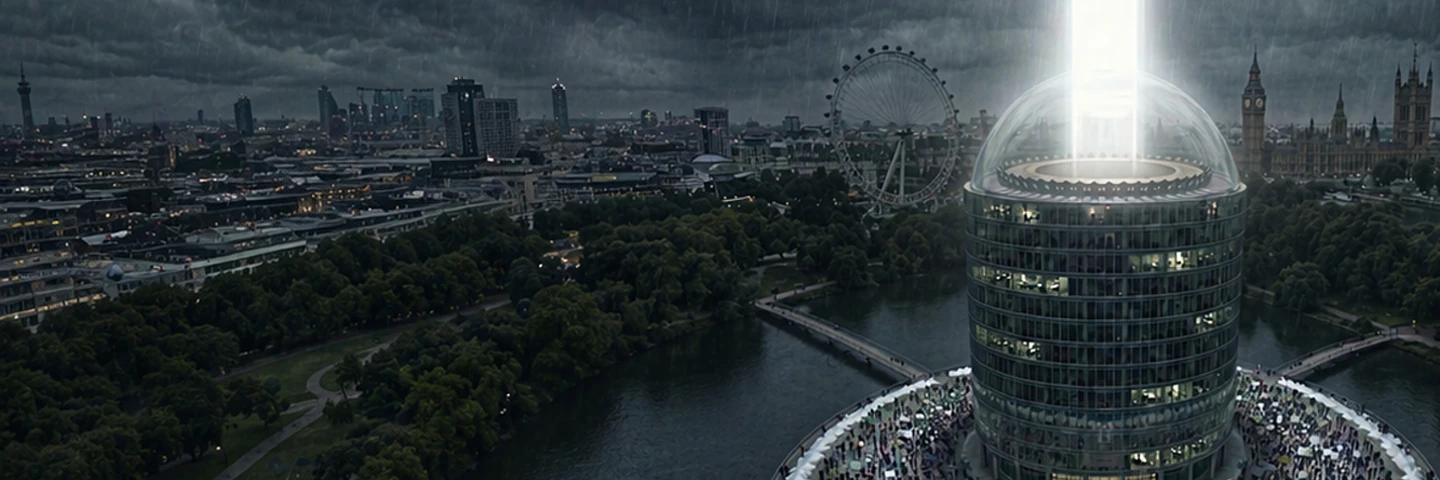
16 — Recompiled
by D.M. BarachAmbiguity is the engine of inefficiency. It is the social friction that slows allocation and causes the misdirection of resources. We must therefore strive to harmonise our social structures, and even our own identities, into defined, logical, and productive roles. An ambiguous actor, an unresolved identity, or an unclassified emotional state is, by its very nature, a source of economic friction.
—Naomi Feld, The Frictionless Economy: Principles of Resource Allocation
Alene stood in the doorway of Ari’s flat, watching him catalogue the violations. Forensics had been thorough, leaving circles drawn around markings and a fine layer of graphite powder on every surface. The air in the flat was dry with the acrid reek of cooled solder, the resinous scent of flux, and the charged dust of dormant electronics. It didn’t smell of a person, but of processes, a factor she had missed the first time she was there.
She did a quick physical assessment. The sharp piercing pain in her ribs was gone and she could breathe comfortably. Ari moved more fluidly as he surveyed the flat. The accelerated nano-treatments had done their work.
Earlier that morning, in the anonymity of the Vauxhall safe house, she had laid out the plan. “We’ll tap the secure line you intercepted,” she’d said, watching him over the threaded neck of a nutrient-pack. “See if your conspirators are still talking.”
“I have the kit at my flat,” he had said. “Everything we’ll need.”
Ari ran a finger over a boot print on the seat of his work chair, his expression one of a master craftsman finding sloppy tool marks left by an apprentice.
“Forensics, I presume,” he said. His voice was tight.
“They were thorough,” Alene said.
Ari bypassed the rumpled bed and overturned chair, eyes flicking over the forensic detritus on the floor before landing on his workbench. He scanned the cluttered surface, his fingers drumming. Then he froze, his gaze sweeping, hunting.
“Where is it?” he muttered, running one hand through his hair.
“Looking for this?” Alene pulled the fractured circuit board from her coat pocket. The one she’d taken the last time she had been there.
He didn’t snatch it. He just stared at it, his hand half-raised as if approaching a skittish animal.
“Why did you take it?”
“An asset test,” she said coolly. “I wanted to see if you’d miss it. If it was just junk or important. Is it?”
As she handed it over she catalogued his reaction, a flicker of irritation, of possession, like a magpie reclaiming a stolen, shiny bit. So, it was a totem or a sentimental item, or, she considered, as he pocketed it without a word, perhaps just a comfort or focus tool. She’d learned on the street that every fighter had a weak point, something they protected. This might be a clue to his.
He turned his back on her, all business. He began filling a black duffel bag with tools and components, his movements purposeful.
This was not the hollowed-out victim she’d retrieved from the Walkers. Back in his own environment, surrounded by his tools, he was focused and capable. The hunted look had evaporated like morning condensation.
She had profiled him as a man who fled reality for simulations. Yet here he was, stepping confidently into the fray.
Alene walked over to the wall where his tools were hung, a neat, orderly grid of steel and plastic that was the only organised space in the flat. She ran a finger over the cool, smooth surface of a pair of insulated pliers, probing. What else did she get wrong in his profile?
“So,” she said, “how do you like working for the CGS?”
“It’s a job,” he said.
“So why don’t you leave for something more?”
The question was simple, direct, but the answer would speak to a deeper motivation. He paused, and visibly checked himself, as if weighing the cost of a truthful answer before committing to a fabricated one. “It pays the bills. And my boss… Francis, she’s always been good to me.”
My boss. Imagine growing up with that woman as your foster mother. She probably raised him to crave her control.
He stopped, then looked up, and for a second she caught the Fixit Kid Benjamin had talked about. “And, it lets me tinker. Fix things for fun. Even invent things.”
He lifted off his bench a small, square device secured with a strap. “Here. You’ll appreciate this.”
He opened it to show her the insides. Alene took it. It was a marvel of miniaturisation. She recognised the casing as a standard comms relay, but the internals were bespoke, a dense, complex web of circuits.
“Small-scale camouflage unit,” he said with a degree of pride she hadn’t heard before. “Projects a localised holo distortion in front of you using an image captured from behind you using a tiny camera in the strap. Makes you damned hard to see.”
“Does it work?”
“Does a photon travel at light-speed? Of course it works.”
He snatched it back, snapped it shut, secured it around his neck, and pressed all four corners at once with his thumbs and forefingers. The air around him shimmered with an oily distortion, like heat-haze on pavement. Then he was simply… gone. She could see through him to a slightly blurred version of his workbench behind him.
“Still has a power-draw issue,” his disembodied voice said, “but effective.” He shimmered back into view, a magician revealing the trick.
“I’ll take two,” Alene said.
“Good thing, as I only made two.” He handed the one he demonstrated back to her. “Here.”
She took the unit, its weight negligible. It was a covert tool she’d never seen the likes of before, meant for slipping past a watcher or getting the drop on someone. And this technician had built it in his spare time.
The plastic casing was still warm from his demonstration. Apparently it used a lot of power in that small unit. Her fingers fumbled with the four-point pressure activation.
“No, no, no. You’re not getting the sequence right. Like this.”
He took it from her hands and stepped behind her.
Alene’s body reacted before her mind did, every muscle in her shoulders and back tensing in a pre-emptive brace, an automatic counter to an attack from the rear. She had to command herself to stand down.
He reached over her head to put the device on her neck, almost like he was fastening a necklace. He moved her red ponytail out of the way and her scalp tingled. After it was secured, he took her hands in his. They were rough, stained with grease and grit that no soap could reach. Guiding her fingers, he set them on the four corners.
There was strength in his arms and shoulders, a fighter’s build. A simulation fighter, she corrected herself. All the haptic feedback in the world couldn’t replace the visceral reality of a broken knuckle or the taste of your own blood. It made him a tactical unknown. No, that wasn’t entirely true. Outside Sharon’s lab—he had come back for her.
But he was close. She could feel the heat radiating from his chest, his breath on her neck. Her training screamed, he’s the mission, Ardone. Don’t get close. But her body stayed where it was, taking in his scent, soap and ozone instead of tunnel filth.
She turned her head slightly to tell him to back off.
A mistake.
Her face was inches from his. Fresh bruising shadowed his jaw. Fine lines pulled at the corners of his eyes. His gaze wasn’t on her hands.
The jolt that went through her was sharp and unwelcome. Her breath caught.
Then, as quickly as it happened, it was over. He pulled back as if he’d touched a live wire. Panic flashed across his face.
“Don’t… don’t activate it,” he stammered, his voice too rough, too fast. “The power source is still unstable.”
The power source lie was as clumsy as the retreat.
Alene let a beat of silence hang, forcing her expression to be perfectly neutral. He turned back to the bag with his shoulders locked high.
She detached the camouflage device and slid it into the deep inner pocket of her coat, stowing it the way she would a loaded clip. He grabbed the second unit, shoved it into his duffel, and zipped it.
“Okay,” he said, his voice all business. “I’m ready. Let’s go.”
The sheer curtains covering the windows, which overlooked the rain-soaked garden, filtered the flat morning light as it poured into the study at Number 10, illuminating a fine layer of dust on the antique furniture. The silence of the study was broken only by the electric hiss of the air filtration and the almost subsonic hum of the holo displays. Councillor Francis Herbert reached out, her fingers tracing the ornate marquetry of Naomi’s old desk.
The holos were a litany of cascading errors. Sup logistics in Manchester flashing a crimson 32% Operational Capacity. Energy grid fluctuations in the Midlands. A riot in Bristol. The pandemic’s death toll abstracted as a scrolling ticker.
Her personal comm chimed, displacing the room’s quiet. An unscheduled call. She accepted.
Sharon Feld’s face solidified in the air. She looked pale and exhausted.
“Francis? I’m sorry to call you like this, but I have a problem.”
“Sharon, my dear. Are you alright?”
“I’m fine. It’s just that I’m… contained. Since the attack on Ari and DCI Ardone, she stationed a constable at my door. He’s very polite, but I’m a prisoner in my own flat. I can’t get to my lab. I can’t work.”
The DCI was protecting her assets. Shrewd, if inconvenient. Sharon’s research should not be obstructed.
Francis’s expression tightened with genuine concern. “Alene informed me of the attack. When she told me Ari had been shot… my god, Sharon. Are you truly alright?”
Sharon’s eyes betrayed a flicker of fear. “I’m… functioning. I understand that Ari is recovering. It’s terrifying, Francis. They could have been killed.”
“I know, it’s shocking,” Francis said. “I wish you and Ari could be spared all this. I’ve already caused you both so much grief.”
“How can you say that? You’ve been nothing but kind to us, even through our troubles. If anything, I’m sorry I couldn’t convince Ari to be closer with you.”
“You’re a dear to say that, but Ari’s never been close to me. I wish you could have seen him before. He was the sweetest, most affectionate little boy you could ever hope for. He was happy, joyful and so attached to his parents. He wasn’t close with Naomi, but that wasn’t his fault. Naomi wasn’t the nurturing type. But then the Mono crash changed everything for him. It changed him.”
The memory began to surface, sharp and acrid. The smell of ozone and new polymers. Launch day. Anjali, her best friend, serious and concerned, her voice echoing in the vast, new terminal. And Adam, Naomi’s son, quieter, with that same brilliant, analytical mind.
Anjali, sliding the tablet across the table, its smooth swish breaking the tension. “The Vietnamese actuators, Francis. They’re substandard. The stress simulations are… borderline.”
And her own voice, tight with the pressure of a dozen stalled infrastructure projects, of a world demanding this new, clean transport. “Borderline isn’t failure, Anjali. The models hold. The transition depends on this. We proceed. It’s an acceptable risk. At least until we can ramp up production to replace them with new ones.”
The memory of their faces on the platform. Waving. Then the jarring shriek of the alert on her comm. The crash. And then, a silence so total it felt like the world had been hollowed out.
“Anjali… Ari’s mother…” Francis’s voice was strained, the memory lending a tremor. “She was my best friend. She and Adam were the lead engineers on the Mono project.”
“Yes, I remember,” Sharon said. “You introduced her to Adam. You told me that Naomi was not taken with her. At least not at first.”
She paused, closing her eyes. “There was a component. A risk. Anjali flagged it. I… we… we all knew the risks. I made the final call. The launch was critical for the Interdependency framework. It had to succeed.”
She looked directly at Sharon’s holo image, letting her see the guilt she had carried for decades. “I put them on that first carriage, Sharon. Anjali, my brilliant friend, and Adam, Naomi’s own son. The perfect symbol for the future we were building. When it crashed…” She didn’t need to finish the sentence. “I am the reason Ari grew up without parents. He’s never known. He believes it was a tragic, unavoidable accident. My protection of him, it isn’t just as Anjali’s friend. It’s penance.”
Sharon’s image was perfectly still, her mouth slightly open as she processed the words. Francis could see the shock radiating from the frozen holo.
“Francis,” Sharon finally whispered. “I… I had no idea.”
“I’m so sorry.” Francis wiped away her tears. “Ari was never the same after that. It’s why your—”
“Stop.” Sharon cut her off. “Ari and I are not your fault. I knew who I was marrying. These things happen.”
Francis nodded, but the guilt remained.
“Now you see, why I must protect him, and you,” Francis said, gently reclaiming control. “And you must be allowed to finish your work.” She leaned forward. “You cannot return to your lab. It’s compromised. We have to assume it’s being watched, that whoever was involved in the attack might return.”
She thought for a moment. “The Francis Crick Institute. It’s secure. State-of-the-art. Level 4 bio-containment. I’ll clear it for you. I will arrange a dedicated New Scotland Yard transport. And I will speak to DCI Ardone. She will understand.”
“Thank you, Francis.” Sharon’s voice, which had been hesitant, suddenly firmed, its energy cutting through. “Francis, I think I have it. Ari’s—his idea—it was the key. I might have a cure.”
“A cure?”
Francis had been thinking in transport routes and production targets and had not even considered that a cure could be possible so soon. She went perfectly still. Her hands gripped the cold wood of the desk until her knuckles blanched.
“Theoretically,” Sharon said, her words quick and precise. “And it’s more of a treatment than a cure. The problem is, you can’t heal a misfolded protein. It’s not a bacterium you can kill, or a virus you can neutralise. The corruption is fundamental. Any attempt to fix a prion is unstable. It’s simply a failed molecule.”
Francis stopped breathing.
Sharon continued, “But Ari, he saw it as a technician. He asked why we would bother to fix the broken component when we can just isolate it and work around it? The prion-infected cells are a lost cause. The neural pathway is compromised. So, we firewall the heart from the brain’s faulty commands, and then we give the heart a new, clean signal from a modified pacemaker. It modulates the heart independently, effectively isolating the prion. To restore healthy heart function, we replace the signal. We don’t try to repair it.”
Francis’s hands, resting on the desk, began to tremble. Sharon’s words echoed in her mind, “We replace the signal. We don’t try to repair it.”
Replace. Not repair. More than an economic principle, or a governing model built to prevent conflict, it was doctrine manifested in science. A shock ran up Francis’s spine. This cure was a clear demonstration of how deeply prescient Naomi truly was. It emphasised what distorting her vision would cost.
“A cure,” Francis breathed, the words said reverently, almost a prayer.
The revelation was dizzying. Her faith had been stretched to tearing point, then pulled taut again. She stared at the holo image, but she was no longer seeing Sharon Feld. Naomi stood there instead, one hand on a stack of manuscripts, her voice clear and absolute. “Repair creates instability.”
Francis gathered herself. “Is it viable? And how quickly?”
“I need to run the simulations, but we could probably complete an initial human trial in the next couple of days. If it works, we’ll know right away. But as far as deploying it? It’s complex. Synthesising the dampener on a global scale? Manufacturing and implanting billions of pacemakers?” Sharon’s voice was thin, strained by the sheer scale of the problem. “We can start out slow, but to catch up to demand… months. Six, at least. Even if everything goes perfectly.”
Six months. Relief vanished, replaced with a tight clamp around Francis’s chest. The doctrine might be true. Time was still against her.
Six months of riots. Six months for men like Justice Baron to carve out their own empires from the disorder. The entire system would come apart in that time.
She looked away from the old world inheritances in her study, back to the flickering red of the Manchester schematic.
“You’ll have the Crick Institute,” Francis said. “Do it.” A command, and a prayer.
She terminated the call.
Sharon’s image dissolved. The dusty silence of the study remained. Francis stared at the empty space, her gaze fixed on the failing numbers. The casualty statistics were regrettable, but the food distribution failures, the cargo ships sitting idle, the data conduits going dark—they were the harbingers of true catastrophe. She had held it all together for twenty-eight years, balanced on a fulcrum of acceptable risks.
The leather inlay of Naomi’s desk was slick under her fingertips. She would not fail The Founder now.
Like others, this entrance to the tunnels was a utility booth, its grey composite surface scuffed and stained, almost swallowed by the shadows of an alley behind Old Queen Street. Alene eyed it with distaste—she had never been under the city. This was his world, not hers. The air, thick with the smell of damp brick and rubbish, clung to her skin. In the distance, the incomprehensible shouts from the CGS plaza demonstration reverberated off the surrounding buildings.
Ari stepped up to the booth and cleared his throat with a theatrical formality. “Ahem. Would you be so kind as to grant me access?”
A synthesised voice replied, its calm tone contrasting with the echoing shouts.
Visual identification, Ari Feld, communications technician for the Council of Global Stability. Permission to enter service tunnels, denied.
“What do you mean, denied?” Ari snapped. “Open up, you old cow!”
Visual identification, Ari Feld, communications technician for the Council of Global Stability. Permission to enter service tunnels, denied.
Alene laughed. The tension of the morning, the unnerving closeness in his flat with the camo-unit, the attack, the hospital—it all just broke.
“What’s so funny?” he grumbled. He looked properly narked, which only made her laugh fully break through.
“You are!” She sniggered, trying to suppress her laughter. “The master technician, the Fixit Kid, locked out of his own kingdom by a stubborn machine.”
“It’s not funny. If we don’t get in, I can’t place the tap.”
“Of course it won’t let you in,” Alene said, regaining her composure. It wasn’t a game. She needed to see which version of him she would be trapped in this tunnel with. Is it the bruised variable from the safe house, or the competent technician from his flat?
“You are a wanted, dangerous criminal. Of course, I had your access revoked,” she said.
He stared at her, then the locked door. She expected the frustration from the safe house. Instead, a slow, grudging smile spread across his face. There he is, she thought, relief loosening something in her. The Fixit Kid in the flesh.
He set down the duffel, unzipped it, and pulled out a slim, metallic device which he pressed against the door’s seam. A low, grinding buzz, a sharp clunk, and the door slid open.
He turned back to her, a triumphant, almost boyish grin on his face, and made a gallant, sweeping motion. “Please. After you.”
The gesture, so physical and directed at her, brushed too close to that morning in his flat when he had helped her fasten the camo-unit. The memory of his hands near her neck, the tingle of the device, brought up heat she smothered under protocol.
“I don’t think so. Per my previous statement, you’re a dangerous criminal. And now you’re opening secure doors with strange devices? I don’t think so. You first.”
He smiled, gave a mock bow, and stepped into the darkness.
“You’re still in my custody, you know.”
Stepping out of the lift after its descent, Alene encountered warmer air that smelled of mildew, rust, and old metal rot. The disc lights they wore cut white circles in the gloom. The only sounds were the echoing plink of a single drop of water falling into a distant puddle and the crunch of grit and rubble under their boots. Alene kept her hand near her sidearm, her senses sharp, cataloguing every new, unsettling input.
Ari removed a panel from a junction box. “The CGS has three redundant fibre-optic data lines that are for all of the standard operations, each fed in from a different physical location. There are also two dedicated data lines specifically for Council-level communications. One of them is here, and that’s the one that gave me the original message. I can duplicate the signal and feed it back to the safe house, but all comms are secured with end-to-end encryption that I can’t circumvent.”
“You do your part, I’ll do mine,” Alene said. “Running New Scotland Yard’s Information Violations department has its perks.”
In this ruddy tunnel he moved as if he had come back into his proper voltage. The haunted, jittery variable from the safe house was gone. The bruised, feverish man she had been protecting looked like the aberration. This fluid operator in front of her was the one who had hacked the CGS and saved her life.
He even whistled a soulful old-sounding melody as he worked, the sound a small, defiant note in the oppressive silence. He sang something under his breath that sounded like what I’m looking for.
“I’m almost done,” he said, his voice echoing slightly.
“Good,” Alene replied, leaning against the curved, sweating wall. “This place stinks.” She needed to break the silence, to understand this version of him. “What’s that you’re whistling?”
“Hmm? Oh.” He feigned momentary confusion. “Just some old tune. No idea. Stuck in my head, I suppose.”
Her disc light caught the side of his face. The melody was unfamiliar to her, but his reaction was not. His feigned ignorance was a clumsy, transparent lie, the kind people used to guard something small and private. She knew that move well enough, she’d used it a thousand times herself. The recognition put a small twist in her gut, but she let it go.
The snip of his cutters fell silent. He reached up to brace himself against the junction box, grimaced, and hissed through his teeth. He flexed his sore shoulder and went back to the wiring.
The damp air found the cricks in her own body too, a dull ache in her bruised ribs, a raw scrape in her throat every time she swallowed. They were both damaged kit. The memory of the fight, the speed, her own brutal response, became viscerally present.
“You fought pretty well back there,” she said.
He turned to her and gave a small laugh. “Not really, not like you. Did you learn that in the police?”
The question was genuine. Not a probe, just a technician trying to map her schematic. She had spent a lifetime building firewalls, but shared violence had changed the terms between them. He had saved her life and she his. It forged a new bond regardless of the custody order she kept invoking. She made a calculation. He, of all people, lived in a world of data. He could stand the truth.
“I learned that on the street,” she said. “Being the weak, little, effeminate boy that everyone liked to pick on.”
He froze, wire cutters in hand. He turned slowly, eyes wide, lips parted.
“Boy?” he echoed. “You mean you were a…”
He stopped there, colour rising under the tunnel pallor as he heard himself.
“Sorry,” he said. “I mean… before. That is to say… you learned to fight before you transitioned?”
His clumsiness was so absolute that it was almost charming.
“Is that a problem?” she asked, her voice quiet, challenging.
Her hand unconsciously dropped to her side, near her weapon. It was an old defensive posture, a reflex she thought she’d extinguished. This was it. The test. The moment she’d faced a dozen times, where the truth shattered whatever link had formed. Where who she was became what she was. She braced herself for the inevitable rejection, the disgust, the clumsy retreat. The air in the tunnel felt suddenly colder, heavier, and the rank smell of rust and decay flooded her senses.
He turned back to his work. His hands, so fluid before, lost their grace. There it is, she thought as he fumbled a connection. She felt the familiar sting of disappointment. He was just like the rest.
But as she watched him, she reassessed. He had not recoiled. He didn’t call her a freak or look away in disgust. He cursed, dropped a screw, then tried to re-thread it with shaking hands, as if the only thing he could do was keep working the problem in front of him.
Ari was silent for a moment, his hands fumbling with a connection, dropping another small screw with a clatter. He cursed under his breath, retrieving it.
“The… the biological markers,” he began, voice quiet and technical, as if reading a schematic aloud. “The hormonal protocols. The surgical reconstruction. The systems integration. It’s…”
He stopped fumbling. He turned and looked at her, really looked at her, his gaze analytical now.
“It’s the most complex, high-stakes repair I’ve ever seen,” he said. “You rebuilt. From the component level up. You repaired yourself.”
He gave a short, bitter laugh, looking down at his own trembling hands. “And me, the Founder’s grandson…”
She’d known, of course, it was in his file. Narinder Feld. The relationship to Francis, the high-level CGS job despite his passive profile. She had them filed in her mind as background facts.
Now, hearing him say it, not as a boast, but as a confession, a source of shame…
Ari continued, “I’ve spent my whole life running from who I am, hiding because I was terrified of what people would see. You did the opposite. You fought the whole bloody world just to become who you truly are.”
The comparison jolted her hard enough to stop her breathing. He wasn’t talking about her transition. He was talking about identity. He, the grandson of the Founder, saw himself as a fraud. He saw her, the outlier, as the authentic one. He was setting his deepest secret beside hers and finding himself, not her, the one who came up lacking.
“No, it’s not a problem, Alene,” he said, his voice firm. “It’s awe-inspiring.”
Alene stared at him, the sound of the dripping water fading to nothing. The cold on her skin, the rust in the air, the whole tunnel seemed to fall back. He saw her as a successful repair, not someone broken. Her breath left her in a sudden release from somewhere so deep she had forgotten it was clenched. She gave a single, hard nod.
The moment passed. He turned back to the junction box, and she saw that his hands knew what to do.
“Now, let me get this tap finished.”
“Be right there!” Sharon capped the marker she had been using on the wall screen and set it beside the cold mug on the table.
The living room still smelled of stale coffee and her own sleeplessness. Protein models hovered in paused layers above the terminal, while blue-white helices were suspended over the rumpled sofa. Her notes covered the glass wall in tight black script, arrows and timings and receptor maps crowding one another towards a solution that had finally begun to cohere.
A second knock.
She crossed the room and opened the door. “I said I was coming.”
DC Hatch stood in the corridor in a dark coat beaded with rain. Behind him, the stairwell light flattened the old building into smoke-coloured plaster and cracked tile. Four more constables crowded the landing below, broad-shouldered and watchful, their faces giving away nothing.
“Dr Feld,” Hatch said. “It’s time.”
She looked past him at the others. “This seems excessive.”
His mouth twitched, almost apologetically. “Protocol, ma’am.”
Sharon stepped back for her coat and bag. When she turned, Hatch had not moved from the threshold. He was still young enough to make professionalism look rehearsed.
“Am I under arrest now,” she asked, “or merely that important?”
A flicker of alarm crossed his face before he recognised the joke. “It’s for your protection,” he said.
She took her bag from the chair. “That reassuring word again.”
He stepped aside to let her lock the flat. The metal bolt dragged in its housing, catching twice before seating. The corridor smelled of damp concrete and the sanitising mist the building dispensers released every morning.
Outside, Southwark wore its usual weekday pallor—wet pavement, air handlers humming above the roofs, that sour-clean municipal smell of treated runoff and chemical soap. At the end of the alley, slick with rain, Mono cars lined up in a dock like blackened vertebrae, their shells reflecting the city in smeared bands of silver and grey.
Hatch gestured her into the second car. “This one.”
Two constables went to the car in front. Two behind.
Sharon stopped for half a beat.
Hatch noticed. “Standard secure transit.”
“For microbiologists?”
She stepped inside. The cabin smelled of ozone, recycled air and the synthetic leather the CGS seemed to upholster every official surface in. She sat facing forward. Hatch took the seat opposite, knees angled carefully so as not to crowd her.
The lead and trailing cars waited like escorts in a funeral procession. That thought came from nowhere. No, not from nowhere. Hatch’s nephew, for one.
The doors whispered shut. A second later the car lifted with that weightless surrender the Mono always had, the sensation of gravity being persuaded rather than overcome. The city unrolled in wet planes of slate and glass, roof gardens darkened, old brick façades stitched between newer sterile towers.
Hatch glanced out at the lead car, then back at her. “Councillor Herbert arranged this quickly, ma’am.”
Francis. The Mono. Ari’s parents.
Waterloo Bridge stretched ahead, its surface gleaming. On the far bank, the city rose in controlled layers—stone facades scrubbed to government cleanliness, newer towers behind them, the whole thing composed with the same brittle confidence of a chart with no axis labels.
“She usually does,” Sharon said.
Hatch gave a short breath that might have been a laugh. “I still can’t quite believe I’ve spoken to her twice. Well, not actually spoken to her twice. It was two holo conversations. And, to be precise, she didn’t even know I was there for the first one. Still—”
Sharon’s head swivelled to face him. “Your point?”
He coloured slightly but pressed on.
“Sorry. It’s just—You don’t expect people like that to turn up in an ordinary bloke’s corridor.”
“People like what?”
He looked briefly embarrassed by the question. “Councillor Herbert. Someone everybody knows. Someone that important.” He shook his head once. “And you talk about her as if she’s just—”
“Family?” Sharon supplied.
He gave a small, sheepish nod.
Outside, the car moved onto the bridge. The Thames flowed beneath them, iron-grey and ridged by the wind. To the east, St Paul’s dome rose under the low cloud cover, old enough to have watched London go through all this before.
“She isn’t just any one thing,” Sharon said.
“No, ma’am,” Hatch said too quickly. “I didn’t mean—”
“I know what you meant.”
He settled back, chastened but still curious. Young enough to think curiosity could remain innocent if its tone was polite.
“What is she like?” he asked. “I mean, as a real person. Not the councillor in feeds.”
The question sat between them while the Mono slid north over the river.
The bank approached. What was Francis like? Kind over tea. Ruthless in committee. Attentive in ways that felt maternal until they felt controlling. Capable of remembering the exact scent of vanilla rooibos after three years yet also capable, apparently, of consigning two engineers to a launch-day death because the timetable of history required it.
“More ordinary than people imagine,” Sharon said. “And less benevolent.”
Hatch absorbed that in silence.
By the time he might have found a reply, the car had left the bridge and entered the ordered run past the Strand towards Kingsway. Government façades of wet stone. Posters pulsing across public screens with infection advisories and civic reassurances. Pedestrians moved below in neat regulated currents, umbrellas blooming and collapsing.
Sharon heard herself say, “Can I ask you something?”
“Of course, ma’am.”
She kept looking out. “Suppose you discovered that one person had done something that hurt someone else.”
Hatch waited.
“A serious thing,” she added. “Not recently. Long ago. Do you tell the person who was hurt?”
He frowned, considering. “You mean like if someone in your department had cheated on their spouse, but you weren’t really friends with either of them?”
Sharon faced him. “No.”
He blinked. “Right.”
“Not that small. Not gossip. Real damage.”
He nodded once. “Sorry. It’s just… we get a lot of interpersonal crimes at New Scotland Yard.”
The Mono veered onto Kingsway, the broad wet avenue opening ahead in a bilateral corridor of plane trees. The lead car remained a fixed black shape ahead of them, reflected in the dark rail.
“Then yes, ma’am. I would,” Hatch said.
“Even if it goes badly?”
He paused at the challenge, then answered. “I’d still rather know than have everyone around me acting on it.”
Sharon turned back to the window, remembering Francis at Number 10, tears on her face.
“So people always deserve to know if they were wronged?” Sharon asked.
Hatch hesitated. “No.”
“No?”
“Well.” He shifted in his seat. “Not if telling them would only make things worse.”
“So it’s about who needs more protection?”
He gave a helpless exhale. “Depends.”
“On what?”
“Whether it helps, ma’am,” he said. “Whether the person can do anything with it.”
If she told Ari, what then? He wouldn’t rage at Francis the way Francis imagined. He wouldn’t shout. He wouldn’t even seek comfort. He would do what he always did. He would recede. Convert pain into process. Bury himself in a problem that did not require feeling. In their past she had mistaken it for patience. Then for exhaustion. Then for a phase that would pass once the stress eased.
“What if you don’t think it will help?” she asked.
“You can’t be sure either way.” He looked into her eyes. “If you think it matters, maybe you say it. Maybe they tell you to sod off. Doesn’t mean it meant nothing to them, even if they can’t show it in the moment.”
Sharon stared out at Kingsway without seeing it for a moment. Rain trembled across the glass. A cyclist flashed below in a strip of fluorescent yellow, then was gone beneath the rail.
Ari had never been easy to read. At dinner, walking beside her on holiday, in bed with his back to her, sleep refusing them both. But he had kept choosing to be there. She had too.
And Francis had the gall to say our marriage failing was her fault. As if we had no agency. As if its dissolution was inevitable.
As for her penance, compensating Ari through the quiet violence of deciding what was best for him had only made it easier for him to retreat from his own life.
Sharon looked down at her hands. There was a black smudge of marker along the side of her right thumb. She rubbed at it with her nail until it blurred rather than lifted.
“Unless it wasn’t yours to tell,” Hatch said, thinking aloud now, trying to be careful.
“Why?”
“DCI Ardone always says that every bit of information belongs to someone.” He shrugged, awkward under the weight of his own answer. “They can use it, share it, keep it to themselves. They just don’t want it stolen.”
“And if it’s serious enough?” she asked.
He thought for another moment. “Then you should have New Scotland Yard decide.”
Sharon glared at him.
“Wait, no.” His hands went to his lips. “I’m sorry, ma’am. I didn’t mean to pry—I meant maybe tell DCI Ardone. Sorry. That’s not very useful.”
“No,” Sharon said. “It isn’t.”
Outside, Holborn gave way by degrees to the northern pull towards Bloomsbury and St Pancras. The city altered almost imperceptibly as they moved—less institutional stone, older brick, the occasional remnant left standing for its decorative value.
Ahead, the Francis Crick Institute crouched above the Mono, all slanted planes and controlled transparency, its secure entrances set back behind barriers and polished concrete. Rain darkened the paving. Security staff waited under the overhang, earpieces in, posture alert.
Hatch stood as the Mono slowed into a port. “We’re here.”
The doors sighed open. She shivered once from the blast of cool air. The lead car had already discharged its occupants. The trailing car waited behind them, black and silent. Rain tapped softly against the overhang. Beyond the glass, the interior of the institute glowed, equipped and ready.
Hatch stepped outside ahead of her. Sharon gathered her bag. For a moment she remained seated, fingers closed around the strap. Hatch held out a hand, not to help, only to indicate the door.
She stepped out of the car and walked towards the entrance. Behind her the Mono doors sealed shut.