20 — Breach
by D.M. BarachEvery large system protects itself by concentrating loss. It decides where failure will be allowed, how much can be sacrificed, and what must be preserved at all costs. People prefer not to see this. They call it tragedy when the losses are visible and leadership when the losses remain hidden. Economically speaking, it is the same act.
—Naomi Feld, The Frictionless Economy: Principles of Resource Allocation
At the edge of a slick, poured-concrete floor, in the skeleton of a half-finished tower, Ari lay flat on his stomach, the rough texture of his black bodysuit pressing into his skin, his head suspended over the side of the building. Rain soaked his head and shoulders, cooling him down. The tremors in his hands were worse, a low-frequency vibration the pathogen was emitting.
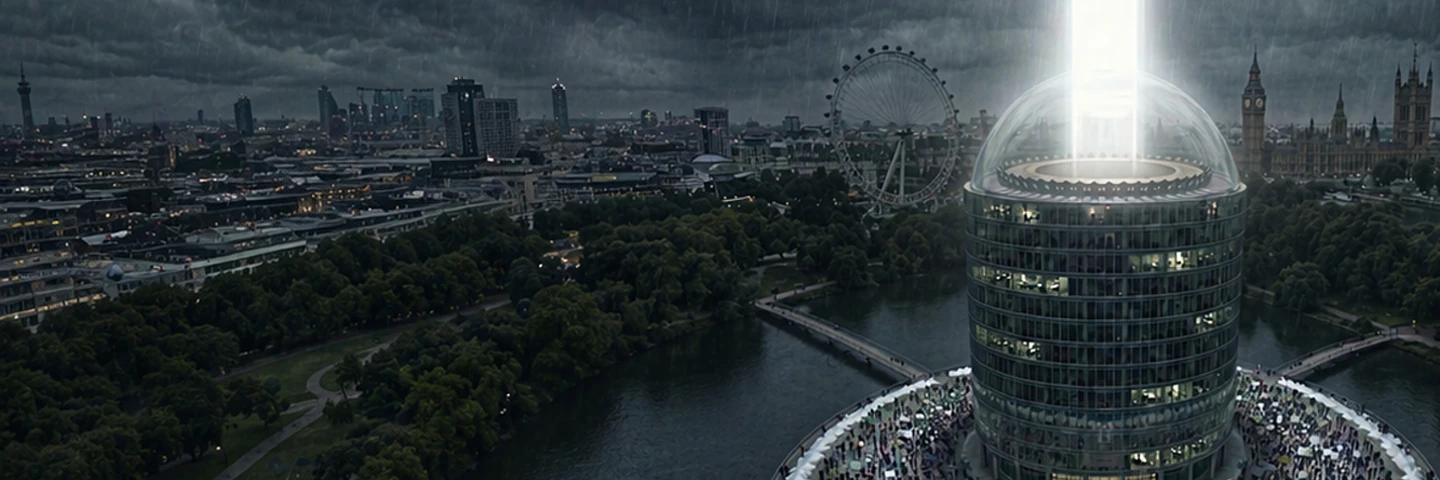
Saint James’s Park with its rain-pocked lake and swaying trees spread out below. In the CGS plaza, protestors surged against the barriers, a heaving, fluid mass. Around them lay the Resignation Protesters facing the inevitable. At the edges hundreds of white-foam mounds lined up, the packaged dead, waiting for the yellow Sweepers that moved among them like combines, harvesting a crop.
Alene placed an aluminium alloy spool harness behind a low parapet and fired its locking anchor pins, securing it to the floor. She yanked on it, putting her full weight into it. It held. She unravelled a few metres of the aramid fibre cable from the spool. Pulling the crossbow from her pack, she activated its automated targeting system. She checked the bolt seating and secured the cable to it.
“Ready?” Alene asked, the words barely audible over the rain and the roar of the protest far below in the CGS plaza.
Ari nodded, his throat too tight to speak. He stood. Across from them, the CGS building shone through the heavy rain. Its lower levels were a hive of activity, bright rectangles where Ari could just make out the tiny figures of analysts and technicians operating like moving parts in a machine. The Council dome was dark along its periphery while its colossal central floodlight painted a giant cylinder of light straight into the storm clouds, appearing like an ethereal projection of the CGS building itself in the sky.
Alene braced the crossbow on a concrete parapet, her form steady, her breath a small, white plume in the cold air. There was a metallic thump, and the bolt, trailing the high-tensile line, shot across the chasm. It struck the dome with a barely audible thwack, the vacuum cup at its tip spreading and sealing against the slick glass, well away from the central beacon’s glare.
Alene activated the spool harness’s integrated winch. A high-torque whirr filled the air as the mechanism retracted the slack, pulling the line taut until it was a humming thread.
“Secured,” she said.
They clipped the rollers to the cable, the electric motors humming to life.
“See you on the other side,” Alene said, giving him a look that was equal parts encouragement and command. She grabbed her handlebars, and with a soft whir, the roller began to pull her upward, a dark shape ascending into the night.
Ari hoisted the heavy kit bag of Walker equipment onto his back, took a deep, shuddering breath and followed.
The ascent was dizzying. The city fell away beneath him, the plaza and its denizens looking like an agitating model. He was suspended between the monochromatic sky and the angry earth, a speck on a wire, the wind and the rain lashing at his face. The dome loomed above him, its surface crawling with rivulets of water.
He reached the dome a few seconds after Alene. They clung to the surface like insects, the powered vacuum cups on their gloves, knees, and boots their only purchase against the rain-slicked gradient of the dome. The central beacon’s light was a blinding presence, their silhouettes against it inevitable. Ari hoped the rain would keep eyes from looking up.
He found the communications junction box at the base of the dome. He’d last inspected it less than a year ago.
“The panel,” Ari hissed. “It’s below me.”
He began to move towards it, a slow, spider-like crawl across the wet surface. He needed to get a device from his pack, a frequency jammer that would disable the panel’s silent alarm. He reached back, his body contorting, but his fingers, slick with fever-sweat, were sliding inside the suction glove. He couldn’t get a proper grip on the jammer. “Bollocks.” He tore the glove off with his teeth. The sudden, clumsy movement, combined with the treacherous surface, broke his balance.
And then he was falling. “Oh shit,” he breathed.
The rain, the plaza, the distant city lights—blurred together into a terrifying smear of motion. He was sliding towards the edge of the dome, a hundred-metre drop to the plaza below.
“Ari!” Alene’s cry reached him thin in the roar of the wind.
Instinct took over. His ungloved hand, slick with rain, shot out, his fingers scrabbling for purchase. They found the lip of the dome, a narrow, metal edge, and clamped down with a strength he didn’t know he possessed. The rest of his body swung over the side, his legs dangling in the vast, empty air. He was holding on by one hand.
He felt his grip slipping, the wet metal sliding through his fingers. He reached with his gloved hand and slapped his palm against the ledge. The suction engaged and he held on, his muscles burning, the abyss pulling at him.
He hung between the sky and the city, the roar of the crowd and the wind filling his ears. Every muscle screamed, his heart hammered against his ribs, and he knew it with terrible clarity. His apartment, the imager, the years of logical boredom—that life was the //HOST TERMINATED. END OF SESSION. screen. This, though, the fear, the pain, the struggle to simply hold on, this was what people who were truly alive felt.
He looked up. Alene was already moving, crab-walking across the dome to get closer. “Ari, listen to me! Your boots also have suction! Use them!”
He adhered one boot, then the other. He was secured, but he wouldn’t be able to get back over the narrow ledge. The ledge wasn’t wide enough to support him, but it jutted out enough to block him from climbing straight up with only one hand grip. He had an idea. He twisted, reaching over his shoulder with his bare hand, and dragged his pack up onto the ledge. Alene had anchored herself on the dome just above him.
“My pack!” Ari roared, the wind tearing the words from his mouth. “The jammer! The cutter!”
“I’ve got them!” she yelled back, her movements economical despite the precarious angle. “Guide me!”
“The panel! Just above the ledge! The jammer goes on top of it!”
She slapped the small, round device onto the glass.
“Now the cutter! Level with the floor inside! Suction it on!”
Her gloved hand worked quickly, placing the hyper-spin diamond cutter and activating its suction. The arm extended and began to rotate at hyper-speed, its high-pitched whine barely audible over the storm as it cut a circular hole in the glass.
The high-pitched whine of the cutter ceased, and the arm stopped rotating. Alene gave the circular cut-out a sharp tap. It tipped inward, landing on the Council Room floor with a clang.
“Pull yourself through!” Alene shouted.
Ari grunted, his muscles almost giving out. Using his boot suction for leverage, he hauled himself up. His fingers found the freshly cut edge. He shoved his arms through the hole, pushed the cut-out aside, and with both arms pulled himself in, rolling onto the polished floor.
He looked up. Alene lay upside down on the glass above him, her form distorted by the rain streaming down the dome. He scrambled to his feet and rushed to the hole, signalling for her to come down. She edged towards the opening, and he reached up, grabbing her, pulling her inside, preventing her momentum from carrying her over the lip of the building as she disengaged the suction in her knees and boots.
Alene’s feet came down hard on the floor, and for a moment the two of them lay there in the near silence in the dome. The roar of the crowd was muffled and rose and fell like a far-off ocean. Rain continued to patter against the glass, and Ari felt it coming through the puncture in the dome, but the sound was diminished. Mostly, he heard their harsh breathing.
Alene stood, and Ari joined her, both of them dripping onto the polished floor.
“This way,” Ari said, his voice a hoarse whisper. He led her around the empty chamber, their footsteps echoing. “Her private lift.”
“It’ll be biometrically locked,” Alene said, her hand resting on her sidearm.
“It is.” Ari pulled open a maintenance panel beside the door, revealing a tangle of wiring. “But it still runs on the building’s physical network.” He pulled his tool from his pack, but his hands shook so violently from the fever and adrenaline that he couldn’t seat the connector.
“Sod it.” Heat climbed his throat. He jammed the connector at the port again and missed.
Alene stepped in, her own hands steady. “Guide me. Where?”
“There. The green port. Bridge it to the red.”
She took the tool and, following his direction, jammed it into the ports. The lift door slid open with a soft, pneumatic hiss.
“One level down,” Ari said, stepping inside.
The lift descended, and the doors opened into Francis Herbert’s office. Exactly as Ari remembered it. Neat and impersonal, the office of a woman who lived for her work, a space devoid of personal touches save for a framed photograph on her desk. Ari didn’t look at it. He knew who was in it, and couldn’t.
Alene went straight to the computer terminal and turned it on. Ari set his pack on the desk and pulled out a hunk of bread and cured meat. The smoky smell of it was energising in Francis’s scent-filtered office. It was real food from the Walkers’ kitchen that they had generously included in the kit. He devoured it in five ragged bites.
“It’s locked down. Hard. She’s not just using the standard CGS protocols.”
“Let me,” Ari said, shouldering her aside.
“She’s using a local RAID array server for these files, not the main CGS network,” Ari muttered, his fingers racing. “But she’s still using the building’s physical hardware. I can bypass the authentication if I…” He knelt, yanking a panel off the wall, exposing a nest of fibre optics. He had to pin his left wrist to the desk with his right forearm to steady the tremor long enough to jam the optical bridge into its port. “There. I’m in.”
“I’m accessing her correspondence files,” he said.
The screen flickered, lines of code scrolling past. “It’s all encrypted,” he hissed, the tremors worsening. “She’s using a non-standard key. It’ll take too long.”
“Forget correspondence,” Alene said. “That’s all deniable. We need something transactional. Look for logistics files, something with a requisition or shipping log related to vaccines.”
He nodded, changing his query. “Right. Logistics. Requisition.” His eyes scanned the new list. “There. Req-Logistics-774. It’s a requisition, inside a Health Committee policy sub-ledger.”
He brought up the policy document. “Herbert ordered a global vaccination operation four years ago.”
“How do we know it wasn’t another routine vaccination?” Alene asked.
Ari tried to open the requisition document. It was locked, but the metadata was visible. Subject: Cross System Requisition – Waste Lift.
Ari said, “Why is a vaccination programme file requisitioning bandwidth on the space waste lift? That’s for non-recyclable industrial or nuclear—”
“What does that mean?” Alene asked.
Ari’s breath caught in his throat. “That whatever remained of the vaccine was meant to be fired into the sun. For a normal vaccination run, you keep the excess in storage in case something goes wrong.” Nausea pushed at his gut, burning up into his throat.
“Get a copy of the entire sub-ledger and all associated logs,” Alene instructed. “I want a full record.”
He took a small, silver data card from his pocket and slid it into a slot on the terminal. A progress bar crawled.
“I should have upgraded this with a faster port.” He forced a smile.
Dizziness hit him, hot and sudden. He staggered, a harsh, dry cough tearing from his chest. “I… I need some water.”
“Go ahead. I want to check one more thing.”
He stumbled towards the adjacent bathroom, pushing the door open, breaking the room’s primary sensor field.
A klaxon blared, a piercing shriek that shattered the silence of the office. Red lights flashed, sweeping across the room in a rhythmic pulse.
“Oh, bollocks,” Ari breathed and was sick all over the floor.
“I thought you neutralised the motion detectors on this floor,” Alene yelled over the din.
“Suppose not,” he yelled back. He grabbed a towel, wet it, and wiped his face. “Let’s get out of here!”
“Just a second,” Alene shouted, her eyes still scanning the screen.
“We need to go.” He came to stand beside her.
The progress bar closed and the terminal chimed. He pulled the card out, the plastic warm to the touch. It felt impossibly small for the magnitude of what it contained. He zipped it into a chest pocket.
“Alene!” Ari pulled on her arm.
“Hold on,” Alene said, not looking away from the screen. “There it is! Okay. The dome. Now!” Alene commanded.
They ran, bolting towards the private lift. The office doors slid open, and Gus and his partner spilled in.
“Ari? What the hell?” Gus roared. “I was worried when you went missing.” Gus levelled his weapon. “You’re a bloody traitor!”
“In!” Alene shoved Ari into the private lift.
Ari saw Gus aim his weapon at the lift mechanism. A desperate bluff came to him. He held up his hands, a placating gesture. “Wait, wait,” he shouted. “You shoot this lift, Gus, it’ll pull the whole dome down!”
The bluff made the guards hesitate for a fraction of a second. It was all the time Alene needed. She dived into the lift as Ari slammed the up button. The doors hissed shut as bullets sparked against the reinforced metal.
The lift shot upwards, the klaxon a muffled shriek. The lift stopped. The doors opened to the beacon’s blinding light. They exited and sprinted around the Council table, their footsteps echoing like gunshots on the polished floor. Gus and his teammate crashed through the public entrance.
“Ari, stand down!” Gus called out.
For a moment, the giant beacon made them invisible to each other.
Ari’s legs burned, his lungs on fire, the tremor in his hands now a full-body vibration.
“Come on, Ari! Move!” Alene grabbed his arm, her strength keeping him upright as they ran for the hole.
Alene reached the hole first. “Go!” she yelled, shoving him towards it. “You first!”
Ari shoved her back. “You’re faster!”
She didn’t argue. She scrambled through the hole, her vacuum-gloved hands and boots finding immediate purchase on the wet glass. She crab-walked up the curve of the dome to where her roller was secured, turning back as Ari pulled himself out.
He emerged onto the dome. His boot and knee suction held, but with only one glove his progress was slow. One hundred metres above the plaza and unable to climb to the rollers easily without tipping.
“Ari!” Alene yelled from her position, a few metres up. “Give me your hand! I’ll stabilise you!”
Through the dome, Ari could see Gus and his team, less than ten seconds from the hole.
He fumbled in his chest pocket with his bare hand, pulling out the small, silver data card. He held it up to her. “Take it!”
“What? Don’t be an idiot! Give me your hand!”
“I’m dead anyway!” he roared, the wind ripping the words from his mouth. “Take it and go!”
She stared at him, not moving.
“Gus is at the hole! Go, Alene! GO!”
Her eyes flicked to the hole. Gus’s face appeared. Her hesitation broke. With a cry, she snatched the card from his fingers.
“Sod you, Ari,” she shouted. She turned and scrambled back up to her roller, releasing the brake and vanishing into the storm.
“Come back in here, you mad bastard!” Gus shouted from inside.
He looked up at his own roller, its handlebars still suspended from the cable, a metre out of reach.
Just like in the Imager, I have nothing to lose.
He disengaged the knee pads and crouched knees wide against the glass.
“Ari, don’t!” He heard Gus yell, fear and grief in his voice. A tone he recognised from when he had watched Santo wash away.
He launched himself into the air, his body parallel to the dome. He grasped for the wet handlebar. He barely caught it with one hand, his grip awkward, but the suction engaged. The momentum swung his legs out over the abyss. White-hot pain tore through his already damaged shoulder, a non-recoverable error that almost made him black out.
He dangled, his entire weight held by one hand. With a sobbing grunt, he swung his other arm up, his free hand fumbling, clamping onto the bar. He grunted, his body screaming, and jammed his thumb onto the brake release.
He began to roll, backward, down the cable, away from the dome, away from the guards. He was a pendulum, swinging out into the dark above the plaza.
The other guard reached the hole. He leaned out, his weapon barking, spitting fire into the night. Ari saw Gus bat the guard’s aim wide.
Ari held on for dear life, hoping that his strength wouldn’t give out on him.
The gunshots drew the demonstrators’ attention. A collective gasp went up from the crowd, then a roar. Thousands of faces turned skyward and found two black figures sliding down a wire from the dome. The cheer that followed was wild, almost hysterical, as if they were cheering the apocalypse. The approval of the living echoing off the white mounds of the dead.
Ari slammed onto the concrete floor in the half-finished tower, his backward momentum and ruined shoulder sending him into an awkward, sprawling crash. He skidded, his kit scraping on the concrete under him.
Alene was on her feet, yanking him up. “That was the stupidest thing I have ever seen,” she hissed as she unclipped his harness. “Don’t you ever do that again.”
“Noted,” Ari gasped, his shoulder in over-torqued agony.
“One of the security officers identified them as DCI Ardone and Ari Feld.” Rhys’s holo stood at the far side of the desk in Francis’s study at Number 10, his dark suit washed faintly blue by the projection. “CCTV places them inside the building under construction south of CGS plaza.”
Francis sat with one hand flat on the old leather inlay, her collar loosened at the throat. Beside Rhys, her terminal was tiled with production, logistics, and public disturbances alerts, each new report reducing the others to smaller summaries. Since her conversation with Sharon, a more immediate threat demanded her attention. And now Ari had broken into her private office with a DCI to search for proof against her.
“I’ll update you as soon as security reports further details.”
“No, I’ll deal with it.” Francis moved the Ardone and Feld alert to the centre of the display and activated the CCTV feed. “What is the status of the charges against Baron?”
“I finished sequencing the evidence this afternoon. I’m confident that enough of the committee will see the expediency in opening a formal investigation.”
“Everything’s logged?”
“Yes, ma’am. The directory is tagged for your review. I’ll distribute it to the committee as soon as you sign off.”
“No, you won’t,” Francis said. “It’s no longer your concern.”
The connection lost a narrow strip of Rhys’s shoulder, then restored it. He adjusted his tie. “No longer my concern?”
“I’ve decided to give you a promotion. You will report to the Shetland Islands tomorrow to oversee fisheries production.”
“Fisheries?” His eyebrows drew together. “That’s hardly a promotion.”
“It’s the promotion you deserve for the work you’ve done recently.” Francis rested her forearms on the desk and interlaced her fingers. “You’ve demonstrated that you prefer to be the one making decisions. Now you will have the appropriate authority to do so. In fisheries.”
“Ma’am, I—”
Rhys’s mouth remained open as if to protest. Then it shut.
“You arranged the abstentions,” Francis said. “You’re the reason the sunset amendment failed.”
“It was the only way to get Condori to withdraw the logistics amendment. I acted on your instructions.” His right hand hovered near the inside pocket where he kept his narrow notebook.
“My instructions were to pass the sunset amendment.”
Francis glanced at the CCTV feed. Ari and Alene were descending in a construction lift.
“The sunset was already lost. The deal made its failure useful.” His chin lifted a fraction. “I was cutting our losses.”
Francis slammed the heels of her hands on the desk. “My losses, Rhys. Not ours. Mine. It was never your decision to make.”
“I made the decision you needed, because you couldn’t make it yourself.”
“All these years together and you still don’t know what I’m capable of,” she said, her voice steady and cold.
Francis opened Rhys’s CGS profile on her terminal. She touched the Office of the Councillor access marker and removed him.
“Consider yourself lucky to have the promotion,” she said. “Goodbye, Rhys.”
She ended the connection. Before the last voxel of Rhys’s shoulders cleared from above the desk, Francis opened her contacts list and placed her next call.
Ari and Alene exited the construction lift and plunged back into the crush of the street. The sick and the dying littered the greenways, their groans carrying at a lower frequency than the angry shouts of the protesters.
The rain had not let up, and the streets were slick with a mixture of water and something foul that Ari didn’t want to identify.
“Alene, I need a rest,” Ari gasped, bent over and breathing heavily, a stitch piercing his side.
“Let’s get out of the open,” she said and pulled him into a public holo booth.
The door hissed shut behind them, plunging them into a silence that made his ears ring. It cut off the street’s stench, replacing it with the plasticky smell of the booth’s filtration system. They were close together, the heat from their bodies radiating in the confined space. For a long moment, they just stood there, catching their breath.
Exhausted, Ari sagged against her, his body trembling. She stiffened for a fraction of a second. He expected the tactical grip of a guard steadying an asset. Instead, her arms came around him. The touch was hesitant at first, then firm as she took some of his weight. In the near darkness of the booth, with the city dying just beyond the door, he could not tell whether the frantic beating against his chest was hers or his. He stayed in her arms as his breathing eased.
After a few minutes, Alene whispered in his ear. “Are you okay?”
He straightened and pulled away. “I’m fine,” he said with exaggerated bravado. “What about you? You ready to keep going, or do you need more time?”
Alene gave a half-hearted chuckle. “I’m ready. Let’s go.”
They stepped out of the holo booth. The street seemed more crowded now, the energy of the crowd darker, more volatile. They pushed their way through the throng for a full block, the shouts and smells of the protest pressing in on them, a disorienting human sea.
They rounded a corner onto a narrower, quieter side street. A group of men materialised out of the shadows, blocking their path. There were six of them, in the same anonymous black as the men from Ari’s apartment. At their head was Jack. He was wearing a black eye patch, and the skin around it was a puckered, weeping scar. His one good eye fixed on Ari, the look in it an unblinking hatred.
“You’ll come with us,” Jack rumbled.
There was no time to think, no time to plan. They turned and ran, plunging back into the dense, heaving mass of the crowd. They rounded a corner, the shouts of Jack and his men close behind them.
“Now!” Ari yelled.
They stopped in a greenway under the Mono and each pinched the small, square devices at their throats, the camouflage units Ari had made. The air around them shimmered, and in an instant, they were gone.
“Pretty good, innit?” Ari whispered with a mixture of pride and terror.
Jack and his men rounded the corner, their eyes scanning the crowd. They ran straight past them, their expressions a mixture of frustration and rage.
But the illusion was already beginning to fail. The power-draw issue made the holos flicker and distort. Ari’s holo projection dissolved into a cloud of voxels. He felt a sudden, terrifying sense of exposure, as if his skin were dissolving. Alene’s holo wavered, revealing flickering fragments of her body.
“Yeah, great,” Alene muttered as the holograms collapsed completely.
Jack, fifty metres down the walkway, looked back. He stopped, a snarl of triumph on his face, and raised his gun. He began to run towards them, his men fanning out behind him.
They ran, dodging through the screaming crowd, becoming separated. Ari heard three gunshots, the reports sending fresh waves of terror through the throng. Ari saw a woman a few metres to his left collapse, a dark stain spreading across the back of her grey tunic.
The sight of it lent him a fresh burst of speed. He glanced back for Alene and saw her stumble, her face pale. She clutched her thigh, blood already seeping between her fingers, grimacing with pain and shock.
“Go!” she shouted. “Go!”
He hesitated. She had taken down two of Jack’s men, but two others were closing in. She was armed and trained. He was unarmed, and dying. If he stayed, they both died. If he ran, the break-in could still mean something even without the card on him.
“No!” he yelled, an impotent cry at the brutal logic of it. He couldn’t fix this.
Jack and one other were still after him, their footsteps pounding on the walkway behind him. He had no choice. He turned and ran, leaving Alene behind.
He reached a Mono port and leaped into an empty car. The door hissed shut, cocooning him, but the car didn’t move. The rail above was jammed, a motionless caravan packed with frightened people. A digital WAITING TO MERGE sign glowed on the console.
“Come on, come on!” he urged.
His brain was fragging. Through the window, Jack closed in, skipping forward in teleporting lurches. He was less than ten metres away, shoving people aside, his gun up.
A lurch. The car accelerated, a gap having finally opened. It shot out onto the main rail, merging into the stream of traffic. Ari looked back. Jack had reached the port, shoved a woman aside and got into his own car, also waiting to merge.
Ari’s gaze skittered over the car’s interior. Nothing useful. Several cars behind him, Jack’s car had merged. Gunmetal flashed, then glass shattered in Jack’s car. The one-eyed man was already hauling his bulk through the frame, climbing onto the roof of his own moving car.
Ari spotted the red emergency release latch above the door and pulled it. The window popped open with a pneumatic hiss. He began to climb out, his body shaking from the effort. The wind tore at him, trying to peel him from the slick car. His bad shoulder screamed as he took his weight, and the tremor in his hands made every grip on the rain-slicked polymer shell a terrifying gamble.
He hauled himself onto the roof and lay flat, the car speeding through the night. Behind him, Jack jumped from roof to roof, eight cars back, then seven. His movements were clumsy and brutal, all thudding impacts. One car closer with every landing.
Ari looked ahead. He was trapped. Then he saw it. On the roof of the car directly in front of his, a yellow navigation light began to flash—the automated signal for “exiting at next port”. His escape vector.
He didn’t have time to think. He scrambled forward, his fingers finding small purchase in the car’s seams. Jack was on the car directly behind him now. Ari launched himself across the gap, landing hard on the roof of the exiting car. His head, landing beyond the front edge, slammed into the windshield. The young woman inside looked up and screamed.
He raised his head and looked over his shoulder. Jack was almost upon him, tensing to make the same jump. Ari’s car veered, peeling off the main track, taking him down the exit ramp. Jack, on the car behind, sped past on the main rail, his eye fixed on Ari as the gap opened between them, his mouth scowling.
Ari let his head fall against the wet roof of the car and laughed in relief. The car decelerated into the ground-level waterfront port and stopped. The young woman exited the car and ran.
Ari climbed painfully down and ran until he reached the oily water of the Thames, a dark gash bisecting the city lights. He vaulted over a low wall and stopped, his lungs burning, his body a continuous torrent of pain. He crouched there for one ragged breath beside the river, then forced himself upright and stumbled back towards the city.
Alene was gone, and Jack could still be somewhere close behind him. The kinetic energy that had been carrying him began to peter out, leaving bone-deep exhaustion behind. His legs felt heavy and unsupportive like poured concrete. His body was a furnace burning through its last reserves. Sweat and rain drenched his clothes, and he felt chilled in the night air.
He kept to the side streets, the less-travelled walkways, moving through the shadows like a dropped signal. The city came at him in broken flashes. A child, no older than five, sat on a bench, weeping silently beside the still form of his mother. A group of teenagers, their faces blank, were systematically smashing the light panels along a walkway, their laughter like vicious barking in the night.
Every face was a potential threat, every shadow a hiding place for Jack and his men. Paranoia prickled at the back of his neck and left a metallic taste in his mouth.
He thought of Alene, her face at the moment he turned away. He had left her—no, he had been forced to leave her. Was she captured? Was she dead? The data card was gone, pressed into her palm, but to what end? Had he saved the truth or guaranteed it died with her? He was alone—network inaccessible.
He clutched his side, his shoulder radiating pain through his neck.
‘If it all goes to shite…’ Santo’s voice in the Walker supply alcove. ‘…if you can’t trust anyone… Junction 44. It’s mine.’
He needed an access point. He tried to recall city schematics from his old obsession with the Sup. The Embankment station. He could get in through a duct and work his way from there to Santo’s bolt-hole—a dead man’s contingency.